DEF 14A: Definitive proxy statements
Published on July 10, 2026
UNITED STATES
SECURITIES AND EXCHANGE COMMISSION
Washington, D.C. 20549
SCHEDULE 14A
Proxy Statement Pursuant to Section 14(a) of the
Securities Exchange Act of 1934
(Amendment No. )
Filed by the Registrant ☒ Filed by a Party other than the Registrant ☐
Check the appropriate box:
☐ Preliminary Proxy Statement
☐ Confidential, for Use of the Commission Only (as permitted by Rule 14a-6(e)(2))
☒ Definitive Proxy Statement
☐ Definitive Additional Materials
☐ Soliciting Material Pursuant to §240.14a-12
(Name of Registrant as Specified in its Charter)
(Name of Person(s) Filing Proxy Statement, if other than the Registrant)
Payment of Filing Fee (Check all boxes that apply):
☒ No fee required.
☐ Fee paid previously with preliminary materials.
☐ Fee computed on table in exhibit required by Item 25(b) per Exchange Act Rules 14a-6(i)(1) and 0-11.

July 10, 2026
Dear Dynatrace Stockholder:
I am pleased to invite you to attend the 2026 Annual Meeting of Stockholders of Dynatrace, Inc. to be held online on Wednesday, August 26, 2026 at 1:00 p.m. Eastern Time. The meeting will be conducted virtually through a live webcast. You may attend the meeting at www.virtualshareholdermeeting.com/DT2026, where you will be able to vote electronically and submit questions.
Details regarding the meeting and the business to be conducted are more fully described in the accompanying Notice of 2026 Annual Meeting of Stockholders and Proxy Statement.
Pursuant to the Securities and Exchange Commission ("SEC") rules that allow issuers to furnish proxy materials to stockholders over the Internet, we are posting the proxy materials on the Internet and delivering a Notice of Internet Availability of Proxy Materials (the "Notice"). On or about July 10, 2026, we will begin mailing the Notice to our stockholders containing instructions on how to access online or request a printed copy of our Proxy Statement for the 2026 Annual Meeting of Stockholders and our Annual Report on Form 10-K for the fiscal year ended March 31, 2026.
Your vote is important. Whether or not you plan to attend the virtual Annual Meeting, I hope you will vote as soon as possible. You may vote over the Internet, by telephone, or virtually at the Annual Meeting or, if you requested printed copies of proxy materials, you also may vote by mailing a proxy card. Please review the instructions on the Notice or on the proxy card regarding your voting options.
Thank you for being a Dynatrace stockholder. We look forward to seeing you at our Annual Meeting.
Sincerely,
Rick McConnell
Chief Executive Officer
| YOUR VOTE IS IMPORTANT | ||||||||||||||||||||
| In order to ensure your representation at the Annual Meeting, whether or not you plan to attend the Annual Meeting, please vote your shares as promptly as possible by following the instructions on your Notice or, if you requested printed copies of your proxy materials, by following the instructions on your proxy card. Your vote will help to ensure the presence of a quorum at the meeting and that your shares are represented at the Annual Meeting. If you hold your shares through a broker, your broker is not permitted to vote on your behalf for Proposal No. 1 (the election of directors), or Proposal No. 3 (the advisory vote to approve the compensation of our named executive officers), unless you provide specific instructions to the broker by completing and returning any voting instruction form that the broker provides (or following any instructions that allow you to vote your broker-held shares via telephone or the Internet). For your vote to be counted, you will need to communicate your vote before the date of the Annual Meeting. Voting your shares in advance will not prevent you from attending the Annual Meeting, revoking your earlier submitted proxy, or voting your stock virtually at the Annual Meeting. | ||||||||||||||||||||
Dynatrace, Inc.
280 Congress Street, 11th Floor
Boston, Massachusetts 02210
NOTICE OF 2026 ANNUAL MEETING OF STOCKHOLDERS
Notice is hereby given that Dynatrace, Inc. will hold its 2026 Annual Meeting of Stockholders online on Wednesday, August 26, 2026 at 1:00 p.m. Eastern Time, for the following purposes:
•To elect four Class I directors: Rick McConnell, Michael Capone, Stephen Lifshatz, and George Riedel to hold office until the 2029 annual meeting of stockholders or until their successors are duly elected and qualified or until their earlier resignation, death, or removal;
•To ratify the appointment of Ernst & Young LLP as our independent registered public accounting firm for the fiscal year ending March 31, 2027;
•To conduct a non-binding, advisory vote to approve the compensation of our named executive officers; and
•To transact any other business that properly comes before the Annual Meeting (including adjournments and postponements thereof).
Our Board of Directors recommends that you vote “FOR” the director nominees named in Proposal No. 1, “FOR” the ratification of the appointment of Ernst & Young LLP as our independent registered public accounting firm as described in Proposal No. 2, and “FOR” the approval of, on a non-binding, advisory basis, the compensation of our named executive officers as described in Proposal No. 3.
Stockholders of record at the close of business on July 6, 2026 (the "Record Date") or who hold a valid proxy for the Annual Meeting are entitled to notice of, and to attend, vote, and participate at the Annual Meeting, as set forth in this Proxy Statement. You may attend, vote, and participate at the Annual Meeting by visiting www.virtualshareholdermeeting.com/DT2026 and entering the 16-digit control number included in the Notice of Internet Availability of Proxy Materials, on the proxy card, or in the instructions included with the proxy materials dated on or about July 10, 2026. Access to the webcast will begin at 12:45 p.m. Eastern Time on August 26, 2026. For instructions on how to vote your shares, please refer to the instructions on the Notice of Internet Availability of Proxy Materials you received in the mail, the “About the Annual Meeting” section of this Proxy Statement or, if you requested to receive printed proxy materials, your enclosed proxy card. If you are a street name stockholder or beneficial owner of our common stock, please refer to the voting instructions or other materials received from your broker, bank, or other nominee to vote your shares.
By Order of the Board of Directors,
Nicole Fitzpatrick
Executive Vice President, Chief Legal Officer and Secretary
Boston, Massachusetts
July 10, 2026
Important notice about the availability of proxy materials for the Annual Meeting. We encourage you to access and review all of the information contained in the proxy materials before voting. Our Proxy Statement, 2026 Annual Report to Stockholders, and other materials are available at https://ir.dynatrace.com/.
PROXY STATEMENT FOR THE 2026 ANNUAL MEETING OF STOCKHOLDERS
Table of Contents
Page
Cautionary Note Regarding Forward-Looking Statements
This Proxy Statement includes certain “forward-looking statements” within the meaning of the Private Securities Litigation Reform Act of 1995, including statements regarding management’s expectations related to industry trends and future financial and operational performance, and statements describing our strategy, outlook, plans, intentions, expectations, or goals, including corporate governance, sustainability, and compensation strategies. These forward-looking statements include, but are not limited to, plans, objectives, expectations, and intentions and other statements contained in this Proxy Statement that are not historical facts and statements identified by words such as "will," “expects,” “anticipates,” “intends,” “plans,” “believes,” “seeks,” “estimates” or words of similar meaning. These forward-looking statements reflect our current views about our plans, intentions, expectations, strategies, and prospects, which are based on the information currently available to us and on assumptions we have made. Although we believe that our plans, intentions, expectations, strategies, and prospects as reflected in or suggested by those forward-looking statements are reasonable, we can give no assurance that the plans, intentions, expectations, or strategies will be attained or achieved. Furthermore, actual results may differ materially from those described in the forward-looking statements and will be affected by a variety of risks and factors that are beyond our control including, without limitation, our ability to maintain our revenue growth rates in future periods; overall demand for and market adoption of our solutions; our ability to compete; the evolution of technology affecting our offerings, platform, and markets, including our plans to continue evolving our technology capabilities, including, but not limited to, artificial intelligence (“AI”); our ability to innovate and develop solutions that meet customer needs, including with AI capabilities and functionalities; our plans to continue investing in research and development and driving innovation to meet customers’ needs and grow our customer base, including our ability to effectively develop our platform and offerings to incorporate AI; our use of new and evolving technologies, including AI, in our offerings and business; our ability to acquire new customers and retain and expand our relationships with existing customers; our ability to expand our sales and marketing capabilities; our ability to maintain successful relationships with partners; the ability of our platform and solutions to effectively interoperate with customers’ IT infrastructures; our ability to hire and retain necessary qualified employees to grow our business and expand our operations; our ability to successfully complete acquisitions and to integrate newly acquired businesses and offerings; security breaches, computer malware, computer hacking attacks, and other security incidents or compromises that could harm our business, reputation, and brands; our ability to protect our intellectual property ("IP"); the effect on our business of the macroeconomic environment, associated global economic conditions and geopolitical disruption; and other risks set forth under the caption “Risk Factors” in our Annual Report on Form 10-K for the fiscal year ended March 31, 2026, subsequent Quarterly Reports on Form 10-Q and our other SEC filings. We assume no obligation to update any forward-looking statements contained in this document as a result of new information, future events or otherwise.
1
Non-GAAP Measures and Key Metrics
Our executives are in certain ways measured and rewarded based on the company's or their personal achievement of certain non-GAAP financial measures, including non-GAAP operating income, and certain operational metrics, such as annual recurring revenue. For additional information and a reconciliation of the differences between each non-GAAP financial measure and the comparable GAAP financial measure, please see Appendix A of this Proxy Statement.
Annual recurring revenue ("ARR") is defined as the daily revenue of all subscription agreements that are actively generating revenue as of the last day of the reporting period multiplied by 365. We exclude from our calculation of ARR any revenues derived from month-to-month agreements and/or product usage overage billings.
Constant currency amounts for ARR are presented to provide a framework for assessing how our underlying businesses performed excluding the effect of foreign exchange rate fluctuations. To present this information, current and comparative prior period results for entities reporting in currencies other than U.S. dollars are converted into U.S. dollars using the average exchange rates from the comparative period rather than the actual exchange rates in effect during the respective periods. All growth comparisons relate to the corresponding period in the last fiscal year.
Free cash flow is defined as the net cash provided by or used in operating activities less capital expenditures, reflected as purchase of property and equipment and capitalized software additions in our financial statements.
Non-GAAP operating income ("NGOI") is defined as GAAP income from operations adjusted for the following items: share-based compensation; employer payroll taxes on employee stock transactions; amortization of intangibles; and transaction, restructuring and other non-recurring or unusual items that may arise from time to time. We also refer to this measure as Non-GAAP Income from Operations in some of our press releases and SEC filings.
Availability of Certain Documents
This Proxy Statement and our 2026 Annual Report to Stockholders are available for viewing, printing, and downloading at www.proxyvote.com.
Unless specifically stated in this Proxy Statement, information (such as our Sustainability Report) contained on, or that can be accessed through, our websites and any other websites listed in this Proxy Statement are not incorporated by reference into this Proxy Statement and should not be considered to be part of this Proxy Statement, and inclusions of our website addresses and other website addresses in this Proxy Statement are inactive textual references only.
A copy of our Annual Report on Form 10-K for the fiscal year ended March 31, 2026, as filed with the SEC, except for exhibits, will be furnished without charge to any stockholder upon written request to Dynatrace, Inc., 280 Congress Street, 11th Floor, Boston, Massachusetts 02210, Attention: Secretary or by e-mail to ir@dynatrace.com. This Proxy Statement and our Annual Report on Form 10-K for the fiscal year ended March 31, 2026 are also available on the SEC’s website at www.sec.gov and on our website at https://ir.dynatrace.com/.
The Dynatrace logo and all Dynatrace product or service names and logos are trademarks or registered trademarks of Dynatrace LLC in the United States and other countries. The Dynatrace® platform is subject to patents owned by Dynatrace LLC issued and pending in the United States and other countries. Third party trademarks and trade names referenced in this Proxy Statement are the property of their respective owners.
2
ABOUT THE ANNUAL MEETING
General Information
This Proxy Statement contains information about the 2026 Annual Meeting of Stockholders of Dynatrace, Inc., which will be held online on August 26, 2026 at 1:00 p.m. Eastern Time.
If you are a stockholder of record as of the close of business on July 6, 2026, you may attend the meeting virtually via the Internet at www.virtualshareholdermeeting.com/DT2026, where you will be able to vote electronically and submit questions. We encourage participants to access the meeting prior to the start time. Online check-in will begin 15 minutes prior to the start of the Annual Meeting, at 12:45 p.m. Eastern Time, and participants should allow ample time for check-in procedures.
The Board of Directors of Dynatrace, Inc. (the "Board") is using this Proxy Statement to solicit proxies for use at the Annual Meeting.
In this Proxy Statement, the terms “Dynatrace,” the “company," “we,” “us,” and “our” refer to Dynatrace, Inc. The mailing address of our principal executive offices is Dynatrace, Inc., 280 Congress Street, 11th Floor, Boston, Massachusetts 02210. Our fiscal year begins on April 1 and ends on March 31.
All properly submitted proxies will be voted in accordance with the instructions contained in those proxies. If no instructions are specified, the proxies will be voted in accordance with the recommendation of our Board with respect to each of the matters set forth in the accompanying Notice of 2026 Annual Meeting of Stockholders. You may revoke your proxy at any time before it is exercised at the meeting by giving our Secretary written notice to that effect.
When are this Proxy Statement and the accompanying materials scheduled to be sent to stockholders?
We have elected to provide access to our proxy materials to our stockholders via the Internet. Accordingly, on or about July 10, 2026, we will begin mailing a Notice of Internet Availability of Proxy Materials (the “Notice”). Our proxy materials, including the Notice of 2026 Annual Meeting of Stockholders, this Proxy Statement, and the accompanying proxy card or, for shares held in street name (i.e., held for your account by a broker, bank, or other nominee), a voting instruction form, and the 2026 Annual Report for the fiscal year ended March 31, 2026 (the “2026 Annual Report”), will be mailed or made available to stockholders on the Internet on or about the same date.
Why did I receive the Notice instead of a full set of proxy materials?
Pursuant to rules adopted by the SEC, for most stockholders, we are providing access to our proxy materials over the Internet rather than printing and mailing our proxy materials. We believe following this process will expedite the receipt of such materials and will help lower our costs and reduce the environmental impact of our annual meeting materials. Therefore, the Notice will be mailed to holders of record and beneficial owners of our common stock starting on or about July 10, 2026. The Notice provides instructions as to how stockholders may access and review our proxy materials, including the Notice of 2026 Annual Meeting of Stockholders, this Proxy Statement, the proxy card, and our 2026 Annual Report, on the website referred to in the Notice or, alternatively, how to request that a copy of the proxy materials, including a proxy card, be sent to them by mail. The Notice also provides voting instructions. In addition, stockholders of record may request to receive the proxy materials in printed form by mail or electronically by e-mail on an ongoing basis for future stockholder meetings. Please note that while our proxy materials are available at the website referenced in the Notice, and our Notice of 2026 Annual Meeting of Stockholders, this Proxy Statement, and our 2026 Annual Report are available on our website, www.dynatrace.com, no other information contained on either website is incorporated by reference in or considered to be a part of this Proxy Statement.
Who is soliciting my vote?
Our Board is soliciting your vote for the Annual Meeting.
When is the Record Date for the Annual Meeting?
The Record Date for determination of stockholders entitled to vote at the Annual Meeting was the close of business on July 6, 2026.
3
How many votes can be cast by all stockholders?
There were 290,228,871 shares of our common stock, par value $0.001 per share, outstanding on July 6, 2026, all of which are entitled to vote with respect to all matters to be acted upon at the Annual Meeting. Each stockholder of record is entitled to one vote for each share of our common stock held by such stockholder. No shares of preferred stock were outstanding as of July 6, 2026.
How do I attend the Annual Meeting virtually?
This year’s Annual Meeting will be held virtually. To attend and participate in the Annual Meeting, stockholders will need to access the live webcast of the meeting. You are entitled to attend and participate if you were a stockholder as of the close of business on July 6, 2026 or hold a valid proxy for the meeting. Individuals who log in as a guest may attend the Annual Meeting, but are not entitled to vote or submit questions. Attendance at the Annual Meeting is subject to capacity limits set by the virtual meeting platform provider.
Stockholders of Record. Stockholders of record will need to visit www.virtualshareholdermeeting.com/DT2026 and enter the 16-digit control number provided in the Notice, on the proxy card, or in the instructions included with the printed proxy materials.
Street Name Stockholders. If shares of our common stock are held on your behalf in a brokerage account or by a bank or other nominee, you are considered to be the beneficial owner of shares that are held in “street name” (i.e., a “street name stockholder”) and the Notice was forwarded to you by your broker or nominee, who is considered the stockholder of record with respect to those shares. If you are a street name stockholder and your voting instruction form or Notice indicates that you may vote those shares through www.proxyvote.com, you may attend and participate in the Annual Meeting by visiting www.virtualshareholdermeeting.com/DT2026 and entering the 16-digit control number indicated on your voting instruction form or Notice. Otherwise, street name stockholders who hold their shares in street name should contact their broker, bank or other nominee (well in advance of the Annual Meeting) to obtain a legal proxy in order to be able to attend and participate in the Annual Meeting.
If you are a stockholder and wish to submit a question during the Annual Meeting, you may log into, and submit a question on, the virtual meeting platform by following the instructions included there. During the formal portion of the meeting, all questions presented should relate directly to the proposal under discussion. Questions from multiple stockholders on the same topic or that are otherwise related to a particular topic may be grouped, summarized, and answered together. If questions submitted are irrelevant to the business of the Annual Meeting or are out of order or not otherwise suitable for the conduct of the Annual Meeting, as determined by the Chair of the Board or Secretary in their reasonable judgment, we may choose to not address them. If there are any matters of individual concern to a stockholder and not of general concern to all stockholders, or if a question posed was not otherwise answered, such matters may be raised separately after the Annual Meeting.
Our Annual Meeting will be governed by the Annual Meeting’s Rules of Conduct, which will address the ability of stockholders to ask questions during the meeting and rules for how questions will be recognized and addressed. The Annual Meeting’s Rules of Conduct will be available on www.virtualshareholdermeeting.com/DT2026 prior to the Annual Meeting. We do not have procedures in place for posting appropriate questions received during the meeting on our website.
What if I have technical issues during the Annual Meeting?
Participants should give themselves plenty of time to log in and ensure they have a strong Internet connection, and they can hear streaming audio prior to the start of the meeting.
Approximately 15 minutes prior to the start of and through the conclusion of the Annual Meeting, a support team will be ready to assist stockholders with any technical difficulties they may have accessing or hearing the virtual meeting. If you encounter technical difficulties with the virtual meeting platform on the meeting day, please call the technical support number that will be posted on the meeting website.
Additional information regarding matters addressing technical and logistical issues, including technical support during the Annual Meeting, will be available at www.virtualshareholdermeeting.com/DT2026.
4
How do I vote?
Stockholders of Record. If shares of our common stock are registered directly in your name with Computershare, our transfer agent, you are considered the “stockholder of record” with respect to those shares. As the stockholder of record, you may vote by any of the methods listed below:
•Virtually In Person - You may attend the Annual Meeting virtually via the Internet at www.virtualshareholdermeeting.com/DT2026 and you may vote during the meeting. Access to the webcast will begin at 12:45 p.m. Eastern Time on August 26, 2026, and you should allow ample time for check-in procedures. In order to be able to attend the Annual Meeting, you will need the 16-digit control number provided in the Notice, on the proxy card, or in the instructions included with the proxy materials dated on or about July 10, 2026.
•By Internet or by Phone Before the Annual Meeting - You may vote by proxy by completing an electronic proxy card over the Internet, or by telephone by following the instructions provided in the Notice or proxy card until 11:59 p.m. Eastern Time on August 25, 2026.
•By Mail - If you requested printed copies of the proxy materials, you may vote by proxy by mailing your proxy card as described in the proxy materials. In order to be counted, proxies submitted by mail must be received before the start of the Annual Meeting.
Street Name Stockholders. As stated above, if shares of our common stock are held on your behalf in a brokerage account or by a bank or other nominee, you are considered to be the beneficial owner of shares that are held in “street name” (i.e., a “street name stockholder”) and the Notice was forwarded to you by your broker or nominee, who is considered the stockholder of record with respect to those shares. As the beneficial owner, you have the right to direct your broker, bank, or other nominee as to how to vote your shares. Please follow the instructions from your broker, bank, or other nominee to vote. Street name stockholders may not vote virtually in person at the Annual Meeting unless they receive a legal proxy from their respective brokers, banks, or other nominees giving them the right to vote virtually in person at the Annual Meeting. If you request a printed copy of our proxy materials by mail, your broker, bank, or other nominee will provide a voting instruction form for you to use.
What is the effect of giving a proxy?
If you are a stockholder of record and complete and submit your proxy before the Annual Meeting, the persons named as proxies will vote the shares represented by your proxy in accordance with your instructions. If you submit a proxy without giving voting instructions, your shares will be voted in the manner recommended by our Board on all matters presented in this Proxy Statement. In the event we receive proxies for disqualified or withdrawn director nominees, such votes for disqualified or withdrawn nominees in the proxies will be treated as abstentions.
If any other matters are properly presented for consideration at the Annual Meeting or any postponements or adjournments thereof, including, among other things, consideration of a motion to adjourn the Annual Meeting to another time or place (including, without limitation, for the purpose of soliciting additional proxies), the persons named in your proxy and acting thereunder will have discretion to vote on those matters in accordance with their best judgment. We do not currently anticipate that any other matters will be raised at the Annual Meeting. If the Annual Meeting is adjourned, continued, or postponed, the proxy holders can vote your shares on the new Annual Meeting date as well, unless you revoke your proxy instructions as described above.
You may also authorize another person or persons to act for you as a proxy in a writing, signed by you or your authorized representative, specifying the details of those proxies’ authority. The original writing must be given to each of the named proxies, although it may be sent to them by electronic transmission if, from that transmission, it can be determined that the transmission was authorized by you.
How do I revoke my proxy?
If you are a stockholder of record, you may revoke your proxy by (1) following the instructions on the Notice and entering a new proxy vote by mail that we receive before the start of the Annual Meeting or over the Internet or by phone by the cutoff time of 11:59 p.m. Eastern Time on August 25, 2026; (2) attending and voting virtually at the Annual Meeting (although attendance at the Annual Meeting will not in and of itself revoke a proxy); or (3) filing an instrument in writing revoking the proxy or another duly executed proxy bearing a later date with our Secretary. Any written notice of revocation or subsequent proxy card must be received by our Secretary prior to the taking of the vote at the Annual Meeting. Such written notice of revocation or subsequent proxy card should be hand delivered to our Secretary or sent to our principal executive offices at Dynatrace, Inc., 280 Congress Street, 11th Floor, Boston, Massachusetts 02210, Attention: Secretary.
5
If a broker, bank, or other nominee holds your shares, you must contact such broker, bank, or nominee in order to find out how to change your vote.
How is a quorum reached?
A majority of the shares entitled to vote, present in person or by remote communication, or represented by proxy, will constitute a quorum for the transaction of business at the Annual Meeting. As of the Record Date, there were 290,228,871 shares of our common stock outstanding. Therefore, a quorum will be present if 145,114,436 shares of our common stock are present, virtually in person or by proxy, representing a majority of all issued and outstanding shares of common stock entitled to vote as of the Record Date.
Shares that are voted “ABSTAIN” and broker “non-votes” are counted as present for purposes of determining whether a quorum is present at the Annual Meeting. If a quorum is not present, the meeting may be adjourned until a quorum is obtained.
What vote is required to adopt the proposals?
| Proposal | Vote Required | Impact of Abstentions | Impact of Broker Non-Votes | Unmarked Proxy Cards | ||||||||||
| 1 - Election of four Class I directors to hold office until the 2029 annual meeting of stockholders or until their successors are duly elected and qualified or until their earlier resignation, death, or removal | Majority of the votes properly cast "FOR" and "AGAINST" each nominee | No effect | No effect | Voted "FOR" each director nominee | ||||||||||
| 2 - Ratification of the appointment of Ernst & Young LLP as the company's independent registered accounting firm for fiscal 2027 | Majority of the votes properly cast "FOR" and "AGAINST" | No effect | No effect; not anticipated as brokers have discretionary voting authority for this proposal | Voted "FOR" | ||||||||||
3 - Non-binding, advisory vote to approve the compensation of our named executive officers (1) | Majority of the votes properly cast "FOR" and "AGAINST" | No effect | No effect | Voted "FOR" | ||||||||||
(1) As Proposal No. 3 is an advisory vote, the result will not be binding on us, our Board or our Compensation Committee of the Board (the "Compensation Committee"). However, the Board values input from stockholders, and the Compensation Committee will consider the outcome of the vote when making future decisions regarding the compensation of our named executive officers.
What are broker "non-votes"?
Your broker or nominee may have the discretion to vote those shares with respect to certain matters if they have not received instructions from you. Under the rules of the New York Stock Exchange (“NYSE”), brokers, banks, and other securities intermediaries that are subject to NYSE rules may use their discretion to vote your “uninstructed” shares on matters considered to be “routine” under NYSE rules but not with respect to “non-routine” matters. Proposal No. 2 is considered to be a “routine” matter under NYSE rules and thus if you do not return voting instructions to your broker by its deadline, your shares may be voted by your broker in its discretion on Proposal No. 2.
A broker non-vote occurs when a broker, bank, or other agent has not received voting instructions from the beneficial owner of the shares and the broker, bank, or other agent cannot vote the shares because the matter is considered “non-routine” under NYSE rules. Proposals No. 1 and 3 are considered to be “non-routine” under NYSE rules such that your broker, bank, or other agent may not vote your shares on those proposals in the absence of your voting instructions.
6
Who pays the cost for soliciting proxies?
We are making this solicitation and will pay the entire cost of preparing and distributing the Notice and our proxy materials and soliciting votes. If you choose to access the proxy materials or vote over the Internet, you are responsible for any Internet access charges that you may incur. Our officers and employees may, without compensation other than their regular compensation, solicit proxies through further mailings, personal conversations, e-mails, or otherwise. We have hired Broadridge Financial Solutions, Inc. to assist us in the distribution of proxy materials. Proxy solicitation expenses that we will pay include those for preparation, mailing, returning, and tabulating the proxies. We have also retained Innisfree M&A Incorporated to provide consulting, analytic, and proxy solicitation services in connection with the Annual Meeting for a fee of $20,000 plus reasonably incurred out of pocket fees and expenses.
How can I know the voting results?
We plan to announce preliminary voting results at the Annual Meeting and will publish final results in a Current Report on Form 8-K to be filed with the SEC within four business days following the Annual Meeting.
PROPOSAL NO. 1
ELECTION OF CLASS I DIRECTORS
Our Board currently consists of ten members, nine of whom are non-employee, independent directors. In accordance with the terms of our certificate of incorporation and bylaws, our Board is divided into three classes, Class I, Class II, and Class III, with members of each class serving staggered three-year terms. Directors are expected to be elected to hold office for such three-year term or until their successors are duly elected and qualified, or until their earlier resignation, death, or removal. Upon the expiration of the term of a class of directors, directors in that class will be eligible to be elected for a new three-year term at the annual meeting of stockholders in the year in which their term expires.
The members of our Class I, Class II, and Class III directors are the following individuals:
| Name | Class | Expiration of Term | ||||||
| Rick McConnell | I | 2026 | ||||||
Michael Caponeü | I | 2026 | ||||||
Stephen Lifshatzü | I | 2026 | ||||||
George Riedelü | I | 2026 | ||||||
Dan Streetmanü | II | 2027 | ||||||
Jill Wardü | II | 2027 | ||||||
Kirsten Wolbergü | II | 2027 | ||||||
Lisa Campbellü | III | 2028 | ||||||
Amol Kulkarniü | III | 2028 | ||||||
Steve Rowlandü | III | 2028 | ||||||
ü = independent
What are you voting on? At the Annual Meeting, you’re being asked to re-elect our four Class I directors - Rick McConnell, Michael Capone, Stephen Lifshatz and George Riedel - for a term to expire at the annual meeting of stockholders to be held in 2029. | ||
| THE BOARD RECOMMENDS THAT YOU VOTE “FOR” EACH DIRECTOR NOMINEE | ||
Rick McConnell, Michael Capone, Stephen Lifshatz, and George Riedel have each indicated a willingness to continue to serve as directors, if elected. If any of the nominees become unable or unwilling to serve, however, your proxy may be voted for a substitute nominee selected by our Board.
7
Majority voting standard
As the Annual Meeting will include an uncontested director election, a majority voting standard will apply and each director nominee must receive more "FOR" votes than "AGAINST" votes to be elected to the Board. Votes to "ABSTAIN" and broker "non-votes" will have no effect on the election of the director nominees.
In accordance with the provision of our bylaws, if an incumbent director nominee fails to receive a majority of the votes properly cast for such director’s election in an uncontested director election, the director nominee will, promptly following the certification of the stockholder vote, tender his or her resignation to the Board. The Nominating and Corporate Governance Committee of the Board (the "Nominating and Corporate Governance Committee") will then make a recommendation to the Board on whether to accept or reject the resignation, or whether other action should be taken. The Board will act on the Nominating and Corporate Governance Committee's recommendation and our company will publicly disclose the Board's decision within 90 days from the date of the certification of the stockholder vote.
A plurality voting standard will apply to any contested director elections in the future. An election will be considered contested if, as of the last date on which nominees may be submitted in accordance with our bylaws, the nominees for election to the Board exceeds the number of positions on the Board to be filled by election at that meeting.
Nominees for Election as Class I Directors
The following are our four directors who are nominated for election at the Annual Meeting and sets forth their principal occupation and business experience during the last five years and their ages as of July 6, 2026.
| RICK MCCONNELL | |||||
 Age: 60 Director Since: 2021 Not Independent Committees: None | Rick McConnell brings more than 30 years of experience in the technology industry with expertise in building broad-based product portfolios and establishing commercialization strategies. He brings deep operational and strategic insights that support the Board’s oversight of Dynatrace’s growth, margin expansion, capital allocation, and disciplined execution in service of long-term value creation. Career Highlights •As Chief Executive Officer of Dynatrace (since December 2021), Rick has more than doubled the company’s revenue and has led the evolution of Dynatrace into an end-to-end, AI-powered observability platform that brings together differentiated data, context, and intelligence layers. Under Rick's leadership, Dynatrace has delivered durable, profitable growth, surpassing $2 billion in ARR while achieving solid operating margins. •Prior to Dynatrace, Rick spent over a decade at Akamai Technologies (Nasdaq: AKAM), a cloud, security, and content delivery company, where he held several President and General Manager roles, including of the Security Technology Group (2021), the Web Division (2016-2021), and Products and Development (2011-2016). •Prior to Akamai, he served as Vice President and General Manager of Sales (2004-2011) at Cisco Systems (Nasdaq: CSCO), a global technology company, where he helped build the company’s multibillion-dollar Communications and Collaboration business. Rick joined Cisco when the company acquired Latitude Communications, where he was Chief Executive Officer (1998-2004). •Rick holds an M.B.A. and a B.A. in Quantitative Economics from Stanford University. Our Board believes that based on Rick’s knowledge of our company and our business, and his service as our Chief Executive Officer, Rick is qualified to serve on our Board. | ||||
8
| MICHAEL CAPONE | |||||
 Age: 59 Director Since: 2019 Independent Committees: •Compensation (Chair) •Cybersecurity | Michael Capone brings to the Board experience driving transformational growth and technology strategy on a global scale. He offers deep expertise in product innovation and strong perspectives on the rapidly evolving data and AI landscape, supporting the Board’s oversight of Dynatrace’s long-term value creation strategy. He also brings extensive background in M&A, providing valuable insights into evaluating strategic transactions, identifying investment opportunities, and supporting disciplined capital allocation. Career Highlights •As Chief Executive Officer (January 2018-May 2026) of Qlik, a data integration, analytics, and AI provider, Mike led the company through a period of significant expansion, completing 14 strategic acquisitions and leveraging disciplined investment in research and development to build a comprehensive, end-to-end data analytics and integration platform aligned with evolving customer needs. Under Mike's leadership, Qlik scaled its global footprint, which serves more than 40,000 customers worldwide, and expanded its platform capabilities across the full spectrum of data integration, analytics, and AI. •Prior to Qlik, he served as Chief Operating Officer (October 2014-December 2017) of Medidata Solutions (formerly Nasdaq: MDSO), where he helped scale the company’s cloud-based offerings and strengthen its operational foundation prior to its $5.8 billion acquisition by Dassault Systemes following Mike's tenure. •Earlier in his career, Mike held senior leadership roles at ADP (Nasdaq: ADP), a human capital management solutions provider, where he led large-scale operations and enterprise technology initiatives. His roles included Corporate Vice President of Product Development and Chief Information Officer (2008-2014), as well as Senior Vice President and General Manager of ADP’s Global Human Resources and Payroll Outsourcing Business (2005-2008). •He holds an M.B.A. from Pace University and a B.S. in Computer Science from Dickinson College. Our Board believes that Mike’s board and business experience and his overall knowledge of our industry qualify him to serve on our Board. | ||||
9
| STEPHEN LIFSHATZ | |||||
 Age: 67 Director Since: 2019 Independent Committees: •Audit (Chair) •Compensation | Stephen Lifshatz has nearly four decades of C-Suite experience at technology software and Software-as-a-Service ("SaaS") companies with deep proficiency in operational effectiveness, M&A, public offerings, and investor relations. Throughout his career, he has played a central role in identifying, assessing, and mitigating enterprise risks through the implementation of robust risk management frameworks that support strategic objectives and promote transparency and accountability for investors. Career Highlights •Steve currently serves as Chief Financial Officer of CDK Global (since February 2023), a technology provider for the automotive retail industry, where he oversees financial strategy, capital allocation, and operational discipline. During Steve’s tenure, the company has maintained strong financial performance and has disclosed that more than $540 billion in automotive commerce is managed by the company's dealer partners annually. •As Chief Financial Officer (May 2018-September 2021) at Lytx, a video telematics company, he helped grow and scale the business through two successful recapitalizations. •As Chief Financial Officer (December 2010-December 2016) of Fleetmatics Group (formerly NYSE: FLTX), a SaaS provider for fleet management, he led financial strategy and processes and enterprise systems that supported the company’s 2012 initial public offering and subsequent growth, which successfully positioned the business for its $2.4 billion acquisition by Verizon. •Steve also served as Chief Financial Officer at Authoria, Lionbridge Technologies (formerly Nasdaq: LIOX), The Dodge Group, and Marcam Corporation (formerly Nasdaq: MRCM), and advised private equity firms on the growth and expansion of their portfolio companies. •He holds a B.S. in Accounting and Marketing from Skidmore College. Our Board believes that Steve’s board and business experience and his overall knowledge of our industry qualify him to serve on our Board. | ||||
10
| GEORGE RIEDEL | |||||
 Age: 68 Director Since: June 30, 2026 Independent Committees: None | George Riedel is a senior executive with more than 40 years of experience leading business strategy across technology and software companies. He has held senior leadership roles across enterprise technology, cybersecurity, telecommunications, and consulting, and has led strategic transformations, including M&A and operational turnarounds. He also brings extensive board experience across public and private companies, providing valuable perspective on corporate strategy, operations, and board governance. Career Highlights •George served as a Senior Lecturer in the General Management Unit at Harvard Business School (2017-June 2026). •As CEO and Chairman (2014–2017) of Cloudmark (formerly NASDAQ: PFPT), a messaging security and threat-intelligence platform, George led the company through its sale to Proofpoint. •At Nortel Networks (formerly NYSE/TSX: NT), a global telecommunications equipment manufacturer, he served in various senior leadership roles, including President, Business Units (2009–2011) and Chief Strategy Officer (2006–2009), where he helped lead corporate strategy and operational execution. •Earlier in his career, George served as Vice President of Strategy and M&A at Juniper Networks (formerly NYSE: JNPR), a networking and cybersecurity company (2003–2006), and spent over 15 years at McKinsey & Company, a global management consulting firm, including as a Senior Partner, advising companies on strategy and operations. He began his career as an Engineering Manager at Exxon (now known as Exxon Mobil (NYSE: XOM)), a multinational energy company. •He holds an M.B.A. from the Harvard Business School and a B.S. in Mechanical Engineering from the University of Virginia. Other Public Company Directorships: •Markforged (formerly NYSE: MKFG), an additive manufacturing company (May 2024–April 2025, until its acquisition by Nano Dimension) •Infinera (formerly NASDAQ: INFN), a manufacturer of optical networking equipment and semiconductors (2020–February 2025, until its acquisition by Nokia) •Cerner (formerly NASDAQ: CERN), a health IT company (2019–June 2022, until its acquisition by Oracle) •Xperi (NYSE: XPER), a technology and IP licensing company (2013–2020) Our Board believes that George’s board and business experience and his overall knowledge of strategy and operations qualify him to serve on our Board. | ||||
11
Directors Continuing in Office
The following are our six directors continuing in office and sets forth their principal occupation and business experience during the last five years and their ages as of July 6, 2026.
Class II Directors (Term Expires at the 2027 Annual Meeting)
| DAN STREETMAN | |||||
 Age: 58 Director Since: June 30, 2026 Independent Committees: None | Dan Streetman is a proven business leader with more than 20 years of experience leading global customer operations, sales, marketing, product development and professional services for public and private enterprise software and information technology companies. His current executive experience creating agentic AI-driven workflows to transform customer experiences, accelerate growth opportunities, and deliver efficiencies will provide valuable perspectives to the Board. Career Highlights •As Chief Executive Officer and a member of the board of directors at Tanium (since February 2023), a privately held cybersecurity and systems management company that is leveraging AI to drive meaningful growth and profitability, Dan leads Tanium’s day-to-day and customer-facing technical operations, as well as the company’s product strategy, development, and company culture. •Prior to Tanium, Dan served as Chief Executive Officer at TIBCO Software, a 4,000-person, $1+ billion global leader that provided integration and analytics solutions, where he was responsible for driving double-digit revenue and EBITDA growth. •Earlier in his career, Dan oversaw and helped propel significant data-driven transformations at BMC Software, an enterprise technology company, Salesforce (NYSE: CRM), a cloud-based CRM platform, and C3.ai, an enterprise AI software company. •He also served as an Airborne Ranger-qualified U.S. Army Officer, including in both peacetime and combat, and was awarded numerous decorations, including the Bronze Star. •Dan holds a holds an M.B.A. from Harvard Business School and a B.S. in National Security Strategy from U.S. Military Academy at West Point, where he served as the first regiment commander. Our Board believes that Dan’s technology and business experience and his overall knowledge of our industry qualify him to serve on our Board. | ||||
12
| JILL WARD | |||||
 Age: 66 Director Since: 2019 Board Chair Since: 2021 Independent Committees: •Audit •Nominating and Corporate Governance (Chair) | Jill Ward is an experienced operating and board executive with a proven track record of scaling technology and business services companies. She brings significant board oversight experience across governance, strategy, operating results, risk, and M&A, shaped by her service on public and private technology company boards. As Dynatrace Board Chair, Jill plays a key role in guiding Dynatrace in its evolution as a public company, and helping to expand and strengthen its focus on growth and leadership in AI-powered observability for enterprises. Career Highlights •As an Operating Partner (October 2018-February 2020) at Lead Edge Capital, a technology-focused growth equity investment firm, Jill helped advise growth-stage private technology companies on scaling and building long-term value. •As President and Chief Operating Officer (April 2015-November 2016) at Fleetmatics Group (formerly NYSE: FLTX), Jill enabled this SaaS company’s rapid global growth with enterprises as well as small and midsize business (“SMBs”) by expanding its platform, strengthening segmented go-to-market ("GTM") and operational execution, and positioning the business for its $2.4 billion acquisition by Verizon. •As Senior Vice President and General Manager at Intuit (NASDAQ: INTU), and previously as Vice President and General Manager (2001-2014), Jill led pivotal business units and channels at this software maker serving SMBs. She led the company's professional tax and accounting software businesses, accountant and developer partner channels that drove sales of Quickbooks to SMBs, and a portfolio of vertical industry software acquisitions, driving strong growth and profitability. •Previously, Jill held senior leadership roles at Telespectrum Worldwide, a customer relationship management services provider to enterprises, Fidelity Investments, a retail and institutional investments provider, and Bain & Company, a management consulting firm. •Jill holds an M.B.A. from the Tuck School of Business at Dartmouth College and a B.A. in History from Wellesley College. Other Public Company Directorships: •HubSpot (NYSE: HUBS), an AI-powered customer relationship management platform for SMBs (since October 2017) •Informatica (formerly NYSE: INFA), a data governance and management platform for enterprises (June 2021-November 2025, until its acquisition by Salesforce) •Carbon Black, Inc. (formerly Nasdaq: CBLK), a cloud native endpoint security platform for enterprises (December 2018-October 2019, until its acquisition by VMware) Our Board believes that Jill’s board and business experience and her overall knowledge of our industry qualify her to serve on our Board. | ||||
13
| KIRSTEN WOLBERG | |||||
 Age: 58 Director Since: 2021 Independent Committees: •Cybersecurity (Chair) •Nominating and Corporate Governance | Kirsten Wolberg is a technology and operations executive with expertise in growing enterprise-wide platforms, strengthening security and reliability, and driving operational excellence. Her background in managing high-performance and secure data systems enables her to provide valuable oversight of Dynatrace’s technology strategy, cybersecurity, and talent management. She also brings experience serving on public company boards, providing additional perspectives on governance, risk oversight, and growth strategy. Career Highlights •As Chief Technology and Operations Officer (November 2017-February 2021) of DocuSign (Nasdaq: DOCU), a provider of e-signature and technology products, Kirsten led DocuSign’s global technology and engineering organizations during a period of rapid growth, helping the company increase its revenues from $381 million in 2017 to $1.5 billion in 2021. •Prior to DocuSign, Kirsten served as Vice President of Technology (January 2012- October 2017) at PayPal (Nasdaq: PYPL), a technology payments platform, where she led large-scale digital transformation across the company’s 17 product lines, while overseeing a 4,000-person organization with a $900 million budget. •She has held several additional leadership roles, including Chief Information Officer (2008-2011) at Salesforce (NYSE: CRM), an enterprise software platform and Vice President of Technology (2001-2008) at Charles Schwab (NYSE: SCHW), a financial services company, where she developed extensive experience building and operating mission-critical cloud and data-driven infrastructure. •She holds an M.B.A. from the Kellogg School of Management at Northwestern University and a B.S. in Business Administration and Management from the University of Southern California. Other Public Company Directorships: •Sallie Mae, formally SLM Corporation (Nasdaq: SLM), a lender (since November 2016) •CalAmp Corp. (formerly Nasdaq: CAMP), an enterprise technology company (August 2020-July 2024) Our Board believes that Kirsten’s board, cyber and enterprise technology experience and her overall knowledge of the SaaS software industry qualify her to serve on our Board. | ||||
14
Class III Directors (Term Expires at the 2028 Annual Meeting)
| LISA CAMPBELL | |||||
 Age: 63 Director Since: 2024 Independent Committees: • Cybersecurity | Lisa Campbell contributes more than 30 years of experience leading business strategy, growth, and marketing at global software companies, providing the Board with relevant insights into shaping GTM strategies designed to accelerate growth and market reach. She has led business transformations by advancing new business models, new industry and product strategies, brand awareness and data-driven capabilities to acquire new customers, entries into new markets, and expansions in existing business lines. She brings deep industry insights, business strategy, and GTM expertise that contribute to the Board’s oversight of the sustained value creation strategy and competitive positioning of Dynatrace. Career Highlights •As Chief Marketing Officer (July 2021-August 2024) at OneTrust, an AI software company, Lisa oversaw the launch of its integrated product suite spanning AI governance, data privacy, security, third-party risk, and compliance, helping reposition the company from a privacy provider to a comprehensive enterprise agentic trust platform. During Lisa's tenure at OneTrust, the company doubled its revenues. •She brings valuable perspectives to the Board on business and industry strategy, product marketing, brand positioning, and demand generation, informed by her leadership at Autodesk (Nasdaq: ADSK), a software company, where she served as the company’s Chief Marketing Officer and EVP Business Strategy (August 2017-July 2021), and oversaw market expansion initiatives and strategic M&A, helping drive the company's revenue from approximately $2.0 billion in 2017 to approximately $4.0 billion in 2021. •Lisa also served in executive leadership roles at other technology companies, including Evolve (now part of Oracle Corporation), Sterling Software Inc., and Digital Equipment Corporation, where she led critical GTM functions to accelerate growth and sustainable market differentiation. •She holds an M.B.A. from Babson College and a B.A. in Mathematics and Computer Science from Boston College. Other Public Company Directorships: •Dropbox (Nasdaq: DBX), a cloud storage company (since August 2019) •Similarweb (NYSE: SMWB), a software development and data aggregation company (since September 2024) Our Board believes that Lisa’s GTM and business experience and her overall knowledge of the SaaS industry qualify her to serve on our Board. | ||||
15
| AMOL KULKARNI | |||||
 Age: 56 Director Since: 2023 Independent Committees: • Compensation • Nominating and Corporate Governance | Amol Kulkarni is a technology executive with over 20 years of expertise in product innovation, cloud platforms, and scaling high-growth software businesses. Throughout his career, he has focused on developing platforms that deliver strong return on investment and differentiated customer experiences. With his background in cybersecurity, data, and AI, and a strong track record of execution, he supports the Board’s oversight of Dynatrace’s continued innovation and long-term value creation. Career Highlights •Leveraging his product development expertise, Amol serves as a board member to privately held technology companies, where he guides innovation and product strategy. He also serves as a senior adviser to Permira, a global private equity firm (since September 2023), where he supports investment origination, due diligence, and value creation, with a focus on generative AI. •He previously held senior roles at CrowdStrike (Nasdaq: CRWD), a cybersecurity company, including as the Chief Product and Engineering Officer and Senior Vice President of Engineering and Products (2014-August 2023). During his tenure, he led product innovation initiatives and drove the development of the company’s AI-native, SaaS security platform, supporting the company’s growth from under $10 million in ARR to $3 billion. •Earlier in his career at Microsoft (Nasdaq: MSFT), (2000-2014), a global technology company, he led the development of Bing’s knowledge graph, helping drive meaningful gains in market share, and held senior leadership roles across key cloud platforms, including Windows Azure and BizTalk Server. •He holds a Ph.D. in Electrical Engineering from the University of Washington, a Master of Technology in Energy Systems Engineering from the Indian Institute of Technology, Bombay, and a Bachelor of Engineering from University of Poona. Our Board believes that Amol’s technology and business experience and his overall knowledge of our industry qualify him to serve on our Board. | ||||
16
| STEVE ROWLAND | |||||
 Age: 58 Director Since: 2021 Independent Committees: •Audit | Steve Rowland is a senior executive with deep experience in building and leading global sales and customer-facing organizations at high-growth enterprise software companies. He brings demonstrated success in GTM execution and scaling recurring revenue models, along with valuable insight into competitive positioning and customer acquisition. He has led companies in international expansion across the EMEA and Asia-Pacific markets, providing valuable perspectives on operating across strategic growth markets and global enterprise risk management. Career Highlights •As Executive Advisor and Limited Partner at Forté Ventures (since May 2019), a venture capital firm focused on high-growth technology companies, as well as through his separate advisory work with privately held, AI-focused technology companies, Steve brings a valuable understanding of emerging technologies and innovation. Steve's experience contributes to the Board’s oversight of Dynatrace's disciplined capital allocation strategy and evaluation of growth opportunities in support of long-term value creation. •He served as President of Klaviyo (NYSE: KVYO) (July 2023-December 2025), a marketing automation and customer data platform, where he helped guide a successful IPO in 2023 and drive post-IPO execution and scale operations for its digital customer engagement platform. •As Chief Revenue Officer at Okta, Inc. (Nasdaq: OKTA) (March 2021-March 2023), an independent identity provider, Steve led the global revenue organization, driving international expansion and contributing to the company’s revenue growth from $835 million in 2021 to $1.86 billion in 2023. •He also served as Vice President, Americas at Splunk Inc. (formerly Nasdaq: SPLK), (August 2019-March 2021), a cybersecurity and observability services provider, and as President of DataStax, Inc. (October 2015-August 2019), a real-time data for AI company, where he was responsible for all marketing operations, including strategy, sales, pre-sales, and customer success. •Steve holds a B.S. in Engineering from Texas A&M University. Our Board believes that Steve’s leadership and GTM experience and his overall knowledge of our industry qualify him to serve on our Board. | ||||
17
Board Experience and Skills Matrix
The Board believes that having a mix of directors with complementary backgrounds is necessary to meet its oversight responsibilities. We believe the Board collectively possesses the experience and skills needed for Dynatrace’s business and strategy.
The matrix below summarizes some of the top areas of experience and skills indicated by our ten directors. This matrix is a summary and does not reflect every experience or skill that a director may possess.
| Experience or Skill | Description | Number of Directors | |||||||||
 | Public Company Board | Experience as a director of another public company | 5 | ||||||||
 | CEO/Senior Executive | Experience as a CEO or senior executive at a public company or large organization | 10 | ||||||||
 | SaaS Scale | Experience building or growing successful SaaS companies, reaching scale and maturity | 10 | ||||||||
 | Software Product Management | Experience in software product strategy, design or development, multi-product management, and/or responsibility for software product roadmap | 4 | ||||||||
 | Technology and AI | A significant background in leading technology businesses and/or experience leading software development, AI, SaaS, cloud, platform, infrastructure, or data | 6 | ||||||||
 | Cybersecurity, Information Security, or Privacy | Significant experience assessing, overseeing, or managing cybersecurity, information security, or privacy strategies, risks, or programs | 7 | ||||||||
 | Go-to-Market | Experience in sales, digital marketing, branding, channels, or partners | 4 | ||||||||
 | Global | Leadership of global operations or global expansion | 7 | ||||||||
 | Financial | Experience in financial strategy, accounting, reporting, financing, P&L ownership, or mergers and acquisitions | 5 | ||||||||
18
Board Highlights
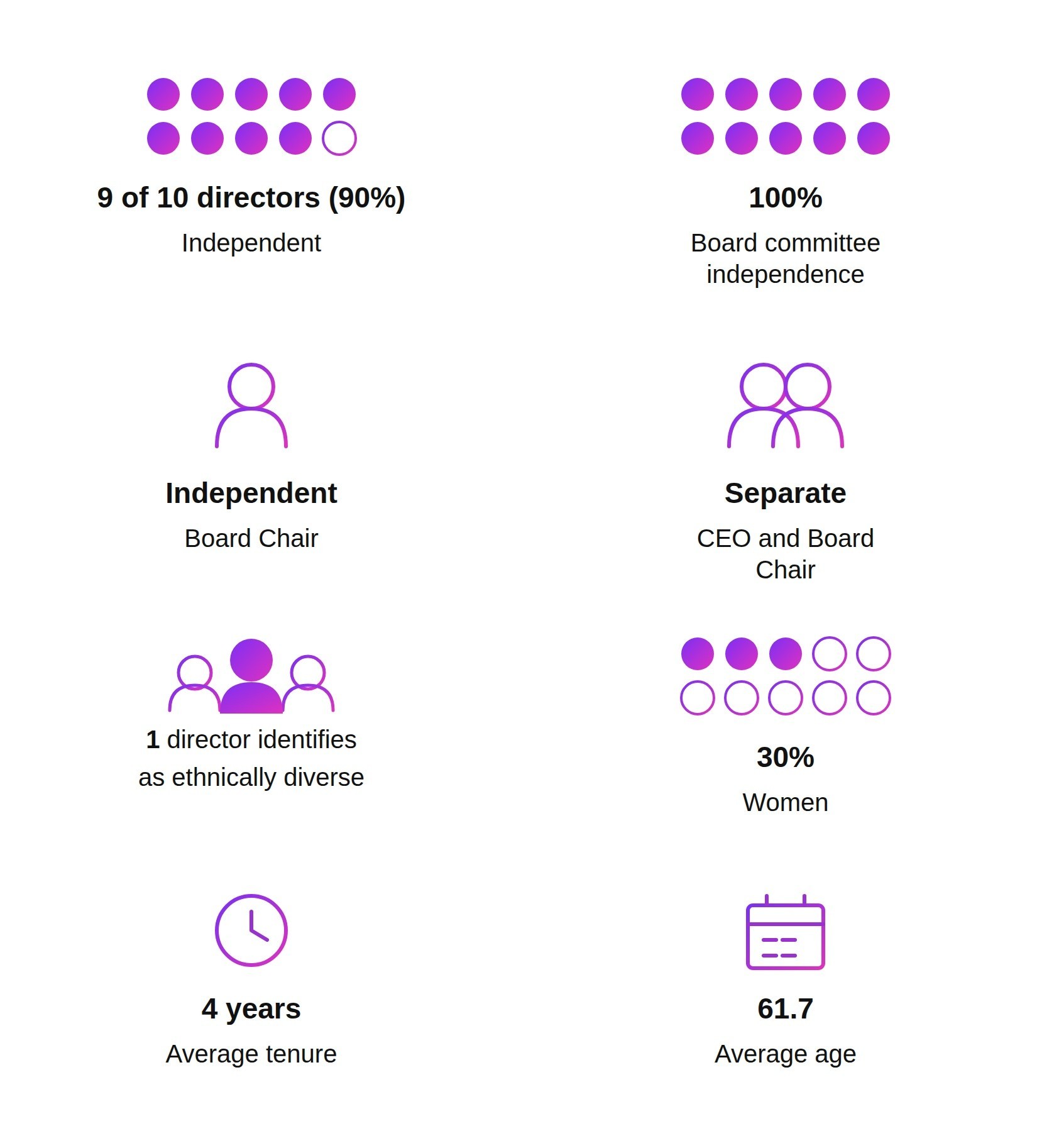
The following highlights related to our Board are as of July 6, 2026:
Other Relationships
There are no family relationships between or among any of our directors or executive officers. The principal occupation and employment during the past five years of each of our directors was carried on, in each case except as specifically identified above, with a corporation or organization that is not a parent, subsidiary, or other affiliate of Dynatrace.
There is no arrangement or understanding between any of our directors and any other person or persons pursuant to which he or she is to be selected as a director.
19
CORPORATE GOVERNANCE
Overview
Our company’s business and affairs are managed by or under the direction of the Board, acting on behalf of stockholders. The Board has delegated authority and responsibility to our company’s officers to manage the company’s day-to-day affairs. The Board has an oversight role and does not perform or duplicate the tasks of the CEO or senior management.
Our Board currently consists of ten members, nine of whom are non-employee, independent directors. In accordance with the terms of our certificate of incorporation and bylaws, our Board is divided into three classes, Class I, Class II, and Class III, with members of each class serving staggered three-year terms. Depending on the Board’s assessment of our company’s needs and other factors, the Board reserves the right at any time to increase or decrease its size, subject to any applicable provisions in our company’s Charter.
Board Structure
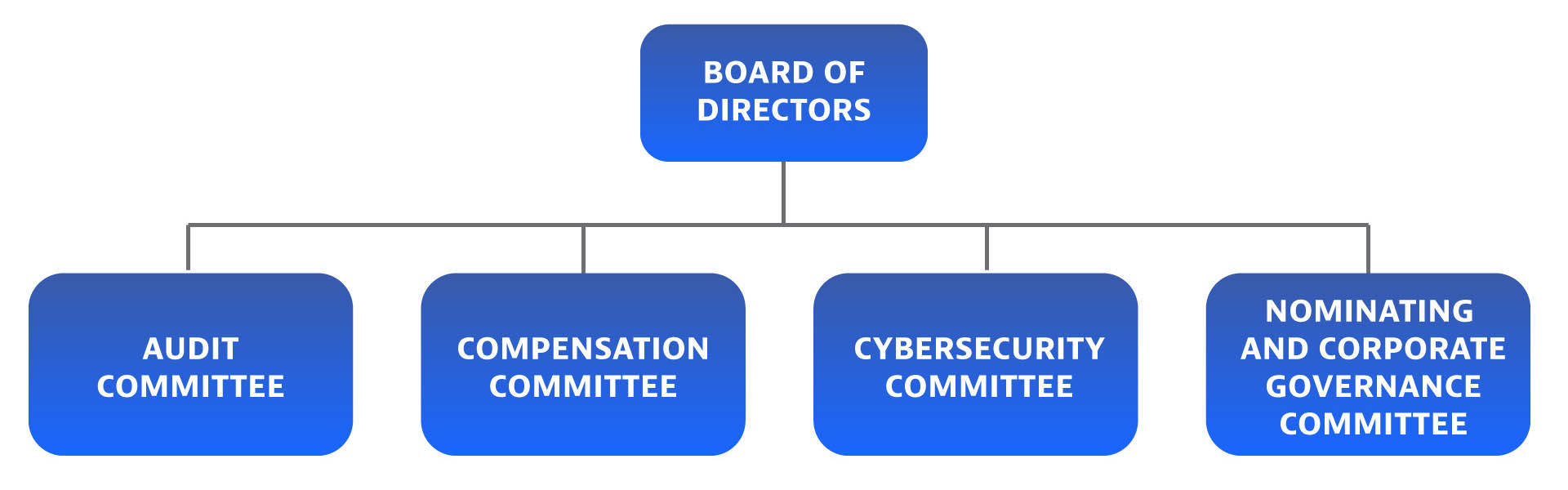
Our Board has four standing committees. The composition and responsibilities of each committee is discussed later in this “Corporate Governance” section. Each committee member is independent.
A copy of the charter for each committee is posted on the governance section of our website, https://ir.dynatrace.com/corporate-governance/governance-documents. In addition, we have adopted Corporate Governance Guidelines that formalize certain fundamental board policies and practices. Both of these documents are posted on the governance section of our website, https://ir.dynatrace.com/corporate-governance/governance-documents.
Independence
Nine of our ten directors are independent. Our Corporate Governance Guidelines provide that at least a majority of the Board shall be independent.
At least annually, the Board evaluates all relationships between our company and each director for the purposes of determining whether a material relationship exists that might represent a potential conflict of interest or otherwise interfere with the director’s ability to satisfy his or her responsibilities as an independent director. Based on this evaluation, the Board then makes an annual determination of whether each director is independent within the meaning of applicable independence standards of the NYSE, the SEC, and our applicable committees.
In June 2026, the Board conducted a review of the independence of George Riedel and Dan Streetman in connection with their proposed appointments to the Board. In July 2026, the Board conducted its annual review of the independence of each director. Based on information submitted by each director concerning his or her background, employment, and affiliations, and upon the recommendation of the Nominating and Corporate Governance Committee, the Board determined that each of our directors (other than our Chief Executive Officer, Rick McConnell) has no material relationship with our company that might represent a potential conflict of interest or otherwise interfere with the director’s ability to satisfy his or her responsibilities as an independent director and that each of these directors is “independent” as that term is defined under NYSE listing standards. In making these determinations, our Board considered the current and prior relationships that each non-employee director has with our company and other facts and circumstances that our Board deemed relevant in determining their independence and eligibility to serve on the committees of our Board.
The Board also determined that each member of each of the committees of the Board is independent within the meaning of applicable independence standards of the NYSE, the SEC, and applicable committees' standards, including Rule 10a-3(b)(1) under the Securities Exchange Act of 1934, as amended (the “Exchange Act”).
20
Board Leadership Structure
Jill Ward has served as Chair of the Board since 2021. Jill is an independent, non-management director. The Chair is primarily responsible for overseeing the operations and affairs of the Board and acting as a liaison between management and the Board. Currently, the role of Chair is separated from the role of Chief Executive Officer. We believe that separating these positions allows our Chief Executive Officer to focus on our day-to-day business, while allowing the Chair to lead the Board in its fundamental role of providing advice to, and independent oversight of, management. Our Board recognizes the time, effort, and energy that the Chief Executive Officer is required to devote to his position in the current business environment, as well as the commitment required to serve as our Chair, particularly as the Board’s oversight responsibilities continue to grow. While our bylaws and our Corporate Governance Guidelines do not require that our Chair and Chief Executive Officer positions be separate, our Board believes that having separate positions is the appropriate leadership structure for us at this time and reflects our commitment to strong corporate governance. If the Chair and Chief Executive Officer were to be the same person or the Chair was not otherwise independent, the Board may consider appointment of a Lead Independent Director.
Our non-employee, independent directors meet at regularly scheduled executive sessions without management participation. Jill Ward, as Chair of the Board, presides at those sessions.
Board’s Risk Oversight Role
Risk is inherent to every business. We face a number of risks, including risks relating to our financial condition, development, and commercialization activities, operations, strategic direction, and IP. Dynatrace’s management is responsible for the day-to-day management of risks we face, while our Board, as a whole and through its committees, has responsibility for the oversight of risk management. In its risk oversight role, our Board has the responsibility to satisfy itself that the risk management processes designed and implemented by management are adequate and functioning as designed.
The role of our Board in overseeing the management of our risks is conducted primarily through committees of the Board, as disclosed in the descriptions of each of the committees below and in the charters of each of the committees. The company has a comprehensive enterprise risk management (“ERM”) program to identify, prioritize as to likelihood and magnitude, and continuously monitor the various short-term and long-term risks that Dynatrace faces and how they are being addressed. The full Board (or the appropriate board committee in the case of risks that are under the purview of a particular committee) discusses with management the company’s major risk exposures, their potential impact on Dynatrace, and the steps that the company is taking to manage them. When a committee of our Board is responsible for evaluating and overseeing the management of a particular risk or risks, the chair of the relevant committee reports on the committee meeting to the full Board. This enables the Board and its committees to coordinate the risk oversight role, particularly with respect to risk interrelationships.
While the Board has ultimate risk oversight responsibility, the Board’s committees are primarily responsible for overseeing the following risk areas, among others:
| Board of Directors | |||||||||||
| Audit | Compensation | Cybersecurity | Nominating and Corporate Governance | ||||||||
•ERM process •Financial, accounting and financial statement risk •Legal and regulatory compliance risks | •Compensation program and practices risks •Talent risks | •Cybersecurity risks •Privacy and data protection risks | •Governance risks •Sustainability risks | ||||||||
AI and the Board's Oversight Role
The modern business world is being fundamentally reshaped by AI, which Dynatrace has been investing in for over a decade. AI is overseen at the Board level given its strategic importance to Dynatrace and the wide range of potential risks related to the use of AI. At Dynatrace, we are committed to using AI responsibly and we focus on practicing good governance that upholds ethical standards to help mitigate risks and foster trust. We have a responsible AI policy and responsible AI principles posted on our website which address customer focus areas and an AI Governance Council composed of a cross-functional team of Dynatrace leaders who assign and oversee organizational accountability, decision rights, risks, policies and investment decisions for applying AI internally. We also evaluate the use of AI by our suppliers in relation to services that they provide to our company. The Board receives periodic AI-related updates from Dynatrace management as part of our governance and oversight processes.
21
Sustainability and the Board’s Oversight Role
Dynatrace is proud to serve more than 4,100 customers, representing many of the world’s largest organizations in over 110 countries. As we continue to scale, we are committed to sustainable business practices – operating in an ethical, equitable, and environmentally responsible way. We remain focused on advancing and strengthening our sustainable business practices and believe they are paramount to our success and our responsibility as a global company. We believe our continued investment in these practices will create a lasting positive impact for our customers, stockholders, employees, and communities.
We group our material sustainability topics into three key pillars: (1) sustaining our environment; (2) people, culture, and community; and (3) governance and ethics. With these topics at the forefront, we have embedded our sustainability strategy into our business priorities, mission, purpose, vision, and values.
During our fiscal 2026, we continued to develop and implement programs that drive progress on our sustainability initiatives, which we shared in our annual Sustainability Report in December 2025. A copy of our most recent Sustainability Report is posted on our website at www.dynatrace.com/company/sustainability/. The contents of our Sustainability Reports are not incorporated into this Proxy Statement and inclusion of the website address above is an inactive textual reference only.
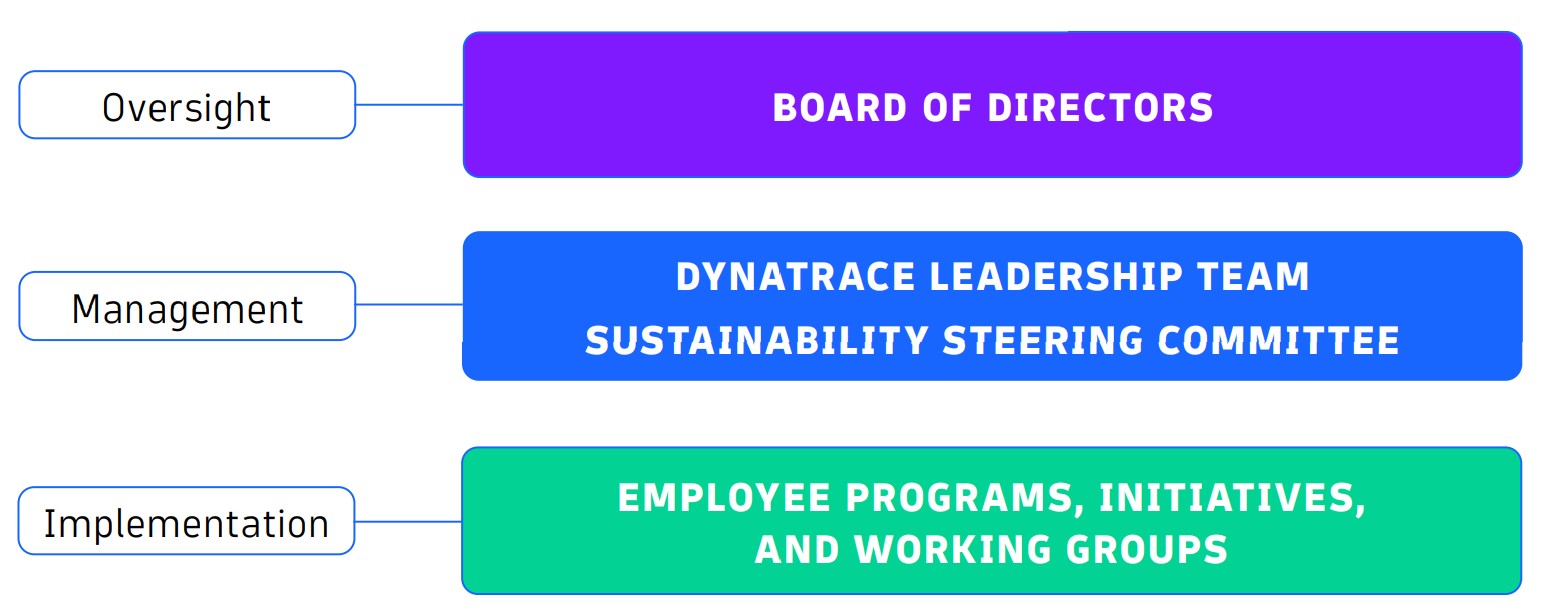
Sustainability at Dynatrace is overseen by management as well as by our Board. Day-to-day sustainability action items, including data collection, strategy, and goal-setting activities, are led by sustainability initiative business owners across the company. We have a cross functional Sustainability Steering Committee that guides our approach and drives our initiatives. The Sustainability Steering Committee comprises representatives from key corporate functions, including Legal, People and Culture, Investor Relations, and Marketing. This committee reports on our progress to the Dynatrace Leadership Team (which is led by our CEO) to align our sustainability strategy with our core business goals.
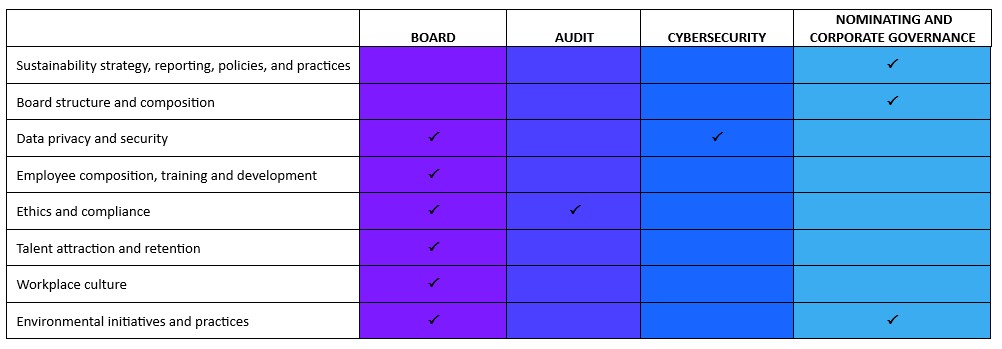
The table below shows how our top tier sustainability topics are overseen by the Board and three of its committees. The Nominating and Corporate Governance Committee provides primary oversight for our sustainability strategy, policies, practices, and related disclosures.
22
Board Committees
The following table sets forth the current membership of the Board’s four committees as of July 6, 2026.
| Name | Audit | Compensation | Cybersecurity | Nominating and Corporate Governance | ||||||||||
| Lisa Campbell | l | |||||||||||||
| Michael Capone | µ | l | ||||||||||||
| Amol Kulkarni | l | l | ||||||||||||
| Stephen Lifshatz | µ | l | ||||||||||||
| Steve Rowland | l | |||||||||||||
| Jill Ward | l | µ | ||||||||||||
| Kirsten Wolberg | µ | l | ||||||||||||
µ = Chair; l = Member
Audit Committee
The responsibilities of the Audit Committee of the Board (the "Audit Committee") include:
•assisting the Board in its oversight of the integrity of our financial statements and our compliance with legal and regulatory requirements;
•assisting the Board in its oversight of the qualifications, independence, and performance of the company’s independent auditors, being directly responsible for the appointment, retention, and termination of the independent auditors, and overseeing the work of the independent auditors;
•approving or, as required, pre-approving audit and permissible non-audit services, other than de minimis non-audit services, and the terms of such services, to be performed by our independent auditors;
•reviewing and discussing the overall audit plan with the independent auditors and with members of management responsible for preparing the company’s financial statements;
•reviewing and discussing the company’s annual audited financial statements and unaudited quarterly financial statements with the independent auditors and with members of management responsible for preparing the company’s financial statements;
•discussing our earnings releases and financial information and guidance provided to analysts and rating agencies;
•evaluating the performance, responsibilities, budget, and staffing of our internal audit function;
•reviewing the company’s ERM framework and major risk exposures, including the company’s ERM processes;
•establishing procedures for employees to submit concerns anonymously about questionable accounting or audit matters; and
•reviewing and approving related party transactions.
Our Board has determined that each member of the Audit Committee is independent for Audit Committee purposes as that term is defined in applicable SEC and NYSE rules, and each is financially literate in accordance with NYSE rules.
Our Board has designated Stephen Lifshatz as an “Audit Committee Financial Expert,” as defined under applicable SEC rules.
During the fiscal year ended March 31, 2026, the Audit Committee met seven times, made recommendations to the Board during Board meetings, and took other actions through written consent. The report of the Audit Committee is included in this Proxy Statement under “Report of the Audit Committee.” The members of the Audit Committee during our fiscal 2026 were Stephen Lifshatz (Chair), Steve Rowland, and Jill Ward.
23
Compensation Committee
The responsibilities of the Compensation Committee include:
•overseeing the company’s overall compensation structure, policies and programs;
•reviewing and approving the terms and conditions of performance-based incentive plans and awards (subject, if applicable, to Board or stockholder approval);
•determining the measures on which performance-based incentive compensation and equity awards are based as well as reviewing and approving the achievement of those metrics and the resulting payouts;
•reviewing and establishing the objectives and performance criteria for the CEO;
•evaluating the performance of our CEO in light of the objectives and performance criteria that were set for the CEO, and determining the compensation of our CEO, in consultation with the Board;
•determining the compensation of other executive officers other than the CEO;
•reviewing and recommending to the Board the compensation of our directors;
•overseeing, reviewing, and discussing certain executive succession planning matters; and
•reviewing and discussing with management, at least on an annual basis, management’s assessment of whether risks arising from the company’s compensation policies, practices and programs for all employees are reasonably likely to have a material adverse effect on the company.
Our Board has determined that each member of the Compensation Committee meets the requirements of a “non-employee director” pursuant to Rule 16b-3 under the Exchange Act and is “independent” for Compensation Committee purposes as that term is defined in the applicable SEC and NYSE rules.
During the fiscal year ended March 31, 2026, the Compensation Committee met four times, made recommendations to the Board during Board meetings, and took other actions through written consent. The members of the Compensation Committee during our fiscal 2026 were Michael Capone (Chair), Amol Kulkarni, and Stephen Lifshatz.
Compensation Committee Interlocks and Insider Participation
None of the members of our Compensation Committee (Michael Capone, Amol Kulkarni, and Stephen Lifshatz) is or has been an officer or employee of our company. None of our executive officers currently serves, or in the past year has served, as a member of the board or compensation committee (or other board committee performing equivalent functions) of any entity that has one or more of its executive officers serving on our Board or Compensation Committee.
Cybersecurity Committee
The responsibilities of the Cybersecurity Committee include:
•managing oversight of our investments, programs, plans, controls, and policies related to cybersecurity, data privacy, and data protection risks associated with our products, services, and business operations;
•providing feedback on cybersecurity related matters, including, but not limited to, strategies, objectives, capabilities, initiatives, and policies; and
•overseeing other tasks related to our cybersecurity and data privacy functions.
During the fiscal year ended March 31, 2026, the Cybersecurity Committee met four times and made recommendations to the Board during board meetings. The members of the Cybersecurity Committee during our fiscal 2026 were Kirsten Wolberg (Chair), Michael Capone, and Lisa Campbell.
24
Nominating and Corporate Governance Committee
The responsibilities of the Nominating and Corporate Governance Committee include:
•identifying, evaluating, and recommending qualified persons to serve on our Board;
•considering and making recommendations to our Board regarding the composition and chairs of the committees of our Board;
•developing and making recommendations to our Board regarding corporate governance guidelines and matters and periodically reviewing such guidelines and recommending any changes;
•overseeing annual evaluations of the Board and its committees;
•providing oversight of the company’s sustainability strategy and reporting; reviewing and assessing the company’s policies and practices regarding sustainability matters; and
•overseeing, reviewing, and discussing CEO succession planning matters.
Our Board has determined that each member of the Nominating and Corporate Governance Committee is “independent” for Nominating and Corporate Governance Committee purposes as that term is defined in the rules of the SEC and the applicable NYSE rules.
During the fiscal year ended March 31, 2026, the Nominating and Corporate Governance Committee met four times, made recommendations to the Board during Board meetings, and took other actions through written consent. The members of the Nominating and Corporate Governance Committee during our fiscal 2026 were Jill Ward (Chair), Amol Kulkarni, and Kirsten Wolberg.
Board Refreshment
We are committed to ongoing Board refreshment to maintain a Board composed of directors with the complementary skills, experience, and perspectives needed to oversee our strategy, operations, and long-term value creation. Since January 2021, we have appointed six of our existing independent directors, reflecting an evolution of our Board. Our directors have an average tenure of approximately four years, providing a balance between the institutional knowledge of longer-tenured directors and new perspectives and approaches brought by directors who joined the Board in recent years. Collectively, we believe our Board possesses significant experience and knowledge about technology (including AI), the software industry, global operations, go-to-market sales, and marketing, positioning it well to guide Dynatrace through the next phase of our expected growth.
On July 1, 2026, we announced the appointments of George Riedel and Dan Streetman to the Board. George brings significant experience as a CEO and senior executive at technology companies and served many years as a board chair and independent director at both private and public technology companies. Dan is the CEO of Tanium, a privately held cybersecurity and systems management company that is leveraging AI to drive meaningful growth and profitability, and he brings decades of senior leadership experience in autonomous IT, enterprise software, and information technology. George and Dan are experienced leaders whose valuable financial, operational, and business strategy expertise in technology broadly, and software and AI specifically, will serve as resources for the Dynatrace management team and our Board in advancing our company's strategy to create value for stockholders.
Board Succession Planning and the Director Nomination Process
The Nominating and Corporate Governance Committee is responsible for recommending to the Board the criteria for Board and committee membership and for identifying, evaluating, and recommending director candidates. As part of this process, the Nominating and Corporate Governance Committee regularly assesses the qualifications, experience, and skills of our current directors and the need for new directors. The Nominating and Corporate Governance Committee considers the current size and composition of the Board and the needs of the Board and its respective committees, together with any other factors that the Nominating and Corporate Governance Committee considers appropriate. The Nominating and Corporate Governance Committee and the Board have adopted a policy and guidelines on considering director candidates, which are appended to the charter of the Nominating and Corporate Governance Committee.
Director candidates are often suggested by an outside search firm that has experience in identifying public company director candidates as well as by current Board members, management, and others. When an outside search firm is engaged, the Nominating and Corporate Governance Committee requests that the firm include qualified candidates from various backgrounds and experiences in the pool.
25
As part of identifying and evaluating any individual recommended for nomination to the Board, the Nominating and Corporate Governance Committee considers a wide range of relevant factors, which include, but are not limited to, character, integrity, judgment, independence, skills, education, expertise, business acumen, business experience, length of service, understanding of the company’s business and industry, conflicts of interest, personal background, and other commitments. The Nominating and Corporate Governance Committee does not assign any particular weight or priority to any one factor.
The Nominating and Corporate Governance Committee expects any nominee for a position on the Board to possess or demonstrate:
•High standards of personal and professional ethics and integrity;
•Proven achievement and competence in the nominee’s field and the ability to exercise sound business judgment;
•Skills that are complementary to those of members of the existing Board;
•The ability to assist and support management and make significant contributions to our company's success; and
•An understanding of the fiduciary responsibilities required of a director and a commitment to devote the time and energy necessary to perform those responsibilities.
Depending on timing and needs, the Nominating and Corporate Governance Committee recommends to the Board that a director nominee be elected by our stockholders at the next annual meeting, or that the Board appoint the director nominee during the year.
In selecting director nominees, the Nominating and Corporate Governance Committee will review candidates properly recommended by stockholders in the same manner and using the same general criteria as candidates recruited by the committee and/or recommended by our Board. Any stockholder who wishes to recommend a candidate for consideration by the committee as a nominee for director should follow the procedures described in this Proxy Statement under the heading “Additional Information.” The Nominating and Corporate Governance Committee will also consider whether to nominate any person proposed by a stockholder in accordance with the provisions of our bylaws relating to stockholder nominations as described later in this Proxy Statement under the heading “Additional Information.”
Executive Succession Planning and the Board's Oversight Role
Executive succession planning is an important component of the Board's oversight of our company's long-term strategy and leadership continuity. Each year, the Board reviews and discusses CEO and key leadership succession plans which are developed under the oversight of the Nominating and Corporate Governance Committee and the Compensation Committee. Succession planning focuses on the readiness levels of identified individual successors as well as the breadth of the leadership bench for key roles across the organization. As part of the succession planning process, the Board and management also discuss programs, steps, and initiatives that the company is utilizing to broaden and develop leaders who have demonstrated potential to be future successors.
Board and Committee Self-Assessments and Evaluations
The Board conducts an annual self-assessment and evaluation process to determine whether it and its committees are functioning effectively. The process is a best practice, helps reinforce the Board's strengths, and provides an opportunity for the Board to consider potential changes and modifications based on factors such as the current business environment, shifting priorities, emerging trends, and future needs.
The Board Chair and the Nominating and Corporate Governance Committee followed an established practice for the self-assessment process in fiscal 2026. Questionnaires were updated with an independent third party that specializes in facilitating these evaluation processes for boards and has supported the process in the past. Directors were then asked to evaluate the performance of the Board and each committee of which they were a member across a variety of topics, including responsibilities, strategy, culture, composition, and communication. Director responses were provided anonymously and the third party firm facilitating the process provided a report to the Board Chair summarizing directors' responses and comments. After reviewing the feedback, the Board Chair subsequently provided a report to the full Board.
Following completion of the self-assessment process, the Chair and other directors develop appropriate action plans to address the feedback. Directors are also encouraged to provide ongoing feedback during the year outside of the formal self-assessment process.
26
Director Education
Our Board has a director continuing education program that provides opportunities to learn and stay current as Board members. As part of regularly scheduled Board/committee meetings, the Board periodically receives updates from outside legal counsel, the Compensation Committee’s independent consultant, and the company’s independent auditors. Directors are also informed through periodic updates and presentations provided by Dynatrace management regarding the company’s products, operations, performance, and industry.
As part of the Board’s individual director education approach, directors are encouraged to choose from among well-regarded third-party programs and seminars. Fees and reasonable out of pocket expenses are covered by our company and include membership in the National Association of Corporate Directors (NACD).
Newly appointed or elected directors also receive an orientation program in connection with joining the Board.
Director Stock Ownership Guidelines
Our non-employee directors are subject to stock ownership guidelines to further align their interests with those of our stockholders. Under the guidelines, our directors are required to hold common stock valued at a multiple of five times their current annual cash retainer fee for regular Board service (which excludes any supplemental annual cash retainers payable for Board or committee service) within five years of joining the Board. Compliance with this requirement will be determined on an annual basis on the last day of each fiscal year beginning on March 31, 2027.
For purposes of the guidelines, stock ownership only includes shares of common stock that a director either owns directly or otherwise beneficially owns and does not include shares of common stock underlying unvested time-based restricted stock units ("RSUs") and other unvested, unsettled and/or unexercised equity awards.
Attendance at Board and Committee Meetings and the Annual Meeting of Stockholders
During fiscal 2026, each member of the Board attended 75% or more of all meetings of the Board and each committee on which they served (during the period that the director served). Our Board met 12 times during fiscal 2026.
Directors are encouraged to attend the annual meeting of stockholders to the extent practicable. Six of our eight directors serving on the Board at the time attended our 2025 annual meeting.
Other Corporate Governance Practices and Policies
Stockholder Engagement
We value the feedback that we receive from our investors and we look to strengthen and develop relationships with them during the year. As part of our corporate governance practices, we actively engage each year with our largest stockholders on a wide range of topics that are of interest to each firm. Our stockholder outreach efforts are primarily led by our head of Investor Relations and have included our Chief Financial Officer, Chief Legal Officer, Board Chair (who is also the Chair of the Nominating and Corporate Governance Committee), and the Chair of the Board’s Compensation Committee.
Since our last annual meeting, we proactively invited our largest 20 institutional stockholders representing approximately 60% of our outstanding common stock (based on ownership at the time of outreach) to meet with us. We subsequently held meetings with a number of these and other stockholders over the course of several months. These efforts resulted in meaningful conversations on matters of importance to our stockholders, and feedback received was discussed by the Board or, as applicable, the Nominating and Corporate Governance Committee or Compensation Committee.
Key topics discussed with our stockholders during our these meetings included:
•Ongoing changes in the software industry, notably related to the impact of AI;
•Corporate governance practices, such as our Board structure, Board refreshment practices, and how the Board oversees AI;
•Capital allocation priorities;
•Growth and profitability opportunities;
•Investor communications;
•Executive compensation policies and practices;
27
•CEO and executive succession planning practices; and
•Sustainability program focus areas and progress.
Recent examples of our responses to stockholder feedback include the following:
•In fiscal 2025, we introduced a component of performance-based restricted stock units ("PSUs") based on relative total stockholder return (“rTSR”) performance for long-term incentive awards granted to our executive officers. Please see the "Compensation Discussion and Analysis" section of this Proxy Statement for additional information.
•In fiscal 2026, we adopted a new majority voting standard for uncontested director elections.
•In fiscal 2027, we appointed George Riedel and Dan Streetman to our Board. We also announced plans to hold an Investor Day following the release of our second quarter fiscal 2027 financial results. As part of this announcement, we reiterated our intention to continue returning significant capital to stockholders under our $1 billion share repurchase authorization and noted our plans to communicate a capital return framework at the Investor Day.
We look forward to continuing our practice of active, ongoing stockholder engagement to inform enhancements to the Board’s governance, compensation, and disclosure practices.
Code of Business Conduct and Ethics
We have adopted a written Code of Business Conduct and Ethics that applies to our directors, officers and employees, including our principal executive officer, principal financial officer, principal accounting officer and controller, and persons performing similar functions. We intend to disclose any amendment or waiver of a provision of the Code of Business Conduct and Ethics that applies to our principal executive officer, principal financial officer, principal accounting officer and controller, or persons performing similar functions, by posting such information on our website available at https://ir.dynatrace.com and/or in our public filings with the SEC. To date, there have been no waivers granted under the Code of Business Conduct and Ethics to our directors, principal executive officer, principal financial officer, principal accounting officer and controller, and persons performing similar functions. We also have a human rights policy and a supplier code of conduct. The Code of Business Conduct and Ethics and these other policies are available at www.dynatrace.com/company/sustainability/.
Communications with the Board
Any interested party may contact our Board (or our non-management or independent directors as a group, the Chair of the Board, or any individual directors) by writing to the attention of the Board as a whole or to one or more individual directors by name, by e-mail at corporatesecretary@dynatrace.com or by mail: Dynatrace, Inc., 280 Congress Street, 11th Floor, Boston, Massachusetts 02210, United States, Attn: Secretary. You may also indicate whether you are a stockholder, customer, supplier, or other interested party.
We will forward such communication to each director to whom such communication is addressed, and to the Chair of the Board in his or her capacity as representative of the Board. Our Secretary will review these communications and reserves the right not to forward communications if they are deemed inappropriate, consist of individual grievances or other interests that are personal to the party submitting the communication and could not reasonably be construed to be of concern to stockholders or other constituencies of the company, solicitations, advertisements, surveys, “junk” mail, or mass mailings.
The Audit Committee oversees the procedures for the receipt, retention, and treatment of complaints received by Dynatrace regarding accounting, internal accounting controls, audit matters, fraud, financial misconduct or potential violations of our Code of Business Conduct and Ethics, including the confidential, anonymous submission by employees of concerns regarding such matters. Dynatrace has established a reporting portal at www.dynatrace.com/ethics/ for reporting such concerns online or by telephone to +1 800-493-0611 (toll free in the United States) or the other numbers listed on the portal. A complaining party may also submit a confidential report to the Audit Committee by sending a letter c/o Dynatrace, Inc., 280 Congress Street, 11th Floor, Boston, Massachusetts 02210; Attention: Audit Committee Chair.
28
Director Compensation
Approach and philosophy
Our non-employee director compensation policy, as described below, is designed to ensure that the compensation of non-employee directors aligns the directors’ interests with the long-term interests of the stockholders, that the structure of the compensation is simple, transparent and easy for stockholders to understand, and that our directors are fairly compensated. This policy is also intended to provide a total compensation package that enables us to attract and retain qualified and experienced individuals to serve as directors. Under our non-employee director compensation policy, employee directors do not receive additional compensation for their services as directors. Rick McConnell is the only employee director on the Board.
Components of our non-employee director compensation policy effective for fiscal 2026
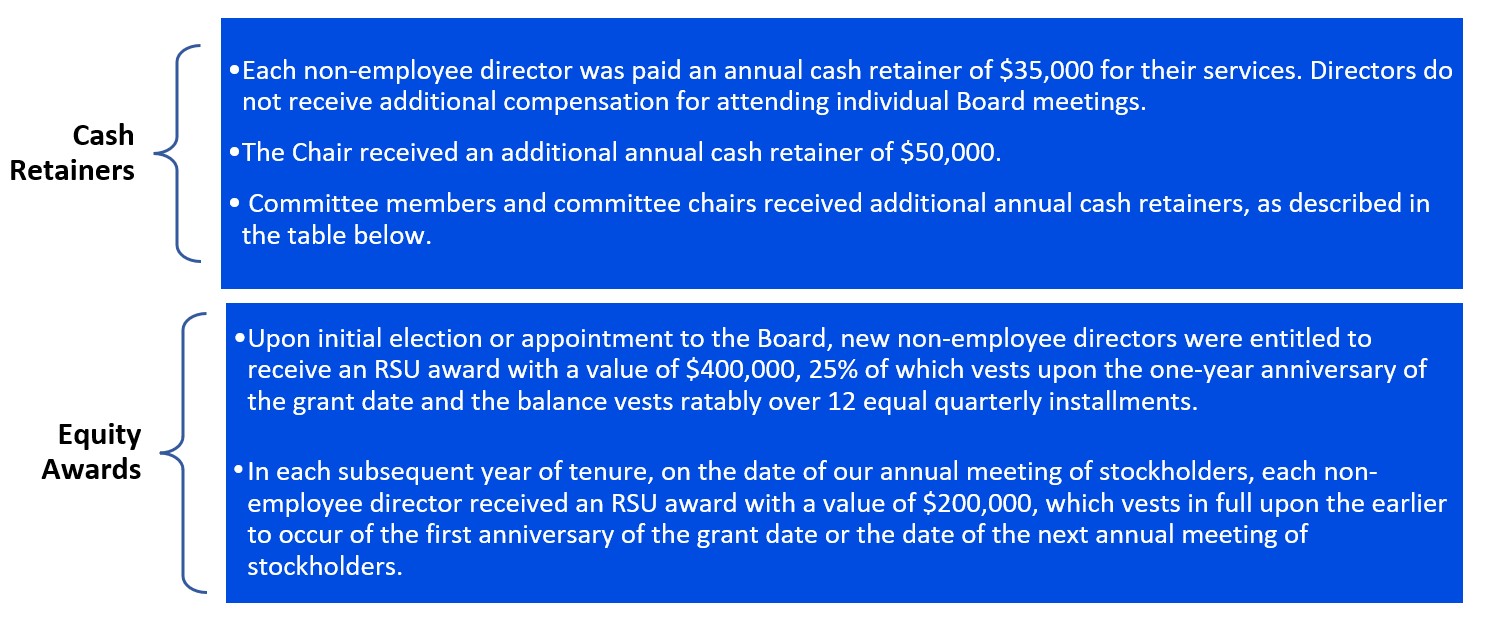
Cash retainers are paid in quarterly installments and may be pro-rated based on the number of actual days served by the director during the calendar quarter. The Board also has discretion to pro-rate the first annual equity award or the first annual equity award for a new director if the Board deems it appropriate in light of the proximity of the initial grant to the anticipated date of our company's next annual meeting of stockholders. Vesting of any equity award ceases if a director resigns from our Board or otherwise ceases to serve as a director, unless the Board determines that circumstances warrant continuation of vesting. In addition, all equity awards will become 100% vested and exercisable in the event of change in control of our company (as defined in the non-employee director compensation policy as a “Sale Event”, which is defined in our 2019 Equity Incentive Plan).
During our fiscal 2026, committee members received the following additional annual retainers due to the workload and broad-based responsibilities of the committees:
| Committee | Member Annual Fee | Chair Annual Fee | ||||||
| Audit Committee | $10,000 | $20,000 | ||||||
| Compensation Committee | $7,500 | $15,000 | ||||||
| Nominating and Corporate Governance Committee | $5,000 | $10,000 | ||||||
| Cybersecurity Committee | $5,000 | $10,000 | ||||||
In setting director compensation for fiscal 2026, the Compensation Committee reviewed benchmarking information provided by the committee’s independent compensation consultant related to director compensation paid by the same peer group utilized for executive compensation benchmarking purposes. That peer group is discussed later in this Proxy Statement. Based on that review, no changes were made to the director compensation program for fiscal 2026. Directors are also reimbursed for reasonable travel and other out-of-pocket expenses attending Board and committee meetings and otherwise directly related to their service as directors.
We offer a non-qualified Deferred Compensation Plan which provides eligible U.S. directors with the opportunity to defer up to 100% of their annual cash retainers. Account balances under the Deferred Compensation Plan are credited with income, gains, and losses based on the performance of investment funds selected by the participant from a list of funds designated by our company. We do not make matching contributions under the Deferred Compensation Plan, but are permitted to make discretionary contributions. However, we did not make any contributions to the Deferred Compensation Plan in our fiscal 2026.
29
Director Compensation – Fiscal 2026
The table below presents the total compensation for each person who served as a non-employee director during fiscal 2026. During fiscal 2026, Rick McConnell, our current CEO, was a member of our Board and received no additional compensation for his service as a director. Please see the “Executive Compensation” section for more information about Rick McConnell’s compensation for fiscal 2026.
| Name | Fees Earned or Paid in Cash ($)(1) | Stock Award ($)(2) | Total ($) | ||||||||
Lisa Campbell | 40,000 | 200,041 | 240,041 | ||||||||
| Michael Capone | 55,000 | 200,041 | 255,041 | ||||||||
Amol Kulkarni | 47,500 | 200,041 | 247,541 | ||||||||
| Stephen Lifshatz | 62,500 | 200,041 | 262,541 | ||||||||
| Steve Rowland | 45,000 | 200,041 | 245,041 | ||||||||
Jill Ward | 105,000 | 200,041 | 305,041 | ||||||||
| Kirsten Wolberg | 50,000 | 200,041 | 250,041 | ||||||||
(1)The amounts include cash retainers, including any retainers deferred by directors under our Deferred Compensation Plan. During our fiscal 2026, Michael Capone was the only director to defer a portion of his cash retainer pursuant to the Deferred Compensation Plan.
(2)The amounts represent the aggregate grant date fair value of RSUs granted to our directors during fiscal 2026, computed in accordance with FASB ASC Topic 718. The assumptions used in calculating the grant date fair value of the RSUs reported in this column are set forth in note 15 to our audited consolidated financial statements included in our 2026 Annual Report. On August 20, 2025 (the date of our 2025 annual meeting of stockholders), each non-employee director serving and re-elected as of that date received an annual equity award of 4,111 RSUs that vest on the earlier of the one year anniversary of the grant or the date of the Annual Meeting. As of March 31, 2026, our non-employee directors as of such date held the following amounts of unvested RSUs: Lisa Campbell - 9,173; Michael Capone – 4,111; Amol Kulkarni – 7,223; Stephen Lifshatz – 4,111; Steve Rowland – 4,111; Jill Ward – 4,111; and Kirsten Wolberg – 4,111.
In April 2026, the Board increased the amounts of cash and equity retainers payable to non-employee directors effective as of April 1, 2026 for our fiscal 2027 to align director pay closer to the midpoint of peer group companies. These adjustments were the first increases since 2023. The annual cash retainer payable to non-employee directors was increased to $40,000. The additional cash retainer payable to the Board Chair was increased to $80,000. Audit Committee cash retainers for members and its chair were increased to $12,500 and $25,000, respectively. Compensation Committee cash retainers for members and its chair were increased to $10,000 and $20,000, respectively. Cybersecurity Committee cash retainers for members and its chair were increased to $6,000 and $12,000, respectively. Nominating and Corporate Governance Committee cash retainers for members and its chair were increased to $6,000 and $12,000, respectively. The values of the annual RSU grant and initial RSU grant were increased to $230,000 and $460,000, respectively.
30
PROPOSAL NO. 2
RATIFICATION OF THE APPOINTMENT OF ERNST & YOUNG LLP
AS DYNATRACE’S INDEPENDENT REGISTERED PUBLIC ACCOUNTING FIRM
FOR THE FISCAL YEAR ENDING MARCH 31, 2027
Our Independent Registered Public Accounting Firm
Our independent registered public accounting firm for the fiscal year ended March 31, 2026 was Ernst & Young LLP ("EY"). The Audit Committee has appointed EY as our independent registered public accounting firm to perform the audit of our consolidated financial statements, including internal controls over financial reporting, for the fiscal year ending March 31, 2027. We are asking our stockholders to ratify this appointment.
The Audit Committee is solely responsible for selecting our independent registered public accounting firm for the fiscal year ending March 31, 2027. Stockholder approval is not required to appoint EY as our independent registered public accounting firm. However, the Board believes that submitting the appointment of EY to the stockholders for ratification is good corporate governance. A majority of the votes properly cast is required in order to ratify the appointment of EY. If the stockholders do not ratify this appointment, the Audit Committee will reconsider whether to retain EY. If the selection of EY is ratified, the Audit Committee, at its discretion, may direct the appointment of a different independent registered public accounting firm at any time it decides that such a change would be in the best interest of our company and our stockholders.
A representative of EY is expected to be present at the Annual Meeting and will have an opportunity to make a statement if he or she desires to do so and to respond to appropriate questions from our stockholders.
Fees Paid to Our Independent Registered Public Accounting Firm
EY served as our independent registered public accounting firm for the fiscal years ended March 31, 2026 and March 31, 2025. The following table sets forth fees incurred for professional services provided by EY for audit, audit-related, tax, and other services.
| Fee Category | Fiscal 2026 | Fiscal 2025 | ||||||
Audit fees (1) | $3,858,263 | $4,335,800 | ||||||
Audit-related fees (2) | — | $32,000 | ||||||
Tax fees (3) | $1,967,000 | $2,308,000 | ||||||
| All other fees | — | — | ||||||
| Total fees | $5,825,263 | $6,675,800 | ||||||
(1)Audit fees consist of fees for professional services performed for the audit of our annual consolidated financial statements, audit of our internal controls over financial reporting, the required review of quarterly condensed consolidated financial statements, international statutory audits, audit services performed in connection with the issuance of comfort letters and consents, and other services that are normally provided by the independent registered accounting firm in connection with statutory and regulatory filings or engagements, including SEC registration statements associated with offerings.
(2)Audit-related fees consist of fees for due diligence in connection with acquisitions and divestitures, employee benefit plan audits, and attest services related to financial reporting that are not required by statute or regulation.
(3)Tax fees consist of fees for all professional services performed by professional staff in our independent registered accounting firm’s tax division, except those services related to the audit of our consolidated financial statements. These include fees for tax compliance, tax planning and tax advice, including federal, state, and local issues. Services may also include assistance with tax audits and appeals before the IRS and similar state and local agencies, as well as federal, state, and local tax issues related to due diligence.
Audit Committee Pre-approval Policy and Procedures
Our Audit Committee has adopted policies and procedures relating to the approval of all audit and non-audit services that are to be performed by our independent registered public accounting firm. This policy provides that we will not engage our independent registered public accounting firm to render audit or non-audit services unless the service is specifically approved in advance by our Audit Committee or the engagement is entered into pursuant to the pre-approval procedure described below, except for services for which the aggregate cost is below a specified de minimis dollar amount.
31
From time to time, our Audit Committee pre-approves specified types of services that are expected to be provided to us by our independent registered public accounting firm during the next 12 months. Any such pre-approval details the particular service or type of services to be provided and is also generally subject to a maximum dollar amount.
During fiscal 2026 and fiscal 2025, no services were provided to us by EY other than in accordance with the pre-approval policies and procedures described above.
Vote Required
The approval of this proposal requires the affirmative vote of a majority of the votes properly cast for and against the proposal. Abstentions and broker non-votes will have no effect on this proposal. However, we expect there will be no broker non-votes on this proposal since brokers have discretionary voting authority with respect to this proposal.
OUR BOARD RECOMMENDS THAT YOU VOTE “FOR” RATIFICATION OF THE APPOINTMENT OF ERNST & YOUNG LLP AS DYNATRACE’S INDEPENDENT REGISTERED PUBLIC ACCOUNTING FIRM FOR THE FISCAL YEAR ENDING MARCH 31, 2027. | ||
REPORT OF THE AUDIT COMMITTEE
The Audit Committee is a committee of the Board comprised solely of financially literate independent directors as required by the listing standards of the New York Stock Exchange and the rules and regulations of the SEC. The Audit Committee is appointed by the Board to assist the Board in fulfilling its oversight responsibilities with respect to (1) the integrity of our financial statements and financial reporting process and systems of internal controls regarding finance, accounting, and compliance with legal and regulatory requirements; (2) the qualifications, independence, and performance of our independent registered public accounting firm; (3) the performance of our internal audit function; and (4) other matters as set forth in the charter of the Audit Committee approved by the Board.
Management is responsible for the preparation of our financial statements and the financial reporting process, including its system of internal control over financial reporting and its disclosure controls and procedures. The independent registered public accounting firm is responsible for performing an audit of our financial statements in accordance with the standards of the Public Company Accounting Oversight Board (“PCAOB”) and issuing a report thereon. The Audit Committee’s responsibility is to monitor and oversee these processes as more specifically set forth in its charter.
In connection with these responsibilities, the Audit Committee reviewed and discussed with management and the independent registered public accounting firm our audited consolidated financial statements for the fiscal year ended March 31, 2026. The Audit Committee also discussed with the independent registered public accounting firm the matters required to be discussed by the PCAOB’s Auditing Standard No. 1301, Communication with Audit Committees. In addition, the Audit Committee received the written disclosures and the letter from the independent registered public accounting firm as required by the applicable requirements of the PCAOB regarding the independent registered public accounting firm’s communication with the Audit Committee concerning independence and has discussed with the independent registered public accounting firm their independence.
Based on the reviews and discussions referred to above, the Audit Committee recommended to the Board that the audited consolidated financial statements be included in our Annual Report on Form 10-K for the fiscal year ended March 31, 2026 that was filed with the SEC.
THE AUDIT COMMITTEE OF THE BOARD OF DIRECTORS OF DYNATRACE, INC.
Stephen Lifshatz, Chair
Steve Rowland
Jill Ward
The information contained in this report shall not be deemed to be (1) “soliciting material”; (2) “filed” with the SEC; (3) subject to Regulations 14A or 14C of the Exchange Act; or (4) subject to the liabilities of Section 18 of the Exchange Act. This report shall not be deemed incorporated by reference into any of our other filings under the Exchange Act or the Securities Act of 1933, as amended (the “Securities Act”), except to the extent that we specifically incorporate it by reference into such filing. In addition, this report shall not be deemed filed under either the Securities Act or the Exchange Act.
32
PROPOSAL NO. 3
NON-BINDING, ADVISORY VOTE TO APPROVE
THE COMPENSATION OF OUR NAMED EXECUTIVE OFFICERS
Section 14A of the Exchange Act requires that we provide our stockholders with the opportunity to vote to approve, on a non-binding, advisory basis, not less frequently than once every three years, the compensation of our named executive officers as disclosed in our annual proxy statement in accordance with the compensation disclosure rules of the SEC.
As described in detail in the section “Compensation Discussion and Analysis,” we seek to closely align the interests of our named executive officers with the interests of our stockholders. Our compensation program is designed to reward our named executive officers for the achievement of short-term and long-term financial, operational, and strategic goals and the achievement of increased total stockholder return, while at the same time avoiding the encouragement of unnecessary or excessive risk-taking.
Stockholders are urged to read the “Compensation Discussion and Analysis” and “Executive Compensation” sections of this Proxy Statement, which discuss how our executive compensation policies and practices implement our compensation philosophy, and contain tabular information and narrative discussion about the compensation of our named executive officers. Our Board and the Compensation Committee believe that these policies and practices are effective in implementing our compensation philosophy and in achieving our compensation program goals.
The vote on this resolution is not intended to address any specific element of compensation but rather the overall compensation of our named executive officers and the philosophy, policies and practices described in this Proxy Statement. The vote is advisory, which means that the vote is not binding on us, our Board, or the Compensation Committee. Although non-binding, our Board and the Compensation Committee place a very high value on the opinions that stockholders express in their votes and will review the voting results and take them into consideration as they deem appropriate when making future decisions regarding our executive compensation program.
At our 2021 annual meeting of stockholders, our stockholders voted on a proposal regarding the frequency of holding a non-binding, advisory vote on the compensation of our named executive officers. More than 99% of the votes cast on the frequency proposal were cast in favor of holding a non-binding, advisory vote on the compensation of our named executive officers annually, which was consistent with the recommendation of our Board. Our Board considered the voting results with respect to the frequency proposal and other factors, and the Board currently intends for the company to hold a non-binding, advisory vote on the compensation of our named executive officers every year until the next required advisory vote on the frequency of holding the non-binding, advisory vote on the compensation of our named executive officers, which vote is required at least every six years.
Accordingly, we are asking our stockholders to vote on the following resolution at the Annual Meeting:
RESOLVED, that the stockholders of Dynatrace, Inc. approve, on a non-binding, advisory basis, the compensation of the company’s named executive officers, as disclosed in this Proxy Statement pursuant to Item 402 of Regulation S-K, including in the Compensation Discussion and Analysis, the compensation tables and the narrative disclosures that accompany the compensation tables.
Vote Required
The approval of this proposal requires the affirmative vote of a majority of the votes properly cast for and against the proposal. Abstentions and broker non-votes will have no effect on this proposal. As noted above, the vote is advisory, which means that the vote is not binding on the company, our Board, or the Compensation Committee.
OUR BOARD RECOMMENDS THAT YOU VOTE "FOR" THE APPROVAL OF, ON A NON-BINDING AND ADVISORY BASIS, THE COMPENSATION OF OUR NAMED EXECUTIVE OFFICERS, AS DISCLOSED IN THIS PROXY STATEMENT. | ||
33
EXECUTIVE OFFICERS
The following table identifies our executive officers, their positions at Dynatrace, and their ages as of July 6, 2026.
| Name | Position | Age | ||||||
| Rick McConnell | Chief Executive Officer and Director | 60 | ||||||
| Jim Benson | Executive Vice President, Chief Financial Officer and Treasurer | 59 | ||||||
| Dan Zugelder | Executive Vice President, Chief Revenue Officer | 58 | ||||||
| Bernd Greifeneder | Executive Vice President, Chief Technology Officer | 54 | ||||||
| Stephen McMahon | Executive Vice President, Chief Customer Officer | 53 | ||||||
| Rick McConnell has served as our Chief Executive Officer and a director since December 2021. Please see the “Proposal No. 1 - Election of Class I Directors” section of this Proxy Statement for Rick’s biography. | ||||
 | Jim Benson has served as our Chief Financial Officer and Treasurer since November 2022. He has been an Executive Vice President of our company since April 2024 and was a Senior Vice President prior to that. Prior to joining Dynatrace, Jim served as Executive Vice President and Chief Financial Officer of Akamai Technologies (NASDAQ: AKAM), a cloud, security, and content delivery company, from 2012 through February 2020 and served as Akamai’s Senior Vice President. Finance, from 2009 to 2012. Prior to joining Akamai, he served in a variety of finance roles at Hewlett-Packard, or HP (NYSE: HPQ), a global technology company, for approximately 20 years, including as Vice President, Finance/Operations & CFO – Americas Technology Solutions Group. Jim served on the Board of Directors of publicly traded Temenos AG (SIX: TEMN), a software provider, from May 2021 to May 2023. Jim is a director of several other private companies. Jim holds a B.S. in Finance from Bentley University and an M.B.A. from Clark University. | ||||
 | Dan Zugelder has served as our Chief Revenue Officer since July 2023. He has been an Executive Vice President since April 2024 and was a Senior Vice President of our company prior to that. Prior to joining Dynatrace, Dan was Senior Vice President and General Manager, Americas, at VMware (formerly NYSE: VMW), a provider of multi-cloud services that is now part of Broadcom, from November 2020 through June 2023. Dan joined VMware as Senior Vice President, Global Accounts in August 2018. Prior to VMware, he worked for 18 years at Dell EMC, a global technology company, where he held several key sales management positions, most recently serving as Senior Vice President, Global Accounts. Before joining Dell EMC, he spent 10 years at Automatic Data Processing, Inc., or ADP (NASDAQ: ADP), a global technology company, in various sales and sales leadership roles. Dan attended Buffalo State University. | ||||
34
 | Bernd Greifeneder has served as our Chief Technology Officer since December 2014. He has been an Executive Vice President since April 2024 and was a Senior Vice President of our company prior to that. Bernd co-founded dynaTrace Software GmbH in 2005, where he was the Chief Executive Officer until 2008, and the Chief Technology Officer until December 2014. Prior to that, Bernd held a variety of roles at Segue Software Inc., a software provider, from January 1998 to February 2005, including Project Lead, Chief Technology Officer of Global Technologies and Chief Software Architect. Bernd holds a B.S. in Computer Science and an M.S. in Computer Science from Johannes Kepler Universität Linz, Austria. | ||||
 | Steve McMahon has served as our Executive Vice President, Chief Customer Officer since May 2025. Prior to joining Dynatrace, Steve served as Chief Customer Success Officer at Zscaler from January 2024 to April 2025, where he led a team of technical support and professional services experts, account managers, architects, and engineers focused on customer adoption, deployment, and utilization of the full portfolio. Prior to Zscaler, Steve ran Customer Success, Operations and served as Chief Information Officer at CrowdStrike from June 2021 to January 2024. He also held various leadership positions at Splunk during his tenure there from May 2015 to June 2021, including Chief Information Officer from October 2018 to June 2021. Before joining Splunk, Steve spent nearly 15 years at Cisco primarily leading customer-focused teams. Steve also served in the United States Navy and received a B.A. in Economics from Yale University. | ||||
The principal occupation and employment during the past five years of each of our executive officers was carried on, in each case except as specifically identified above, with a corporation or organization that is not a parent, subsidiary or other affiliate of us. There is no arrangement or understanding between any of our executive officers and any other person or persons pursuant to which he was or is to be selected as an executive officer.
35
COMPENSATION DISCUSSION AND ANALYSIS
This Compensation Discussion and Analysis section describes our executive compensation program and explains our compensation principles and each component of compensation paid to our named executive officers.
Named Executive Officers
Our named executive officers for the fiscal year ended March 31, 2026 are:
Name | Position | ||||
| Rick McConnell | Chief Executive Officer and Director | ||||
| Jim Benson | Executive Vice President, Chief Financial Officer and Treasurer | ||||
| Dan Zugelder | Executive Vice President, Chief Revenue Officer | ||||
| Bernd Greifeneder | Executive Vice President, Chief Technology Officer | ||||
| Steve McMahon | Executive Vice President, Chief Customer Officer | ||||
The following discussion should be read together with the compensation tables and related disclosures set forth below.
Executive Summary
Business Overview
Dynatrace combines broad and deep observability, continuous runtime application security, and advanced agentic AI operations to deliver answers and intelligent automation across IT operations, development, security, business, and executive teams. This unified approach enables organizations to optimize their rapidly evolving AI, cloud, and IT operations, accelerate secure software delivery, and improve digital performance. Our vision is a world where software works perfectly.
The Dynatrace platform is built to scale, partnering and integrating seamlessly into hybrid, multicloud ecosystems, including major hyperscalers such as Amazon Web Services, Microsoft Azure, and Google Cloud Platform, as well as traditional on-premises and mainframe solutions.
Our customers include many of the world’s largest enterprises which deploy the Dynatrace platform to support increasingly complex IT environments. As workloads scale and cybersecurity threats evolve, cloud modernization and rapid AI adoption have significantly increased data volume and complexity, rendering traditional monitoring and observability approaches insufficient for many organizations. We believe this positions Dynatrace to address a significant market opportunity through our differentiated platform, deep cloud ecosystem integrations, and trusted customer and partner relationships.
Financial Performance Highlights – Fiscal 2026
In fiscal 2026, we continued to execute our strategic plan to drive sustainable, long-term value, reinforcing our record of delivering balanced growth, profitability, and free cash flow. We also continued to maintain our disciplined approach to capital allocation, optimizing costs, improving efficiencies, and investing in innovation and growth while delivering meaningful value to Dynatrace stockholders. Performance highlights for our fiscal 2026 included the following. Growth rates for ARR, total revenue, subscription revenue, free cash flow and non-GAAP operating income are compared to our fiscal 2025 on a constant currency basis.
$2.054 billion +16% ARR | $2.018 billion +17% Total Revenue | $1.930 billion +17% Subscription Revenue | ||||||
$562 million Net Cash Provided by Operating Activities $529 million Free Cash Flow(1) 26% Free Cash Flow Margin(1) | 12% GAAP Operating Margin 29% Non-GAAP Operating Margin(1) | Completed $500 million share repurchase program and authorized new $1 billion share repurchase program | ||||||
(1) Non-GAAP financial measure. For additional information, please see the "Non-GAAP Measures and Key Metrics” section for applicable definitions and “Appendix A - Reconciliation of Non-GAAP Financial Measures” for a reconciliation to the most directly comparable GAAP financial measure.
36
We believe in a disciplined and balanced approach to operating our business. We plan to continue driving innovation to meet customers’ needs and grow our customer relationships. We also plan to invest in future growth opportunities that we expect will drive long-term value, while leveraging our global partner ecosystem, optimizing costs, and improving efficiency and profitability.
Executive Compensation Program Highlights – Fiscal 2026
Highlights of our fiscal 2026 executive compensation program included the following:
•Competitive Base Salaries: After evaluating the competitive positioning of our named executive officers’ base salaries in the context of our overall compensation philosophy, the Compensation Committee approved base salary increases between approximately 2.4% and 3.1% in local currencies for fiscal 2026.
•Challenging Short-Term Incentive ("STI") Goals: Our named executive officers were eligible to earn an annual STI bonus based on our level of achievement of rigorous corporate financial goals for the year. Fiscal 2026 annual STI awards for our named executive officers were weighted 65% on the achievement of ARR goals and 35% on the achievement of Non-GAAP Operating Income goals. Our named executive officers earned 102.7% of their target annual STI award, which reflected the Compensation Committee's exercise of discretion under the STI plan to cap STI payouts for the ARR metric at target, notwithstanding above-target achievement.
•Emphasis on Performance-Based Long-term Incentive ("LTI") Awards: Our named executive officers were eligible to receive LTI awards in the form of RSUs and PSUs, each representing 50% of the target value awarded. In fiscal 2026, PSUs granted consisted of units based on financial performance ("Financial PSUs") and units based on rTSR performance ("rTSR PSUs"). Financial PSUs were weighted 40% on ARR, 40% on revenue, and 20% on Non-GAAP Operating Income. rTSR PSUs were based on the company’s stock price performance relative to companies that are the constituents of the Russell 3000 index over performance periods of one, two, and three fiscal years that began on April 1, 2025. Financial PSUs for fiscal 2026 were earned at approximately 114.0% of target. rTSR PSUs granted in June 2025 for the one year period ended March 31, 2026 (fiscal 2026) were not earned as performance was below threshold performance, and rTSR PSUs granted in June 2024 for the two year period ended March 31, 2026 (fiscal 2025 and fiscal 2026) were earned at approximately 61.5% of target.
The table below sets forth the mix of our LTI equity awards for fiscal 2026:
Vehicle | % of Award Mix | Metric | Metric Weighting | ||||||||
Financial PSUs | 30% | ARR | 40% | ||||||||
| Revenue | 40% | ||||||||||
| Non-GAAP Operating Income | 20% | ||||||||||
| rTSR PSUs | 20% | rTSR | 100% | ||||||||
RSUs | 50% | Time | - | ||||||||
The Compensation Committee determined it was appropriate to include ARR and Non-GAAP Operating Income as performance measures in both fiscal 2026 STI awards and Financial PSUs to emphasize the importance of these metrics to the company's financial outcomes and because both are principal measures used by stockholders to assess Dynatrace's performance. The Compensation Committee also believed that ARR and Non-GAAP Operating Income appropriately align incentive compensation with the company's strategic priorities of sustainable growth and disciplined profitability. The Compensation Committee also determined it was appropriate to include both ARR and revenue in the fiscal 2026 Financial PSU awards, as ARR reflects future revenue and growth in the recurring base while revenue reflects realized performance within the fiscal year. While the Compensation Committee is mindful of stockholder concerns regarding overlapping metrics across the STI and PSU programs, the inclusion of ARR and Non-GAAP Operating Income in both plans was designed not to be duplicative, but rather to deliberately reinforce the metrics that investors and analysts most closely associate with Dynatrace's long-term business health and operational efficiency.
The Compensation Committee continued to include rTSR PSUs in fiscal 2026 LTI awards as a relative performance metric that both measures the company's performance against a broad benchmark index and also aligns executives' compensation with driving long-term stockholder value. In fiscal 2027, the weighing for rTSR PSUs was increased to 25% of the total LTI equity award mix (with Financial PSUs reduced to 25% of the total LTI equity award mix), reinforcing the Compensation Committee's commitment to tying a meaningful portion of executive compensation to a performance measure that is evaluated over multiple years and is aligned with the stockholder experience.
37
Overview of Executive Compensation Program
Our executive compensation program philosophy is to:
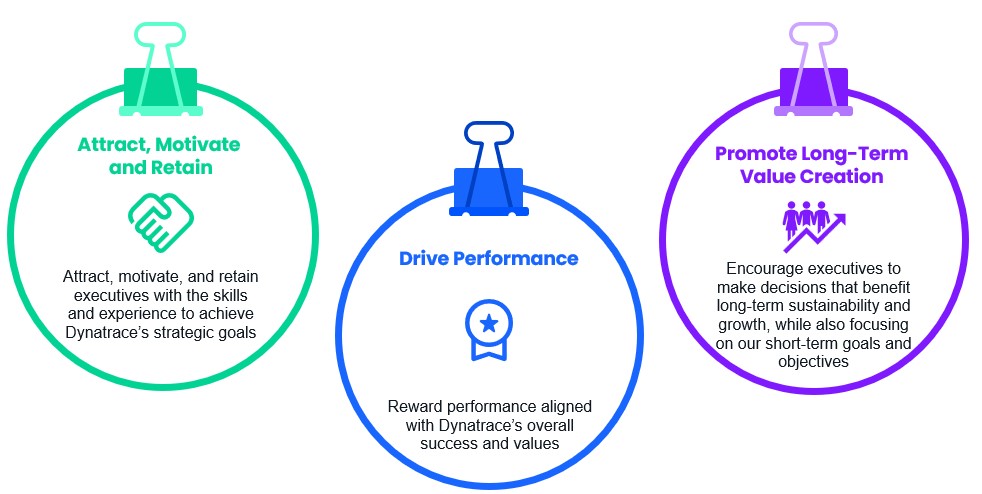
We provide our named executive officers with a significant portion of their compensation through variable incentive compensation determined based upon the achievement of financial performance metrics, and equity compensation, half of which is also determined based on achievement of performance goals.
Approximately 96% of our Chief Executive Officer’s target fiscal 2026 compensation and approximately 93% on average of our other named executive officers was variable or "at risk" and provided through STI and LTI awards. We consider these vehicles to be "at risk" because compensation ultimately earned depends on the achievement of performance goals and/or the value of our stock price.
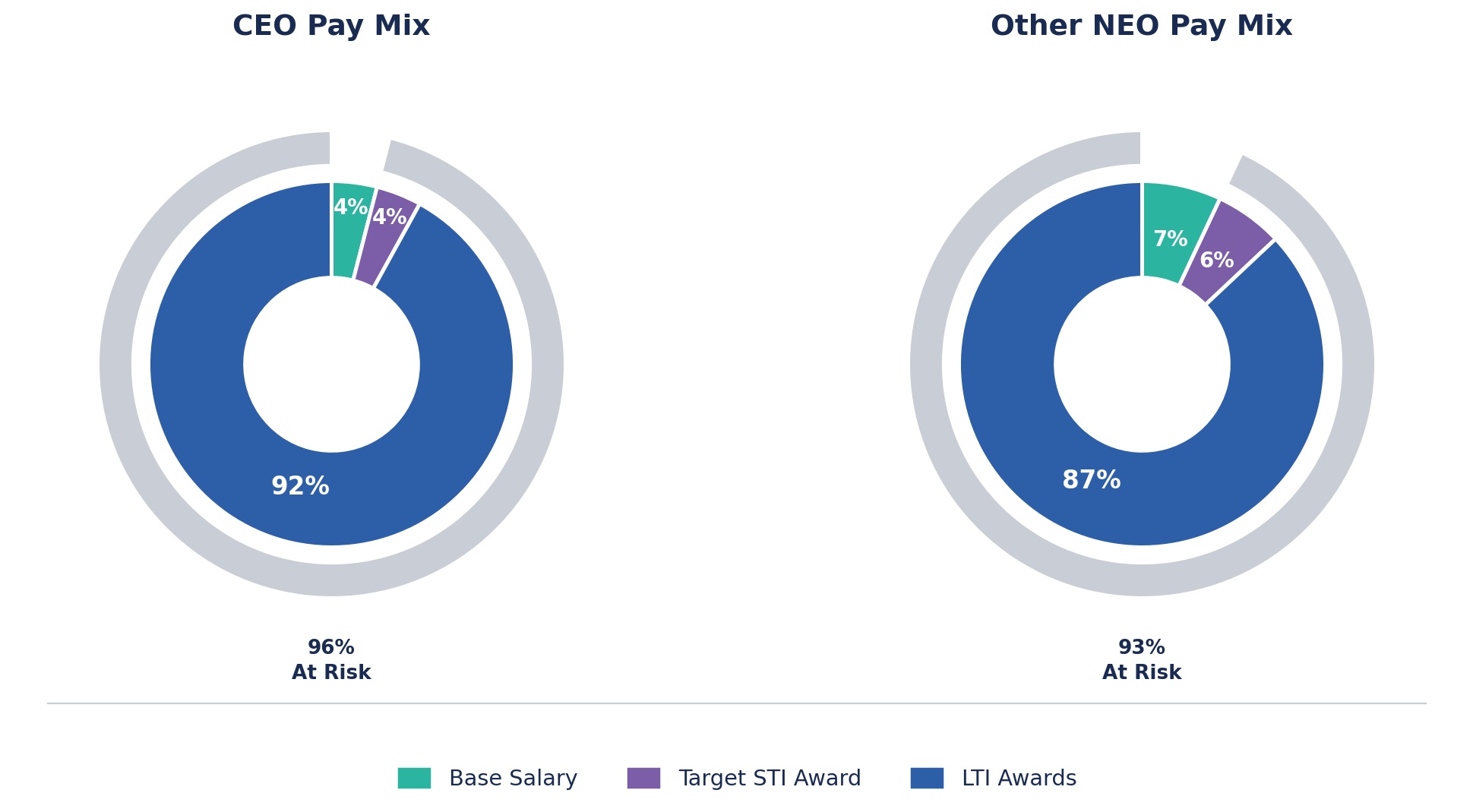
Compensation in the pay mix graphs above reflect at-target STI and LTI opportunities. LTI awards are valued using the NYSE closing price of $54.94 per share on June 5, 2025, which was the grant date for fiscal 2026 equity awards.
38
Executive Compensation Objectives and Design
The compensation of our named executive officers in fiscal 2026 consisted of the following components. We describe each of these components later in this section.
| Component | Purpose | Features | Type | Form | ||||||||||
| Base salary | Provides a fair and competitive base level of compensation for services rendered. | Fixed annual salary targeted at or around the 50th percentile of our peer group. | Fixed | Cash | ||||||||||
| Annual incentive bonus (STI) | Motivates and rewards for achievements relative to our goals and expectations for each fiscal year. | Bonus payment of a targeted amount contingent on achievement of corporate financial results, with payout on a sliding scale depending on over or under-achievement of corporate financial results. | Short-term variable | Cash | ||||||||||
| Equity awards (RSUs and PSUs) | Aligns executives’ interests with those of our stockholders and provides an incentive for our executives to remain with us. | Grants of restricted stock units, which are comprised of time-based RSUs, Financial PSUs, and rTSR PSUs. RSUs and PSUs vest over a three year period. | Long-term variable | Equity | ||||||||||
| Other benefits | Provides market-competitive benefits to enable our executives to maintain their health and welfare, and to save for their retirement. | Benefit plans such as medical, dental, and life and disability insurance plans; 401(k) plan, deferred compensation plan, and similar plans. We do not provide material executive perquisites or supplemental executive benefits. | Various | |||||||||||
On an annual basis, the Compensation Committee, with support from Compensia, Inc. ("Compensia"), its independent compensation consultant, undertakes a comprehensive review of our approach to executive compensation. This review incorporates market perspectives from our peer group companies as well as consideration given to our compensation objectives and desired emphasis on variable, at-risk compensation.
The Compensation Committee will continue to monitor our programs in the context of evolving market practice and our compensation objectives to ensure that we continue to attract, motivate and retain talented executives who can support our growth and long-term stockholder value creation.
In addition to our direct compensation elements, the following features of our compensation program are designed to align our executive team with stockholder interests and with market best practices:
| What We Do | What We Don’t Do | ||||||||||
ü | Deliver executive compensation primarily through performance-based pay and to the achievement of rigorous performance goals, with fixed payout caps | × | No hedging or pledging of equity | ||||||||
ü | Target pay evaluated annually in the context of our peer group and market practice | × | No excessive perquisites | ||||||||
ü | Maintain an industry-specific peer group for benchmarking pay | × | No supplemental executive retirement plans | ||||||||
ü | Offer market-competitive benefits for executives that are consistent with the rest of our employees | × | No tax gross-up payments for any change in control payments | ||||||||
ü | Maintain a clawback policy | × | No guaranteed increases to base salaries or incentive compensation opportunities | ||||||||
ü | Maintain stock ownership guidelines for our executive officers and directors | × | No inclusion of unvested PSUs, time-based RSUs, or unexercised stock options in the calculation of stock ownership guidelines | ||||||||
ü | Utilize an independent compensation consultant | ||||||||||
ü | Review compensation award design, principles and processes annually | ||||||||||
39
Consideration of Say-On-Pay Advisory Vote
In accordance with the requirements of Section 14A of the Exchange Act and the related rules of the SEC, our stockholders have the opportunity to cast an annual non-binding, advisory vote to approve the compensation of our named executive officers as disclosed pursuant to the SEC’s compensation disclosure rules which includes the "Say-on-Pay" vote. The Say-on-Pay vote gives our stockholders the opportunity to express their views on our named executive officers’ compensation. At our fiscal 2026 annual meeting of stockholders held in August 2025, approximately 92% of votes cast supported our executive compensation program.
Because we place very high value on the opinions of our stockholders, the Board and the Compensation Committee will consider the outcome of the Say-on-Pay vote described in Proposal No. 3 of this Proxy Statement, as well as feedback received from stockholders throughout the year, when making compensation decisions for our executive officers in the future. For example, in response to stockholder feedback on compensation matters, we introduced rTSR PSUs as a component of LTI awards granted to our executive officers in our fiscal 2025, and as a more recent example of our responsiveness to stockholder feedback, we increased the weighing of rTSR PSUs to 25% of the total LTI equity award mix in our fiscal 2027.
Governance of Our Executive Compensation Program

Role of our Compensation Committee and Board of Directors
The Compensation Committee discharges many of the responsibilities of our Board relating to the compensation of our executive officers, including our named executive officers. The Compensation Committee oversees and evaluates our compensation and benefits policies generally, and the compensation plans, policies, and practices applicable to our Chief Executive Officer and other executive officers. As described below, the Compensation Committee retains a compensation consultant to provide support in its review and assessment of our executive compensation program.
At the beginning of each fiscal year, the Compensation Committee reviews and approves the primary elements of compensation, including base salary increases, annual cash bonuses, and annual equity awards for each of our named executive officers. In addition, the Compensation Committee may deem it advisable to review and approve subsequent compensation arrangements for our executive officers, including our named executive officers.
Role of our Chief Executive Officer and Other Executive Officers
The Compensation Committee oversees the design and administration of our executive compensation program and makes all final decisions regarding executive compensation. In carrying out its responsibilities, our senior People and Culture and Legal executives support the Compensation Committee in designing our executive compensation program and analyzing competitive market practices. In addition, members of management, including our Chief Executive Officer and Chief People Officer, regularly participate in Compensation Committee meetings to provide input on our compensation philosophy and objectives.
Our Chief Executive Officer also evaluates the performance of our executive officers and provides recommendations to our Compensation Committee regarding the compensation of our executive officers (other than with respect to his own compensation). The Compensation Committee reviews and discusses these recommendations and proposals with our Chief Executive Officer and uses them as one factor in determining and approving the compensation for our named executive officers. None of our executive officers attend any portion of Compensation Committee meetings at which their compensation is discussed.
Role of the Compensation Consultant
For fiscal 2026, our Compensation Committee engaged Compensia as its independent compensation consultant to advise on executive compensation matters including: overall compensation program design, peer group development and updates, and benchmarking executive officer and director compensation programs. Compensia reports directly to our Compensation Committee. Our Compensation Committee has assessed the independence of Compensia consistent with NYSE listing standards and has concluded that the engagement of Compensia does not raise any conflict of interest.
40
Use of Competitive Market Data and Peer Groups
The Compensation Committee directs Compensia to provide it with competitive market data and analysis based on a select group of peer companies and published compensation survey data, as well as information about current market practices and trends, compensation structures and peer group compensation ranges. The competitive market data that Compensia provides is based on a compensation peer group selected and approved by the Compensation Committee with input and guidance from Compensia, and published compensation survey data in cases where there is insufficient data for specific executive positions with the peer group companies. The compensation peer group is comprised of companies that are considered similar to us at the time of selection based on industry, business model and type of software, and various financial criteria, including revenue, profitability, market capitalization and revenue growth rate.
Our compensation peer group is reviewed annually and adjusted as the Compensation Committee determines to be appropriate. For fiscal 2026, the selection criteria for our compensation peer group targeted comparable public software companies with annual revenues generally between approximately $750 million and $3.0 billion, and market capitalization generally between approximately $7.6 billion and $30.3 billion. When executive compensation for fiscal 2026 was set, our peer group as approved by our Compensation Committee was comprised of the following 18 companies:
| Aspen Technology | Elastic | MongoDB | Samsara | ||||||||
| Cloudflare | Fair Isaac | Nutanix | UiPath | ||||||||
| Commvault Systems | HubSpot | Okta | Zscaler | ||||||||
| Confluent | Informatica | Paylocity Holdings | |||||||||
| Datadog | Manhattan Associates | PTC | |||||||||
Aspen Technology, Commvault Systems, and Manhattan Associates were new additions to the peer group. Five9 was removed from the peer group due to having a lower market capitalization and Splunk was removed after it ceased to be a public company after its acquisition by Cisco. When the Compensation Committee initially discussed fiscal 2026 compensation in January 2025, Dynatrace ranked at the 48th percentile for revenue and 46th percentile for market capitalization.
Our executive compensation benchmarking also included survey data provided by Radford, a business unit of Aon Hewitt Consulting, representing publicly traded software companies with revenue levels and market capitalization levels comparable to ours. Radford did not provide compensation consulting services to the Compensation Committee during fiscal 2026.
In determining the compensation of our executive officers, our Compensation Committee considered the market data provided by Compensia, peer data supplemented by Radford survey data where peer benchmarks were not available, and other factors outlined below in “Compensation-Setting Factors.” The Compensation Committee generally does not specifically benchmark the compensation of any individual to a precise percentile within the range of compensation found in the market and survey data. In addition, the Compensation Committee does not have a set formula by which it determines how much of the named executive officer’s compensation is fixed rather than variable or at risk.
The Compensation Committee and the Board also considered other criteria, including market factors, the experience level of the executive, and the executive’s performance against established company and individual goals in determining variations to this general target range.
While we compete for executive talent with some of the companies in our peer group, due to the nature of our business and our industry, we also compete for executive talent with many other public companies that are larger and more established than we are or that possess greater resources than we do, and with smaller private companies that may be able to offer greater equity compensation potential.
Compensation-Setting Factors
The Compensation Committee reviews compensation annually for all our executive officers. In setting executive base salaries and bonuses and granting equity incentive awards, the Compensation Committee and the Board consider compensation for comparable positions in the market, the historical compensation levels of our executives, company-wide and individual performance as compared to our expectations and objectives, our desire to motivate our employees to achieve short and long-term results that are in the best interests of our stockholders, and the desire to incent a long-term commitment to our company. We target a general competitive position, based on independent third-party benchmark analytics to inform the mix of base salary, bonus and long-term equity incentives.
Our Compensation Committee has historically determined our executives’ compensation and consults with the full Board in determining the compensation of our Chief Executive Officer. Our Compensation Committee typically reviews and discusses
41
management’s proposed compensation with the Chief Executive Officer for all executives other than the Chief Executive Officer. Based on those discussions and its discretion, taking into account the factors noted above, the Compensation Committee discusses and ultimately approves the base salaries and cash incentive bonuses for our executive officers without members of management present. The Compensation Committee also reviews its decisions with the full Board, and considers any input received.
When reviewing and approving the amount of each compensation element and the target total compensation opportunity for our executive officers, the Compensation Committee considers the following factors:
•Our performance against the annual corporate goals established by the Compensation Committee and our Board in consultation with management;
•Each executive officer’s skills, experience, and qualifications relative to other similarly situated executives at the companies in our compensation peer group;
•The scope of each executive officer’s role compared to other similarly situated executives at the companies in our compensation peer group;
•The performance of each individual executive officer, based on an assessment of their contributions to our overall performance, ability to lead their department, and work as part of a team, all of which reflect our core values;
•Compensation parity among our executive officers;
•Our retention goals, and the potential difficulty of replacing the executive officer if they were to leave Dynatrace;
•Our financial performance relative to our peers;
•The compensation practices of our compensation peer group and the positioning of each executive officer’s compensation in a ranking of peer company compensation levels; and
•The recommendations provided by our Chief Executive Officer with respect to the compensation of our other executive officers.
These factors provide the framework for determining the compensation of each of our executive officers, including our named executive officers. The Compensation Committee does not assign relative weights or rankings to these factors, and does not consider any single factor as determinative in the compensation of our executive officers. Rather, the Compensation Committee and our Board, as applicable, rely on their own knowledge and judgment in assessing these factors and making compensation decisions.
Primary Elements of Executive Compensation Program
Base Salary
We provide base salaries to our named executive officers to provide them with a fair and competitive base level of compensation for services rendered during the year. Base salaries may be adjusted in the event of a promotion or significant change in responsibilities.
Fiscal 2026 Base Salary
The table below sets forth the base salary for each of our named executive officers as of March 31, 2026 and 2025. After evaluating the competitive positioning of our named executive officers’ base salaries in the context of our overall compensation philosophy, the Compensation Committee approved base salary increases in local currency between approximately 2.4% and 3.1% for fiscal 2026. Annual base salary increases were in line with market increases.
| Base Salary | |||||||||||
| Name | Fiscal 2025 | Fiscal 2026 | % Change | ||||||||
| Rick McConnell | $675,000 | $695,000 | 3.0% | ||||||||
Jim Benson | $505,000 | $520,000 | 3.0% | ||||||||
Dan Zugelder | $490,000 | $505,000 | 3.1% | ||||||||
Bernd Greifeneder(1) | EUR 412,212 | EUR 422,000 | 2.4% | ||||||||
Steve McMahon(2) | - | $450,000 | - | ||||||||
42
(1)Bernd Greifeneder is paid his base salary in Euros. Bernd Greifeneder’s base salary converted to U.S. dollars was $445,931 for fiscal 2025 and $483,950 for fiscal 2026, based on an exchange rate of EUR 1.00:USD 1.0818 as of March 31, 2025 and EUR 1.00:USD 1.1468 as of March 31, 2026, respectively.
(2)Steve McMahon joined our company during fiscal 2026. The determination of his base salary is discussed later in this Proxy Statement.
Annual STI Awards
Our annual STI plan motivates and rewards our executives for achievements relative to our goals and expectations for each fiscal year. Each named executive officer has a target bonus opportunity, defined as a percentage of his annual base salary. Target annual bonuses are determined with respect to the same corporate objectives and formula for all of our executive officers, including our named executive officers, who are at the same level, and represent a specific percentage of annual base salary.
Fiscal 2026 Target Annual Bonuses
In the first quarter of fiscal 2026, the Compensation Committee reviewed and approved the fiscal 2026 target annual bonuses of our named executive officers below:
Target Annual Bonus (% of Base Salary) | ||||||||
| Name | Fiscal 2025 | Fiscal 2026 | ||||||
| Rick McConnell | 100% | 100% | ||||||
| Jim Benson | 75% | 75% | ||||||
| Dan Zugelder | 100% | 100% | ||||||
| Bernd Greifeneder | 70% | 70% | ||||||
| Steve McMahon | - | 70% | ||||||
Fiscal 2026 STI – Financial Performance Targets
The Compensation Committee designed our company’s STI plan for fiscal 2026 to align the interests of our executives with those of our investors and reward performance that would increase the value of the company to our stockholders. Accordingly, in June 2025, the Compensation Committee decided that payments under the fiscal 2026 STI plan would depend on the company's achievement of:
| Metric | Weighting | Rationale / Why We Use This Metric | ||||||
| Annual Recurring Revenue (ARR) | 65% | We define ARR as the daily revenue of all subscription agreements that are actively generating revenue as of the last day of the reporting period multiplied by 365. We exclude from our calculation of ARR any revenues derived from month-to-month agreements and/or product usage overage billings. ARR performance is evaluated on a constant currency basis. | ||||||
| Non-GAAP Operating Income (NGOI) | 35% | Non-GAAP Operating Income is GAAP income from operations adjusted for the following items: share-based compensation; employer payroll taxes on employee stock transactions; amortization of intangibles; transaction, restructuring and other non-recurring or unusual items that may arise from time to time. We also refer to this measure as Non-GAAP Income from Operations in some of our press releases and SEC filings. | ||||||
Threshold Performance (50% Payout) | Target Performance (100% Payout) | Maximum Performance (150% Payout) | |||||||||||||||||||||
| Measure | Percentage | Value | Percentage | Value | Percentage | Value | Weighting | ||||||||||||||||
| ARR | 95% | $1,894,015,000 | 100% | $1,993,700,000 | 105% | $2,093,385,000 | 65% | ||||||||||||||||
| Non-GAAP Operating Income | 90% | $524,610,000 | 100% | $582,900,000 | 110% | $641,190,000 | 35% | ||||||||||||||||
Under the 2026 STI plan, no bonus was payable with respect to a particular measure (ARR or NGOI) if the percentage achievement was below the threshold indicated above (95% or 90%, respectively). If either ARR or NGOI was achieved at or above the threshold value/percentage indicated above, the payout with respect to those measures was between 50% and 150% of the target bonus, interpolated on a straight-line basis. The maximum total payout could not exceed 150% of the executives' on-target bonuses.
Fiscal 2026 STI Results
43
In May 2026, the Compensation Committee determined that our company’s financial performance was equal to 100.8% and 101.5% of ARR and NGOI targets for fiscal 2026, respectively. Our named executive officers earned 102.7% of their target annual STI award, which reflected the Compensation Committee's exercise of discretion under the STI plan to cap STI payouts for the ARR metric at target, notwithstanding above-target achievement. Actual performance for ARR is reported based on foreign exchange rates used in our Board-approved fiscal 2026 plan, which differ from rates used in our external reporting of financial results.
Target Performance | Actual Performance | Actual Performance as a Percentage of Target | Payout Percentage | Weighting | Payout Percentage | |||||||||||||||
| ARR | $1,993,700,000 | $2,009,000,000 | 100.8% | 100.0% | 65% | 102.7% | ||||||||||||||
| Non-GAAP Operating Income | $582,900,000 | $591,900,000 | 101.5% | 107.7% | 35% | |||||||||||||||
Fiscal 2026 STI Payouts
In light of the achievement under the 2026 STI plan, the percentage of base salary and the actual cash incentive bonus amounts as a percentage of base salary that were approved by our Compensation Committee and paid to our named executive officers are set forth in the table below.
Name | Target Award (% of Base Salary) | Target Award Opportunity | Actual Award Payment | Award Payment as a Percentage of Target | ||||||||||
| Rick McConnell | 100% | $695,000 | $713,765 | 102.7% | ||||||||||
| Jim Benson | 75% | $390,000 | $400,530 | 102.7% | ||||||||||
| Dan Zugelder | 100% | $505,000 | $518,635 | 102.7% | ||||||||||
Bernd Greifeneder(1) | 70% | $338,765 | $347,911 | 102.7% | ||||||||||
Steve McMahon(2) | 70% | $279,616 | $287,166 | 102.7% | ||||||||||
(1) Bernd Greifeneder's STI award is paid in Euros. The amounts reported in this table is based on an exchange rate of EUR 1.00:USD 1.1468 as of March 31, 2026.
(2) Steve McMahon joined Dynatrace on May 12, 2025 and his STI payout was prorated based on the number of days that he worked for our company during fiscal 2026.
LTI Awards
Our LTI program is designed to:
•align executives’ interests with those of our stockholders by providing incentives (restricted stock units) that will increase in value if our share price rises;
•align executives' interests with those of our stockholders by providing incentives (PSUs) having a value that depends on achievement of corporate financial measures (ARR, revenue and NGOI) and stock price performance relative to a broad index of publicly traded companies; and
•provide a meaningful retention incentive for our executives to remain with us for the long-term.
The market for qualified and talented executives is highly competitive and we compete for talent with many companies that have greater resources than we do. Accordingly, we believe equity compensation is a crucial component of any competitive executive compensation package we offer. In this Proxy Statement, references to “restricted stock units” are to PSUs and time-based RSUs collectively.
44
Equity Awards: Restricted Stock Units (RSUs and PSUs)
Annual 2026 Equity Awards
For annual equity awards to our executives in fiscal 2026, our Compensation Committee granted:
•50% in the form of PSUs (which were split between 30% Financial PSUs and 20% rTSR PSUs); and
•50% in the form of time-based RSUs.
The target LTI award for each participant was expressed as a U.S. dollar value, with the final number of PSUs and RSUs granted calculated based on the trailing 30-day average closing price as reported on the NYSE through the date of grant.
The following table sets forth the target number of PSUs and the number of RSUs granted to our named executive officers as part of fiscal 2026 annual equity awards:
Name | Grant Date | Grant Date Target Value (1) | Financial PSUs (# of Shares at Target) | rTSR PSUs (# of Shares at Target) | Time-Based RSUs (# of Shares) | ||||||||||||
| Rick McConnell | June 5, 2025 | $16,500,000 | 97,059 | 64,706 | 161,765 | ||||||||||||
| Jim Benson | June 5, 2025 | $6,000,000 | 35,295 | 23,530 | 58,824 | ||||||||||||
| Dan Zugelder | June 5, 2025 | $5,000,000 | 29,412 | 19,608 | 49,020 | ||||||||||||
| Bernd Greifeneder | June 5, 2025 | $4,600,000 | 27,059 | 18,040 | 45,099 | ||||||||||||
Steve McMahon (2) | June 5, 2025 | $9,500,000 | 55,883 | 37,255 | 93,138 | ||||||||||||
(1)The amounts in this column differ from amounts reflected in the Summary Compensation Table's "Stock Awards" column due to differences in determining grant date value.
(2)Reflects a sign-on equity award to Steve McMahon.
Time-Based RSUs
The RSUs granted on June 5, 2025 to all of our named executive officers except Steve McMahon vest over three years, with 33% of the units vesting on the first anniversary of the date of grant and the remainder vesting in equal quarterly installments over the following two years, provided that the executive officer remains employed by the company through the applicable vesting dates. The RSUs granted on June 5, 2025 to Steve McMahon vest over four years, with 25% of the units vesting on the first anniversary of the date of grant and the remainder vesting in equal quarterly installments over the following three years, provided that Steve remains employed by the company through the applicable vesting dates.
Financial PSUs
The Financial PSUs granted on June 5, 2025 to all of our named executive officers except Steve McMahon vest over three years and included a one-year financial performance period, with 33% of the earned Financial PSUs vesting on the first anniversary of the grant date or, if later, the date on which achievement of the Financial PSU metrics is determined for the performance period, and the remainder vesting in equal quarterly installments over the following two years. The Financial PSUs granted on June 5, 2025 to Steve McMahon vest over four years and included a one-year financial performance period, with 25% of the earned Financial PSUs vesting on the first anniversary of the grant date or, if later, the date on which achievement of the Financial PSU metrics is determined for the performance period, and the remainder vesting in equal quarterly installments over the following three years.
Our Financial PSUs have a one year financial performance period given the dynamic nature of our industry and operating environment, and based on an analysis from the Compensation Committee's compensation consultant that our practice is in line with comparable peers.
The number of shares that could be earned pursuant to the Financial PSUs was based 40% upon the company’s achievement of an ARR target, 40% upon the company’s achievement of a revenue target, and 20% upon the company’s achievement of an NGOI target. The table below sets forth the threshold, target, and maximum ARR, revenue, and NGOI goals for the Financial PSUs.
45
Threshold Performance (0% Payout) | Target Performance (100% Payout) | Maximum Performance (200% Payout) | |||||||||||||||||||||
| Measure | Percentage | Value | Percentage | Value | Percentage | Value | Weighting | ||||||||||||||||
| ARR | 95% | $1,894,015,000 | 100% | $1,993,700,000 | 105% | $2,093,385,000 | 40% | ||||||||||||||||
| Revenue | 95% | $1,867,890,000 | 100% | $1,966,200,000 | 105% | $2,064,510,000 | 40% | ||||||||||||||||
| Non-GAAP Operating Income | 90% | $524,610,000 | 100% | $582,900,000 | 110% | $641,190,000 | 20% | ||||||||||||||||
The table below sets forth the actual ARR, revenue, and NGOI results for fiscal 2026 and achievement of the ARR, revenue and NGOI goals as a percentage of target. Actual performance for ARR and revenue is reported based on foreign exchange rates used in our Board-approved fiscal 2026 plan, which differ from rates used in our external reporting of financial results.
Target Performance | Actual Performance | Actual Performance as a Percentage of Target | Payout Percentage | Weighting | Payout Percentage | |||||||||||||||
| ARR | $1,993,700,000 | $2,009,000,000 | 100.8% | 115.4% | 40% | 114.0% | ||||||||||||||
| Revenue | $1,966,200,000 | $1,977,800,000 | 100.6% | 111.8% | 40% | |||||||||||||||
| Non-GAAP Operating Income | $582,900,000 | $591,900,000 | 101.5% | 115.5% | 20% | |||||||||||||||
In May 2026, the Compensation Committee determined that the company performance was equal to 100.8%, 100.6%, and 101.5% of ARR, revenue, and NGOI targets for the fiscal year, respectively. As a result, the weighted payout for the Financial PSUs was equal to 114.0% of target.
rTSR PSUs
rTSR PSUs granted on June 5, 2025 were based on the company’s stock price performance relative to companies that are the constituents of the Russell 3000 Index over performance periods of one, two, and three fiscal years that began on April 1, 2025 and end on March 31, 2026, March 31, 2027, and March 31, 2028, respectively. The Compensation Committee selected rTSR as a performance measure to align a portion of executive pay with stockholder value creation. The number of rTSR PSUs that a named executive officer can receive in each performance period ranges from 0% to 200% of target and is based on one‑third of the total number of rTSR PSUs granted, multiplied by the applicable payout percentage of target, as determined by a pre‑established scale based on the company’s rTSR percentile rank in comparison to companies that are constituents of the Russell 3000 Index for the applicable performance period. The rTSR PSUs for the one‑year performance period ending March 31, 2026 (fiscal 2026) vested on June 5, 2026. The earning of the remaining two‑thirds of the rTSR PSUs granted on June 5, 2025 will be dependent on the Company’s performance for the two‑ and three‑year performance periods that started on April 1, 2025 and end on March 31, 2027 and March 31, 2028, respectively. Vesting of the two‑year and three‑year performance periods will be on June 5, 2027 and June 5, 2028, respectively.
The following table sets forth payout information for the rTSR PSUs. Payout for achievement between performance levels is determined on a linear, interpolated basis.
Performance Level | Percentile Rank | Payout Percentage of Target | ||||||
| Maximum | Greater or equal to 75th | 200% | ||||||
| Target | 50th | 100% | ||||||
| Threshold | 25th | 50% | ||||||
| Below Threshold | Below 25% | 0% | ||||||
For the rTSR PSUs for the one year performance period that started on April 1, 2025 and ended on March 31, 2026 (fiscal 2026), the Compensation Committee determined that based on the company's 18th rTSR percentile rank, the threshold performance had not been met, and no payout would be made.
46
rTSR PSUs granted on June 5, 2024 were based on the Company’s stock price performance relative to companies that are the constituents of the Russell 3000 Index over performance periods of one, two, and three fiscal years that began on April 1, 2024 and end on March 31, 2025, March 31, 2026, and March 31, 2027, respectively. For the rTSR PSUs for the two year performance period that started on April 1, 2024 and ended on March 31, 2026 (fiscal 2025 and fiscal 2026), the Compensation Committee determined that based on the company's 31st rTSR percentile rank, the applicable payout percentage was 61.5% of target.
Benefits and Other Compensation
Health and Welfare Benefits
Our executive officers, including our named executive officers, are eligible to participate in the same employee benefit plans that are generally available to all of our employees working in the same country, subject to the satisfaction of certain eligibility requirements, such as medical, dental, and life and disability insurance plans. We pay, on behalf of our employees, all or a portion of the premiums for health, life, and disability insurance.
Retirement Savings Plans
We maintain a tax-qualified 401(k) retirement plan for eligible employees in the United States to save for retirement on a tax advantaged basis. Under our 401(k) plan, employees may elect to defer up to 90% of their eligible compensation subject to applicable annual limits set pursuant to the Internal Revenue Code. Our 401(k) plan permits participants to make both pre-tax and certain after-tax (Roth) deferral contributions. The retirement plan is intended to qualify under Section 401(a) of the Internal Revenue Code. We match 50% of employees’ contributions to the 401(k) plan up to 6% of compensation. Employees are 100% vested in their contributions to the 401(k) plan.
Deferred Compensation Plan
We offer a non-qualified deferred compensation plan ("Deferred Compensation Plan") which provides eligible U.S. employees with the opportunity to defer up to 75% of their eligible base salary, up to 100% of their eligible fiscal year bonus, and up to 100% of eligible commissions in excess of the limits imposed on the 401(k) plan by the Internal Revenue Code. Account balances under the Deferred Compensation Plan are credited with income, gains and losses based on the performance of investment funds selected by the participant from a list of funds designated by us. Rick McConnell, Jim Benson, Dan Zugelder, and Steve McMahon are eligible to participate in this plan. All of the members of our Board are eligible to participate in this plan. During fiscal 2026, Rick McConnell and Jim Benson were the only named executive officers participating in this plan and Michael Capone was the only director participating in the plan. We do not make matching contributions under the Deferred Compensation Plan. In addition, although we are permitted to make discretionary contributions, we have not made any contributions to the Deferred Compensation Plan to date.
Perquisites
Currently, we do not view perquisites or other personal benefits as a significant component of our executive compensation program. Accordingly, we provide a limited amount of perquisites to our named executive officers. In the future, we may continue to provide perquisites or other personal benefits in limited circumstances, such as where we believe it is appropriate to assist an individual named executive officer in the performance of their duties, to make them more efficient and effective, and for recruitment, motivation or retention purposes.
Employment Agreements
We have entered into employment agreements with each of our named executive officers, which provide assurances of specified benefits to our named executive officers in the event of an involuntary termination of their employment for reasons other than for death, disability, or in the case of cause or a voluntary termination of their employment for good reason, in either case, under the circumstances described in their employment agreements. The terms of these agreements were developed with input from Compensia regarding severance practices at comparable companies, and are designed to attract, retain, and reward senior level employees.
We believe that these protections serve our retention objectives by helping our named executive officers and other key employees maintain continued focus and dedication to their responsibilities to maximize stockholder value, including in the event of a transaction that could result in a change in control of the company. For more information, see the section of this Proxy Statement entitled “Potential Payments Upon Termination or Change in Control.”
47
Other Compensation Practices and Policies
Executive Stock Ownership Guidelines
We have equity ownership guidelines to further align the interests of our executive officers with those of our stockholders. Under the guidelines, our Chief Executive Officer is expected to hold common stock valued at a multiple of five times his base salary and our other executive officers are expected to hold common stock valued at a multiple of two times their base salary. For purposes of these guidelines, stock ownership only includes shares for which the executive has direct or indirect ownership or control, but does not include unexercised stock options, unvested restricted stock units, and other unvested, unsettled and/or unexercised equity awards. Executives are expected to meet their ownership guidelines within five years of becoming subject to the guidelines. Compliance with this requirement will be determined on an annual basis on the last day of each fiscal year beginning on March 31, 2027.
Clawback Policy
We have a Compensation Recovery Policy (the “Clawback Policy”) that complies with NYSE listing rules. The Clawback Policy provides that if we are required to prepare a restatement of our previously-issued financial statements due to our material non-compliance with any financial reporting requirement under the securities laws, including any required accounting restatement to correct an error in previously-issued financial statements that is material to the previously-issued financial statements or that would result in a material misstatement if the error were corrected in the current period or left uncorrected in the current period, then we will, subject to certain limited exceptions described in the Clawback Policy and permitted under final NYSE listing rules, recover any "Erroneously Awarded Compensation" from any current or former executive officer. For purposes of the Clawback Policy, "Erroneously Awarded Compensation" means the amount of any "Incentive-Based Compensation" received by an executive officer on or after the effective date of the Clawback Policy and during the three fiscal years immediately preceding the date that we are required to restate our financial restatements that was in excess of the amount the executive officer would have received if the compensation had been calculated based on the financial results reported in the restated financial statements. "Incentive-Based Compensation" means any compensation provided that is granted, earned, or vested based in whole or in part upon the attainment of a financial reporting measure. The Clawback Policy amended and restated our previous policy, which continues to apply to incentive-based compensation received prior to October 2, 2023 (the effective date of the Clawback Policy).
Policy on Trading, Pledging, and Hedging of Company Stock
We have adopted an insider trading policy and related Rule 10b5-1 trading plan policy, which we believe are reasonably designed to promote compliance with applicable insider trading laws, rules, regulations, and NYSE listing standards. It is also our company’s policy to comply with applicable insider trading laws, rules, and regulations, and NYSE listing standards when engaging in transactions in company securities.
Our insider trading policy prohibits our officers, directors, employees, designated consultants, and their affiliated persons from trading in company securities while in possession of material nonpublic information about our company. The policy also prohibits tipping (i.e., disclosing material nonpublic information about our company to others who may trade of the basis of that information).
Under our insider trading policy, designated insiders may only trade in company securities during open trading windows at a time when they do not possess material nonpublic information about our company. We also require our executive officers, directors, and certain other employees to receive approval before trading in company securities. Our insider trading policy also expressly prohibits short sales; purchases or sales of puts, calls, or other derivative securities or hedging transactions; using company securities as collateral in a margin account; or pledging company securities as collateral for a loan.
Any waiver of the provisions of this policy requires the approval of our Audit Committee. To date, no such requests have been made or approved.
We have adopted an additional policy that governs adoption, modification and termination of written securities trading plans, known as Rule 10b5-1 plans, by our directors, executive officers and certain other persons ("Covered Persons"). These plans are intended to take advantage of a safe harbor provided under SEC rules from liability for violating federal antifraud prohibitions that proscribe certain insider trading, including Section 10(b) of the Exchange Act. A qualifying Rule 10b5-1 plan may only be entered into when the individual is not in possession of material nonpublic information about the company and must authorize a broker to buy or sell shares of our common stock on a periodic basis pursuant to parameters established by the Covered Person when entering into the plan, without further direction from them. A Covered Person may amend or terminate a Rule 10b5-1 plan in certain circumstances. Our policy provides that all Rule 10b5-1 plans must comply with SEC rules applicable to the Rule 10b5-1 safe harbor and imposes additional requirements and limitations. A Covered Person also may buy or sell additional shares outside of a Rule 10b5-1 plan when they are not in possession of material nonpublic information, subject to compliance with the terms of our insider trading policy.
48
Equity Award Grant Policy
Our annual equity awards are granted after our fourth quarter and fiscal year financial results have been announced publicly, within a trading window under our company's insider trading policy. Grants of annual equity awards to current employees will be made during our first fiscal quarter, effective on June 5, and are approved by the Compensation Committee.
Grants of off-cycle equity awards for new hires, promotions, or retention are generally made once per month effective on or around the 15th day of each month. The Compensation Committee also has authority to grant off-cycle equity awards. The Board has delegated the Chief Executive Officer with non-exclusive authority to grant up to a specified dollar amount of annual RSU awards and a specified dollar amount of off-cycle new hire, promotion and retention-related RSUs and PSUs during each fiscal year of the company to employees who are below the Senior Vice President level and not otherwise Section 16 officers of the company (which include all of our executive officers). Unless otherwise approved by the Compensation Committee, any annual awards approved by the Chief Executive Officer during a fiscal year must be granted in accordance with award-related guidelines approved from time to time by the Board or the Compensation Committee. Similarly, unless otherwise approved by the Compensation Committee, any such off-cycle awards approved by the Chief Executive Officer during a fiscal year must reflect grants per individual employee that are not in excess of the greater of a specified maximum dollar amount or the applicable maximum value per range (depending on level in our company) and otherwise are granted in accordance with award-related guidelines approved from time to time by the Board or the Compensation Committee.
For grants of RSUs and PSUs to named executive officers in fiscal 2026, the number of shares subject to each equity award was calculated by dividing the dollar value of the approved award by the 30-day closing price average of our common stock on the NYSE through the day of grant, rounded up to the nearest one unit. For grants of RSUs and PSUs to named executive officers in fiscal 2027, the number of shares subject to each equity award will be calculated by dividing the dollar value of the approved award by the closing price of our common stock on the NYSE on the day of grant, rounded up to the nearest one unit, provided that, to the extent it determines necessary or advisable, the Compensation Committee may utilize a different methodology. For any grants of stock options, the exercise price will be equal to (or, if specified in the approval of a stock option award, greater than) the closing market price on the NYSE of one share of our common stock on the effective date of the grant, or, if no closing price is reported for such date, the closing price on the last preceding date for which a closing price is reported.
Under our policy, any grants of equity awards that are stock options, stock appreciation rights, or similar option-like awards will only be granted to an executive officer during a trading window under our company's insider trading policy and on a date that is two business days after our company files a Form 10-K, Form 10-Q, or Form 8-K that includes material nonpublic information (including, without limitation, earnings information). We did not grant any stock options, stock appreciation rights, or similar option-like awards in fiscal 2026.
Tax and Accounting Considerations
Deductibility of Executive Compensation
Section 162(m) of the Internal Revenue Code generally imposes limitations on the deductibility for corporate federal income tax purposes of remuneration in excess of $1 million paid to certain executive officers and other individuals. As a result, we expect that compensation awarded to our U.S.-based named executive officers will not be deductible to the extent it exceeds the $1 million threshold.
In designing our executive compensation program and determining the compensation of our executive officers, including our named executive officers, the Compensation Committee considers a variety of factors, including the potential impact of the deduction limit under Section 162(m) of the Internal Revenue Code. However, the Compensation Committee will not necessarily limit executive compensation to that which is or may be deductible under Section 162(m) of the Internal Revenue Code. The Compensation Committee will consider various alternatives to preserving the deductibility of compensation payments and benefits to the extent consistent with its compensation goals. The Compensation Committee believes that our stockholders’ interests are best served if its discretion and flexibility in awarding compensation is not restricted, even though some compensation awards may result in non-deductible compensation expense.
49
Taxation of “Parachute” Payments
Sections 280G and 4999 of the Internal Revenue Code provide that executive officers and directors who hold significant equity interests and certain other service providers may be subject to significant additional taxes if they receive payments or benefits in connection with a change in control of the company that exceeds certain prescribed limits, and that the company (or a successor) may forfeit a deduction on the amounts subject to this additional tax. We have not agreed to provide any executive officer, including any named executive officers, with a “gross-up” or other reimbursement payment for any tax liability that the executive officer might owe as a result of the application of Sections 280G or 4999 of the Internal Revenue Code.
Section 409A of the Internal Revenue Code
Section 409A of the Internal Revenue Code imposes additional significant taxes in the event that an executive officer, director, or service provider receives “deferred compensation” that does not satisfy the requirements of Section 409A of the Internal Revenue Code. Section 409A of the Internal Revenue Code applies to our Deferred Compensation Plan and may apply to certain severance arrangements, bonus arrangements, and equity awards. We structure all our severance arrangements, bonus arrangements, and equity awards in a manner to either avoid the application of Section 409A or, to the extent doing so is not possible, to comply with the applicable requirements of Section 409A.
Accounting for Stock-Based Compensation
We follow Financial Accounting Standards Board Accounting Standards Codification Topic 718 Compensation—Stock Compensation (“ASC 718”) for our stock-based compensation awards. ASC 718 requires us to measure the compensation expense for all share-based payment awards made to our employees and non-employee members of our Board, including stock options and restricted stock unit awards, based on the grant date “fair value” of these awards. This calculation is performed for accounting purposes and reported in the executive compensation tables required by the federal securities laws, even though the recipient of the awards may never realize any value from their awards.
Compensation Risk Assessment
We believe that our executive compensation program does not encourage excessive or unnecessary risk taking. As described more fully above, we structure our pay to consist of both fixed and variable compensation. We believe this structure motivates our executives to produce superior short- and long-term results that are in the best interests of our company and stockholders in order to attain our ultimate objective of increasing stockholder value, and we have established, and our Compensation Committee endorses, several controls to address and mitigate compensation related risk. As a result, we do not believe that our compensation programs are reasonably likely to have a material adverse effect on us.
REPORT OF THE COMPENSATION COMMITTEE
The Compensation Committee has reviewed and discussed the Compensation Discussion and Analysis section of this Proxy Statement with management. Based on the review and discussions, the Compensation Committee recommended to the Board of Directors that the Compensation Discussion and Analysis section be included in this Proxy Statement, which is incorporated by reference in our Annual Report on Form 10-K for the fiscal year ended March 31, 2026.
THE COMPENSATION COMMITTEE OF THE BOARD
OF DIRECTORS OF DYNATRACE, INC.
Michael Capone, Chair
Amol Kulkarni
Stephen Lifshatz
The information contained in this report shall not be deemed to be (1) “soliciting material”; (2) “filed” with the SEC; (3) subject to Regulations 14A or 14C of the Exchange Act; or (4) subject to the liabilities of Section 18 of the Exchange Act. This report shall not be deemed incorporated by reference into any of our other filings under the Exchange Act or the Securities Act, except to the extent that we specifically incorporate it by reference into such filing.
50
EXECUTIVE COMPENSATION
Summary Compensation Table
The following table presents the compensation awarded to, earned by, and paid during the fiscal years ended March 31, 2026, 2025, and 2024 for each of our named executive officers.
Name and Principal Position | Year | Salary ($)(1) | Bonus ($)(2) | Stock Awards ($)(3) | Non-Equity Incentive Plan Compensation ($)(4) | All Other Compensation ($)(6) | Total ($) | ||||||||||||||||
Rick McConnell Chief Executive Officer | 2026 | 695,000 | - | 19,790,764 | 713,765 | 34,924 | 21,234,453 | ||||||||||||||||
| 2025 | 675,000 | - | 18,000,733 | 671,828 | 32,787 | 19,380,348 | |||||||||||||||||
| 2024 | 655,000 | - | 15,896,813 | 696,265 | 31,556 | 17,279,634 | |||||||||||||||||
Jim Benson EVP, Chief Financial Officer and Treasurer | 2026 | 520,000 | - | 7,196,753 | 400,530 | 15,762 | 8,133,045 | ||||||||||||||||
| 2025 | 505,000 | - | 6,000,311 | 376,970 | 15,737 | 6,898,018 | |||||||||||||||||
| 2024 | 490,000 | - | 5,393,626 | 390,653 | 13,637 | 6,287,916 | |||||||||||||||||
Dan Zugelder EVP, Chief Revenue Officer | 2026 | 505,000 | - | 5,997,238 | 518,635 | 58,115 | 7,078,988 | ||||||||||||||||
| 2025 | 490,000 | - | 5,018,402 | 487,697 | 27,313 | 6,023,412 | |||||||||||||||||
| 2024 | 352,292 | 250,000 | 13,348,691 | 374,486 | 2,190 | 14,327,659 | |||||||||||||||||
Bernd Greifeneder (5) EVP, Chief Technology Officer | 2026 | 483,950 | - | 5,517,545 | 347,911 | 1,486 | 6,350,892 | ||||||||||||||||
| 2025 | 445,931 | - | 5,018,402 | 310,696 | 282 | 5,775,311 | |||||||||||||||||
| 2024 | 429,512 | - | 4,825,814 | 319,600 | 17,433 | 5,592,359 | |||||||||||||||||
Steve McMahon EVP, Chief Customer Officer | 2026 | 400,568 | - | 11,394,746 | 287,166 | 13,712 | 12,096,192 | ||||||||||||||||
(1)Reflects base salaries earned for the applicable fiscal year. Dan Zugelder's base salary for fiscal 2024 reflects the amount that he earned from his start date at our company through the end of that fiscal year. Steve McMahon's base salary for fiscal 2026 reflects the amount that he earned from his start date at our company through the end of that fiscal year.
(2)Amounts reported in this column for Dan Zugelder reflect a cash sign-on bonus paid to him in fiscal 2024 in connection with joining our company.
(3)Amounts reported in this column do not reflect stock award compensation actually received by each named executive officer. The amounts reported in this column reflect the aggregate grant date fair value of time-based RSUs, Financial PSUs, and rTSR PSUs granted to our named executive officers during the fiscal years ended March 31, 2026, 2025, and 2024, computed in accordance with FASB ASC Topic 718. These aggregate grant date fair values do not take into account any estimated forfeitures related to service-vesting conditions. The assumptions used in calculating the grant date fair value of the restricted stock units reported in this column are set forth in note 15 to our audited consolidated financial statements included in our Annual Report on Form 10-K for the fiscal year ended March 31, 2026, which was filed with the SEC on May 20, 2026. The amounts reported in this column reflect the accounting cost for these stock awards and may not correspond to the actual economic value that will be received by the named executive officers upon vesting of the awards. Stock awards for Dan Zugelder in fiscal 2024 and Steve McMahon in fiscal 2026 include their respective sign-on awards.
The aggregate grant date fair value of Financial PSUs granted in fiscal 2026 is reported at the probable outcome, which is assumed to be the target level of performance. The aggregate grant date fair value of Financial PSUs granted during fiscal 2026, assuming maximum achievement (200%), was $10,664,843 for Rick McConnell, $3,878,215 for Jim Benson, $3,231,791 for Dan Zugelder, $2,973,243 for Bernd Greifeneder, and $6,140,424 for Steve McMahon. For rTSR PSUs granted in fiscal 2026, the achievement of rTSR is considered a market condition, and the effect of that market condition is reflected in the aggregate grant date fair value of these units. We calculate the aggregate grant date fair value of the rTSR PSUs using the Monte Carlo simulation model to account for the market condition. This requires the input of assumptions, including the fair value of our underlying common stock, the expected performance period of the award, the expected volatility of the price of the company’s and peer group’s common stock, risk-free interest rates, and the expected dividend yield of the company’s common stock. The aggregate grant date value of rTSR PSUs granted during fiscal 2026, assuming maximum achievement (200%), was $7,109,895 for Rick McConnell, $2,585,476 for Jim Benson, $2,154,527 for Dan Zugelder, $1,982,235 for Bernd Greifeneder, and $4,093,579 for Steve McMahon. These amounts reflect the grant date share price multipled by the number of rTSR PSUs granted, which is then multipled by 200%.
The aggregate grant date fair value of Financial PSUs granted during fiscal 2025, assuming maximum achievement (200%), was $9,908,484 for Rick McConnell, $3,302,890 for Jim Benson, $2,762,336 for Dan Zugelder, and $2,762,336 for Bernd Greifeneder. The aggregate grant date value of rTSR PSUs granted during fiscal 2025, assuming maximum achievement (200%), was $6,605,687 for Rick McConnell, $2,201,896 for Jim Benson, $1,841,619 for Dan Zugelder, and $1,841,619 for Bernd Greifeneder. These amounts reflect the same calculation methodology for the rTSR PSUs granted during fiscal 2026. The aggregate grant date fair value of Financial PSUs granted during fiscal 2024, assuming maximum achievement (200%), was $15,896,813 for Rick McConnell, $5,393,626 for Jim Benson, $13,348,691 for Dan Zugelder, and $4,825,814 for Bernd Greifeneder.
51
(4)The amounts reported in this column represent bonuses paid under our annual STI plan based on company performance for the applicable fiscal year. The amounts reported for Dan Zugelder for fiscal 2024 and Steve McMahon for fiscal year 2026 are pro-rated to reflect their respective partial first fiscal year of employment at our company.
(5)Bernd Greifeneder is paid his base salary and annual STI bonus in Euros. The applicable U.S. dollar amounts in this table for him for fiscal 2026, 2025, 2024 are based on an exchange rate of 1 EUR:USD 1.1468, 1 EUR:USD 1.0818, and 1 EUR:USD 1.0811 respectively.
(6)The following table sets forth amounts included in the "All Other Compensation" column for our named executive officers for fiscal 2026.
| Name | Insurance Premium Contributions ($) (a) | 401(k) Plan - Company Matching Contributions ($) | Telecommunications ($) | All Other Amounts ($)(b) | Total ($) | ||||||||||||
| Rick McConnell | 5,057 | 10,650 | 1,500 | 17,717 | 34,924 | ||||||||||||
| Jim Benson | 3,649 | 10,613 | 1,500 | - | 15,762 | ||||||||||||
| Dan Zugelder | 3,620 | 10,609 | 1,500 | 42,386 | 58,115 | ||||||||||||
| Bernd Greifeneder | - | - | - | 1,486 | 1,486 | ||||||||||||
| Steve McMahon | 4,467 | 8,445 | 500 | 300 | 13,712 | ||||||||||||
(a) Reflects disability insurance premiums.
(b) For Rick McConnell, the amount reported reflects expenses of $8,997 related to Rick and his spouse attending the company's annual President's Club (our sales recognition event) and a related tax gross-up of $8,720. For Dan Zugelder, the amount reported reflects expenses of $19,644 related to Dan and his spouse attending the company's annual President's Club event and a related tax gross-up of $21,842, and a home office benefit of $900. For Bernd Greifeneder, the amount reported reflects a local benefit in kind of $303 for parking, a tax-free payment for home office days, and a tax-free overtime lump sum allowance of $1,184. For Steve McMahon, the amount reported reflects a home office benefit of $300.
Grants of Plan-Based Awards for Fiscal 2026
The following table shows information regarding grants of plan-based awards during the fiscal year ended March 31, 2026 to our named executive officers.
Name | Grant Date | Award | Estimated Future Payouts Under Non-Equity Incentive Plan Awards (1) | Estimated Future Payouts Under Equity Incentive Plan Awards (2) | All other Stock Awards: Number of Shares of Stock or Units (3) (#) | Grant Date Fair Value of Stock and Option Awards (4) ($) | ||||||||||||||||||||||||||
| Threshold ($) | Target ($) | Maximum ($) | Threshold (#) | Target (#) | Maximum (#) | |||||||||||||||||||||||||||
| Rick McConnell | - | STI | 347,500 | 695,000 | 1,042,500 | - | - | - | - | - | ||||||||||||||||||||||
| 6/5/25 | Financial PSUs | - | - | - | - | 97,059 | 194,118 | - | 5,332,421 | |||||||||||||||||||||||
| 6/5/25 | rTSR PSUs | - | - | - | 32,353 | 64,706 | 129,412 | - | 5,570,973 | |||||||||||||||||||||||
| 6/5/25 | RSUs | - | - | - | - | - | - | 161,765 | 8,887,369 | |||||||||||||||||||||||
| Jim Benson | - | STI | 195,000 | 390,000 | 585,000 | - | - | - | - | - | ||||||||||||||||||||||
| 6/5/25 | Financial PSUs | - | - | - | - | 35,295 | 70,590 | - | 1,939,107 | |||||||||||||||||||||||
| 6/5/25 | rTSR PSUs | - | - | - | 11,765 | 23,530 | 47,060 | - | 2,025,855 | |||||||||||||||||||||||
| 6/5/25 | RSUs | - | - | - | - | - | - | 58,824 | 3,231,791 | |||||||||||||||||||||||
| Dan Zugelder | - | STI | 252,500 | 505,000 | 757,500 | - | - | - | - | - | ||||||||||||||||||||||
| 6/5/25 | Financial PSUs | - | - | - | - | 29,412 | 58,824 | - | 1,615,895 | |||||||||||||||||||||||
| 6/5/25 | rTSR PSUs | - | - | - | 9,804 | 19,608 | 39,216 | - | 1,688,184 | |||||||||||||||||||||||
| 6/5/25 | RSUs | - | - | - | - | - | - | 49,020 | 2,693,159 | |||||||||||||||||||||||
Bernd Greifeneder(5) | - | STI | 169,382 | 338,765 | 508,147 | - | - | - | - | - | ||||||||||||||||||||||
| 6/5/25 | Financial PSUs | - | - | - | - | 27,059 | 54,118 | - | 1,486,621 | |||||||||||||||||||||||
| 6/5/25 | rTSR PSUs | - | - | - | 9,020 | 18,040 | 36,080 | - | 1,553,184 | |||||||||||||||||||||||
| 6/5/25 | RSUs | - | - | - | - | - | - | 45,099 | 2,477,739 | |||||||||||||||||||||||
Steve McMahon | - | STI | 139,808 | 279,616 | 419,424 | - | - | - | - | - | ||||||||||||||||||||||
| 6/5/25 | Financial PSUs | - | - | - | - | 55,883 | 111,766 | - | 3,070,212 | |||||||||||||||||||||||
| 6/5/25 | rTSR PSUs | - | - | - | 18,628 | 37,255 | 74,510 | - | 3,207,533 | |||||||||||||||||||||||
| 6/5/25 | RSUs | - | - | - | - | - | - | 93,138 | 5,117,002 | |||||||||||||||||||||||
52
(1)Represents the amounts that each named executive officer was eligible to receive under our annual STI plan for fiscal 2026 based on financial performance. Threshold for the annual STI plan for fiscal 2026 reflects achievement at threshold for each of the two financial metrics. The actual amount received by each executive officer is set forth in the Summary Compensation Table above under the column titled "Non-Equity Incentive Plan Compensation."
(2)Represents the number of shares of common stock subject to Financial PSUs and rTSR PSUs granted in fiscal 2026 at target and maximum performance.
Financial PSUs granted on June 5, 2025 include a one-year financial performance condition. Financial PSUs granted to all named executive officers except for Steve McMahon vest over three years, and 33% of the earned Financial PSUs vested on June 5, 2026 (the first anniversary of the grant date) and the remainder vest in equal quarterly installments over the following two years. Financial PSUs granted to Steve McMahon vest over four years and 25% of Steve's earned Financial PSUs vested on June 5, 2026 (the first anniversary of the grant date) and the remainder vest in equal quarterly installments over the following three years. The number of shares that could be earned pursuant to the Financial PSUs was based 40% upon the company’s achievement of an ARR target, 40% upon the company’s achievement of a revenue target, and 20% upon the company’s achievement of an NGOI target.
rTSR PSUs granted on June 5, 2025 are based on the company’s stock price performance relative to companies that are the constituents of the Russell 3000 index over performance periods of one, two, and three fiscal years that began on April 1, 2025 and end on March 31, 2026, March 31, 2027 and March 31, 2028, respectively. The number of rTSR PSUs that a named executive officer can receive in each performance period ranges from 0% to 200% of target and is based on one-third of the total number of rTSR PSUs granted, multiplied by the applicable payout percentage of target (as determined by a pre-established scale) based on the company's rTSR percentile rank in comparison to companies that are constituents of the Russell 3000 index for the applicable performance period. The rTSR PSUs for the one year performance period ended March 31, 2026 vested on June 5, 2026. The earning of the remaining two-thirds of the rTSR PSUs granted on June 5, 2025 will be dependent on the company's performance for the two and three year performance periods that started on April 1, 2025 and end on March 31, 2027 and March 31, 2028, respectively.
(3)Represents the number of shares of common stock subject to time-based RSUs granted in fiscal 2026. RSUs granted as part of annual awards on June 5, 2025 to all named executive officers except for Steve McMahon vest over three years. 33% of the RSUs granted to our named executive officers other than Steve McMahon vested on June 5, 2026 (the first anniversary of the grant date) and the remainder vest in equal quarterly installments over the following two years. RSUs granted as part of a sign-on award on June 5, 2025 to Steve McMahon vest over four years. 25% of Steve's RSUs vested on June 5, 2026 (the first anniversary of the grant date) and the remainder vest in equal quarterly installments over the following three years.
(4)The amounts reported in this column reflect the grant date fair value of time-based RSUs, Financial PSUs, and rTSR PSUs granted to our named executive officers, computed in accordance with FASB ASC Topic 718. For additional information, please see note 3 to the Summary Compensation Table above.
(5)Bernd Greifeneder is paid his annual STI bonus in Euros. The applicable U.S. dollar amounts in this table for his non-equity incentive plan award is based on an exchange rate of 1 EUR:USD 1.1468 as of March 31, 2026.
53
Outstanding Equity Awards at 2026 Fiscal Year End Table
The following table presents information regarding all outstanding equity-based awards held by each of our named executive officers on March 31, 2026.
Option Awards (1) | Stock Awards | |||||||||||||||||||||||||||||||
| Name | Grant Date | Award | Number of Securities Underlying Unexercised Options (#) Exercisable | Number of Securities Underlying Unexercised Options (#) Unexercisable | Option Exercise Price ($) | Option Expiration Date | Number of Shares or Units of Stock That Have Not Vested (#) | Market Value of Shares or Units of Stock That Have Not Vested ($)(2) | Equity Incentive Plan Awards: Number of Unearned Shares, Units or Other Rights That Have Not Vested (#) | Equity Incentive Plan Awards: Market or Payout Value Of Unearned Shares, Units or Other Rights That Have Not Vested ($)(2) | ||||||||||||||||||||||
| Rick McConnell | 6/5/2023 | FY24 Financial PSUs | - | - | - | - | 17,145 (3) | 634,022 | - | - | ||||||||||||||||||||||
| 6/5/2023 | FY24 RSUs | - | - | - | - | 12,607 (3) | 466,207 | - | - | |||||||||||||||||||||||
| 6/5/2024 | FY25 Financial PSUs | - | - | - | - | 57,772 (4) | 2,136,409 | - | - | |||||||||||||||||||||||
| 6/5/2024 | FY25 RSUs | - | - | - | - | 74,071 (4) | 2,739,146 | - | - | |||||||||||||||||||||||
| 6/5/2024 | FY25 rTSR PSUs - FY25-FY26 | - | - | - | - | 14,504 (5) | 536,358 | - | - | |||||||||||||||||||||||
| 6/5/2025 | FY26 Financial PSUs | - | - | - | - | 110,644 (6) | 4,091,615 | - | - | |||||||||||||||||||||||
| 6/5/2025 | FY26 RSUs | - | - | - | - | 161,765 (6) | 5,982,070 | - | - | |||||||||||||||||||||||
| 6/5/2024 | FY25 rTSR PSUs - FY25-FY27 | - | - | 23,585 (7) | 872,173 | |||||||||||||||||||||||||||
| 6/5/2025 | FY26 rTSR PSUs - FY26-FY27 | - | - | - | - | - | - | 10,784 (8) | 398,792 | |||||||||||||||||||||||
| 6/5/2025 | FY26 rTSR PSUs - FY26-FY28 | - | - | - | - | - | - | 10,784 (9) | 398,792 | |||||||||||||||||||||||
| Jim Benson | 12/15/2022 | FY23 New Hire RSUs | - | - | - | - | 53,195 (10) | 1,967,151 | - | - | ||||||||||||||||||||||
| 6/5/2023 | FY24 Financial PSUs | - | - | - | - | 5,816 (3) | 215,076 | - | - | |||||||||||||||||||||||
| 6/5/2023 | FY24 RSUs | - | - | - | - | 4,277 (3) | 158,163 | - | - | |||||||||||||||||||||||
| 6/5/2024 | FY25 Financial PSUs | - | - | - | - | 19,257 (4) | 712,124 | - | - | |||||||||||||||||||||||
| 6/5/2024 | FY25 RSUs | - | - | - | - | 24,691 (4) | 913,073 | - | - | |||||||||||||||||||||||
| 6/5/2024 | FY25 rTSR PSUs - FY25-FY26 | - | - | - | - | 4,835 (5) | 178,798 | - | - | |||||||||||||||||||||||
| 6/5/2025 | FY26 Financial PSUs | - | - | - | - | 40,229 (6) | 1,487,668 | - | - | |||||||||||||||||||||||
| 6/5/2025 | FY26 RSUs | - | - | - | - | 58,824 (6) | 2,175,312 | - | - | |||||||||||||||||||||||
| 6/5/2024 | FY25 rTSR PSUs - FY25-FY27 | - | - | - | - | - | - | 7,862 (7) | 290,737 | |||||||||||||||||||||||
| 6/5/2025 | FY26 rTSR PSUs - FY26-FY27 | - | - | - | - | - | - | 3,921 (8) | 144,999 | |||||||||||||||||||||||
| 6/5/2025 | FY26 rTSR PSUs - FY26-FY28 | - | - | - | - | - | - | 3,922 (9) | 145,036 | |||||||||||||||||||||||
| Dan Zugelder | 7/15/2023 | FY24 New Hire Financial PSUs | - | - | - | - | 13,918 (11) | 514,688 | - | - | ||||||||||||||||||||||
| 7/15/2023 | FY24 Hew Hire RSUs | - | - | - | - | 31,937 (11) | 1,181,030 | - | - | |||||||||||||||||||||||
| 6/5/2024 | FY25 Financial PSUs | - | - | - | - | 16,104 (4) | 595,526 | - | - | |||||||||||||||||||||||
| 6/5/2024 | FY25 RSUs | - | - | - | - | 20,650 (4) | 763,637 | - | - | |||||||||||||||||||||||
| 6/5/2024 | FY25 rTSR PSUs - FY25-FY26 | - | - | - | - | 4,043 (5) | 149,510 | - | - | |||||||||||||||||||||||
| 6/5/2025 | FY26 Financial PSUs | - | - | - | - | 33,522 (6) | 1,239,644 | - | - | |||||||||||||||||||||||
| 6/5/2025 | FY26 RSUs | - | - | - | - | 49,020 (6) | 1,812,760 | - | - | |||||||||||||||||||||||
| 6/5/2024 | FY25 rTSR PSUs - FY25-FY27 | - | - | - | - | - | - | 6,576 (7) | 243,180 | |||||||||||||||||||||||
| 6/5/2025 | FY26 rTSR PSUs - FY26-FY27 | - | - | - | - | - | - | 3,268 (8) | 120,851 | |||||||||||||||||||||||
| 6/5/2025 | FY26 rTSR PSUs - FY26-FY28 | - | - | - | - | - | - | 3,268 (9) | 120,851 | |||||||||||||||||||||||
| Bernd Greifeneder | 7/31/2019 | FY20 Options | 243,000 | - | 16.00 | 7/31/2029 | - | - | - | - | ||||||||||||||||||||||
| 5/15/2020 | FY21 Options | 106,400 | - | 33.03 | 5/15/2030 | - | - | - | - | |||||||||||||||||||||||
| 6/5/2023 | FY24 Financial PSUs | - | - | - | - | 5,204 (3) | 192,444 | - | - | |||||||||||||||||||||||
| 6/5/2023 | FY24 RSUs | - | - | - | - | 3,827 (3) | 141,522 | - | - | |||||||||||||||||||||||
| 6/5/2024 | FY25 Financial PSUs | - | - | - | - | 16,104 (4) | 595,526 | - | - | |||||||||||||||||||||||
| 6/5/2024 | FY25 RSUs | - | - | - | - | 20,650 (4) | 763,637 | - | - | |||||||||||||||||||||||
| 6/5/2024 | FY25 rTSR PSUs - FY25-FY26 | - | - | - | - | 4,043 (5) | 149,510 | - | - | |||||||||||||||||||||||
| 6/5/2025 | FY26 Financial PSUs | - | - | - | - | 30,845 (6) | 1,140,648 | - | - | |||||||||||||||||||||||
| 6/5/2025 | FY26 RSUs | - | - | - | - | 45,099 (6) | 1,667,761 | - | - | |||||||||||||||||||||||
| 6/5/2024 | FY25 rTSR PSUs - FY25-FY27 | - | - | - | - | - | - | 6,576 (7) | 243,180 | |||||||||||||||||||||||
54
Option Awards (1) | Stock Awards | |||||||||||||||||||||||||||||||
| Name | Grant Date | Award | Number of Securities Underlying Unexercised Options (#) Exercisable | Number of Securities Underlying Unexercised Options (#) Unexercisable | Option Exercise Price ($) | Option Expiration Date | Number of Shares or Units of Stock That Have Not Vested (#) | Market Value of Shares or Units of Stock That Have Not Vested ($)(2) | Equity Incentive Plan Awards: Number of Unearned Shares, Units or Other Rights That Have Not Vested (#) | Equity Incentive Plan Awards: Market or Payout Value Of Unearned Shares, Units or Other Rights That Have Not Vested ($)(2) | ||||||||||||||||||||||
| 6/5/2025 | FY26 rTSR PSUs - FY26-FY27 | - | - | - | - | - | - | 3,006 (8) | 111,162 | |||||||||||||||||||||||
| 6/5/2025 | FY26 rTSR PSUs - FY26-FY28 | - | - | - | - | - | - | 3,007 (9) | 111,199 | |||||||||||||||||||||||
Steve McMahon | 6/5/2025 | FY26 Financial PSUs | - | - | - | - | 63,702 (6) | 2,355,700 | - | - | ||||||||||||||||||||||
| 6/5/2025 | FY26 RSUs | - | - | - | - | 93,138 (6) | 3,444,243 | - | - | |||||||||||||||||||||||
| 6/5/2025 | FY26 rTSR PSUs - FY26-FY27 | - | - | - | - | - | - | 6,209 (8) | 229,609 | |||||||||||||||||||||||
| 6/5/2025 | FY26 rTSR PSUs - FY26-FY28 | - | - | - | - | - | - | 6,209 (9) | 229,609 | |||||||||||||||||||||||
(1)For stock options granted on July 31, 2019 and May 15, 2020, 25% of each award vested on the first anniversary of the grant date, with the balance vesting in 12 equal quarterly installments thereafter.
(2)Based on the NYSE closing price on March 31, 2026 of $36.98 per share.
(3)Represents RSUs and Financial PSUs granted on June 5, 2023 as part of annual awards. 33% of the RSUs and Financial PSUs granted vested on June 5, 2024 and the balance of the RSUs and Financial PSUs vested in equal quarterly installments thereafter until fully vested on June 5, 2026, subject to each named executive officer's continued employment on the applicable vesting dates. The Financial PSUs reflect units earned following certification by the Compensation Committee of certain financial performance results for the company's fiscal year 2024 that started on April 1, 2023 and ended on March 31, 2024.
(4) Represents RSUs and Financial PSUs granted on June 5, 2024 as part of annual awards. 33% of the RSUs and Financial PSUs granted vested on June 5, 2025 and the balance of the RSUs and Financial PSUs vest in equal quarterly installments thereafter until fully vested on June 5, 2027, subject to each named executive officer's continued employment on the applicable vesting date. The Financial PSUs reflect units earned following certification by the Compensation Committee of certain financial performance results for the company's fiscal year 2025 that started on April 1, 2024 and ended on March 31, 2025.
(5) Represents the second tranche of rTSR PSUs granted on June 5, 2024 as part of annual awards. The two-year performance period ended on March 31, 2026. The number of shares reflects units earned following certification by the Compensation Committee of certain performance conditions related to rTSR. These earned rTSR PSUs vested on June 5, 2026.
(6) Represents RSUs and Financial PSUs granted on June 5, 2025 as part of annual awards and for Steve McMahon, part of his sign-on award. 33% of the RSUs and Financial PSUs granted to our named executive officers other than Steve McMahon vested on June 5, 2026 and the balance of the RSUs and Financial PSUs vest in equal quarterly installments thereafter until fully vested on June 5, 2028, subject to each named executive officer's continued employment on the applicable vesting dates. 25% of Steve McMahon's RSUs and Financial PSUs vested on June 5, 2026 and the balance of the RSUs and Financial PSUs vest in equal quarterly installments thereafter until fully vested on June 5, 2029, subject to Steve's continued employment on the applicable vesting dates. The Financial PSUs reflect units earned following certification by the Compensation Committee of certain financial performance results for the company's fiscal year 2026 that started on April 1, 2025 and ended on March 31, 2026.
(7) Represents the third tranche of rTSR PSUs granted on June 5, 2024 as part of annual awards for the three-year performance period that began on April 1, 2024 and ends on March 31, 2027. These rTSR PSUs vest on June 5, 2027 and the number of rTSR earned will be dependent on the Compensation Committee's certification of certain performance conditions related to rTSR for the three-year performance period. As rTSR performance for the first two years of the performance period was between threshold and target, the number of rTSR PSUs reflected represents the target number of shares that may be issued following the end of the three-year performance period.
(8) Represents the second tranche of rTSR PSUs granted on June 5, 2025 as part of annual awards for the two-year performance period that began on April 1, 2025 and ends on March 31, 2027. These rTSR PSUs vest on June 5, 2027 and the number of rTSR earned will be dependent on the Compensation Committee's certification of certain performance conditions related to rTSR for the two-year performance period. As rTSR performance for the first year of the performance period was below threshold, the number of rTSR PSUs reflected represents the threshold number of shares that may be issued following the end of the two-year performance period.
(9) Represents the third tranche of rTSR PSUs granted on June 5, 2025 as part of annual awards for the three-year performance period that began on April 1, 2025 and ends on March 31, 2028. These rTSR PSUs vest on June 5, 2028 and the number of rTSR earned will be dependent on the Compensation Committee's certification of certain performance conditions related to rTSR for the three-year performance period. As rTSR performance for the first year of the performance period was below threshold, the number of rTSR PSUs reflected represents the threshold number of shares that may be issued following the end of the three-year performance period.
(10) Represents the remaining unvested portion of Jim Benson's sign-on award of RSUs that he received after he joined our company in November 2022. 25% of the RSUs granted vested on December 15, 2023 and the balance of the RSUs vest in equal quarterly installments thereafter until fully vested on December 15, 2026, subject to Jim Benson's continued employment on the applicable vesting dates.
55
(11) Represents the remaining unvested portion of Dan Zugelder's sign-on equity award that he received after he joined our company in July 2023. 12.5% of the RSUs granted vested on December 5, 2023 and the balance of the RSUs vest in equal quarterly installments thereafter through June 5, 2027, subject to Dan Zugelder's continued employment on the applicable vesting dates. The Financial PSUs reflect units earned following certification by the Compensation Committee of certain financial performance results for the company's fiscal year 2024 that started on April 1, 2023 and ended on March 31, 2024. 33% of the Financial PSUs granted vested on June 5, 2024 and the balance vested in equal quarterly installments thereafter until fully vested on June 5, 2026.
Option Exercises and Stock Vested in Fiscal 2026
The following table sets forth, for each of the named executive officers, information with respect to the exercise of stock options and the vesting of restricted stock unit awards during the year ended March 31, 2026.
| Option awards | Stock awards | |||||||||||||
Name | Number of shares acquired on exercise (#) | Value realized on exercise ($) | Number of shares acquired on vesting (#) | Value realized on vesting ($)(1) | ||||||||||
| Rick McConnell | - | - | 378,175 | 18,939,981 | ||||||||||
| Jim Benson | - | - | 183,113 | 8,844,946 | ||||||||||
| Dan Zugelder | - | - | 141,278 | 6,900,026 | ||||||||||
| Bernd Greifeneder | - | - | 109,586 | 5,502,325 | ||||||||||
Steve McMahon | - | - | - | - | ||||||||||
(1) Amounts disclosed in this column were calculated based on the fair market value of our common stock on the date upon which the restricted stock unit awards vested or, if the vesting date is not a trading day, based upon the closing price on the last trading day immediately preceding the vesting date.
Non-Qualified Deferred Compensation Plan
We offer a non-qualified Deferred Compensation Plan which provides eligible U.S. employees with the opportunity to defer up to 75% of their eligible base salary, up to 100% of their eligible fiscal year bonus, and up to 100% of eligible commissions in excess of the limits imposed on the 401(k) plan by the Internal Revenue Code. Account balances under the Deferred Compensation Plan are credited with income, gains, and losses based on the performance of investment funds selected by the participant from a list of funds designated by our company. We do not make matching contributions under the Deferred Compensation Plan, but are permitted to make discretionary contributions. However, we did not make any contributions to the Deferred Compensation Plan in our fiscal 2026.
The following table sets forth information with respect to deferrals made by Rick McConnell and Jim Benson, who were the only named executive officers participating in the Deferred Compensation Plan during fiscal 2026.
| Name | Executive contributions in last fiscal year ($)(1) | Registrant contributions in last fiscal year ($) | Aggregate earnings in last fiscal year($)(2) | Aggregate withdrawals/contributions ($) | Aggregate balance at last fiscal year end (3) | ||||||||||||
| Rick McConnell | 17,375 | - | (571) | - | 16,804 | ||||||||||||
| Jim Benson | 580,428 | - | 62,033 | - | 962,286 | ||||||||||||
(1)Amounts disclosed in this column are reflected in the "Salary" column of the Summary Compensation Table.
(2)None of the earnings set forth in this column are considered above-market or preferential as determined under SEC rules, and, therefore, none of such amounts are reflected in the Summary Compensation Table.
(3)The balance shown represents compensation already reported in the Summary Compensation Table in this Proxy Statement, except for any earnings that were not above-market or preferential as determined under SEC rules.
56
Potential Payments Upon Termination or Change in Control
Employment Agreements with Named Executive Officers
We have entered into employment agreements with each of our named executive officers. Each of these agreements provides for “at will” employment (subject to any applicable notice periods) and sets forth terms and conditions of employment, including base salary, target annual bonus opportunity and standard employee benefit plan participation. In addition, each of our named executive officers has entered into an agreement with us which contains protections of confidential information, requires the assignment of inventions, and contains other restrictive covenants.
Rick McConnell
Rick McConnell is party to an employment agreement with us that was amended and restated in March 2023 and superseded his initial employment agreement entered into in December 2021 when he joined our company. This agreement has no specific term and constitutes at-will employment. Under the amended and restated agreement, we agreed to pay Rick an initial base salary of $630,000 per year, which will be reviewed annually and is subject to change from time to time by our Compensation Committee in its discretion. Rick is eligible to receive annual incentive compensation with a target of 100% of his base salary, subject to the terms of applicable incentive compensation plans. Rick is also entitled to participate in all employee benefit plans and vacation policies in effect for our U.S. employees.
Jim Benson
Jim Benson is party to an employment agreement with us that became effective in November 2022 when he joined our company. This employment agreement has no specific term and constitutes at-will employment. Under the agreement, we agreed to pay Jim an initial base salary of $475,000, which will be reviewed annually and is subject to change from time to time by our Compensation Committee in its discretion. Under the agreement, Jim is eligible to receive annual incentive compensation with a target of 75% of his base salary, subject to the terms of applicable incentive compensation plans. Notwithstanding the foregoing, for fiscal 2023 only, Jim was guaranteed annual incentive compensation at target attainment (as opposed to 75% of his base salary). Jim is also entitled to participate in all employee benefit plans and vacation policies in effect for our U.S. employees.
Dan Zugelder
Dan Zugelder is party to an employment agreement with us that became effective in July 2023 when he joined our company. This employment agreement has no specific term and constitutes at-will employment. Under the agreement, we agreed to pay Dan an initial base salary of $475,000, which will be reviewed annually and is subject to change from time to time by our Compensation Committee in its discretion. Under the agreement, Dan is eligible to receive annual incentive compensation with a target of not less than 100% of his base salary, subject to the terms of applicable incentive compensation plans. Dan's fiscal 2024 STI award was pro-rated based on the number of days that he was employed by our company in fiscal 2024. Dan is also entitled to participate in all employee benefit plans and vacation policies in effect for our U.S. employees.
Bernd Greifeneder
Bernd Greifeneder is party to an employment agreement with us that was amended and restated in September 2025 and superseded his employment agreement entered into in August 2019. This employment agreement has no specific term. The agreement sets forth a monthly all-inclusive gross salary (as of the time of the agreement) of EUR 30,142.86 paid 14 times per year in accordance with Austrian law, which will be reviewed annually and is subject to change from time to time by our Compensation Committee in its discretion. Bernd is also eligible to receive an annual bonus based upon the achievement of business metrics established by our Compensation Committee under and subject to the terms of our annual short-term incentive plan. Bernd’s target annual bonus for fiscal 2026 was 70% of his base salary and is subject to review and change from time to time by our Compensation Committee or Board in its discretion. Bernd is also entitled to participate in all employee benefit plans and vacation policies in effect for our Austrian employees.
Steve McMahon
Steve McMahon is party to an employment agreement with us that became effective in May 2025 when he joined our company as our new Chief Customer Officer. In designing the compensation package for Steve, the Compensation Committee (advised by its independent compensation consultant, Compensia) sought to deliver a competitive level of compensation that aligned with our corporate objectives. The Compensation Committee, with input from Compensia, received market data among companies in our compensation peer group as well as new hire equity compensation among recently hired Chief Customer Officers of comparable public companies. In addition to market data, the Compensation Committee considered the competitive market for talent,
57
experienced Chief Customer Officers and the relevance of Steve’s background, which includes more than 25 years of expertise in developing programs to drive exceptional customer experience and productivity.
Steve’s employment agreement has no specific term and constitutes at-will employment. Under the agreement, we agreed to pay Steve an initial base salary of $450,000, which will be reviewed annually and is subject to change from time to time by our Compensation Committee in its discretion. Under the agreement, Steve is eligible to receive annual incentive compensation with an initial target of 70% of his base salary, subject to the terms of applicable incentive compensation plans. Steve's fiscal 2026 STI award was pro-rated based on the number of days that he was employed by our company in fiscal 2026. Pursuant to Steve's employment agreement, in June 2025, we granted him 93,138 time-based RSUs, 25% of which vested in June 2026, with the remainder vesting in equal quarterly installments thereafter over the next three years, subject to Steve's continued employment with our company; (ii) 55,883 Financial PSUs (based on the same fiscal 2026 financial performance metrics applicable to awards granted to our other named executive officers), 25% of which vested in June 2026, with the remainder vesting in equal quarterly installments thereafter over the next three years, subject to Steve's continued employment with our company; and (iii) 37,255 rTSR PSUs (based on the same rTSR-related metrics applicable to fiscal 2026 awards granted to our other named executive officers). The number of rTSR PSUs that Steve can receive in each performance period ranges from 0% to 200% of target and is based on one-third of the total number of rTSR PSUs granted, multiplied by the applicable payout percentage of target (as determined by a pre-established scale) based on the company's rTSR percentile rank in comparison to companies that are constituents of the Russell 3000 index for the applicable performance period. Steve is also entitled to participate in all employee benefit plans and vacation policies in effect for our U.S. employees.
Severance and Potential Payments Upon a Change in Control
Pursuant to the employment agreements as currently in effect with our named executive officers, if a named executive officer's employment is terminated by us without cause, or good cause as defined in the employment agreements, or by the named executive officer for good reason (for Bernd Greifeneder, good cause), as defined in the employment agreements, or in connection with a change in control (a "Sale Event," as defined in our 2019 Equity Incentive Plan) and subject to the execution and effectiveness of a separation agreement, including a general release of claims in our favor, the named executive officers will be entitled to receive the benefits described below.
Rick McConnell
Pursuant to Rick McConnell’s amended and restated employment agreement, if his employment is terminated without cause, as such term is defined in his employment agreement, or if Rick McConnell terminates his employment for good reason, as such term is defined in the employment agreement, and if he executes a separation and release agreement, we will be obligated to (i) pay him a cash severance payment equal to the sum of 12 months of his then-current base salary, the amount of any bonus earned in respect of the prior fiscal year that would have been paid if his employment had not been terminated and 100% of his target bonus for the then-current year, with payments made ratably over a 12 month period, and (ii) subject to Rick’s copayment of premium amounts, if he elects healthcare continuation coverage under COBRA, pay up to 12 monthly payments equal to the monthly employer contribution that the company would have made to provide health insurance to him if he had remained employed by the company.
If Rick McConnell’s employment is terminated without cause or he terminates his employment for good reason either three months before or during the 12-month period after a change in control, and if he executes a separation and release agreement, then in lieu of the payments and benefits set forth above, he would be entitled to (i) a lump-sum cash severance payment equal to the sum of 24 months of his then-current base salary and the amount of any bonus earned in respect of the prior fiscal year that would have been paid if his employment had not been terminated, (ii) acceleration of all unvested equity awards, as of the later of (A) the date of termination or (B) the effective date of a separation and release agreement, and (iii) subject to Rick’s copayment of premium amounts, if he elects healthcare continuation coverage under COBRA, the company will pay up to 18 monthly payments equal to the monthly employer contribution that the company would have made to provide health insurance to him if he had remained employed by the company.
Jim Benson
Pursuant to Jim Benson’s employment agreement, if his employment is terminated without cause, as such term is defined in his employment agreement, or if Jim Benson terminates his employment for good reason, as such term is defined in the employment agreement, and if he executes a separation and release agreement, we will be obligated to (i) pay him a cash severance payment equal to the sum of 12 months of his then-current base salary and the amount of any bonus earned in respect of the prior fiscal year that would have been paid if his employment had not been terminated, with payments ratably over a 12 month period, and (ii) subject to Jim’s copayment of premium amounts, if he elects healthcare continuation coverage under COBRA, pay up to 12 monthly payments equal to the monthly employer contribution that the company would have made to provide health insurance to him if he had remained employed by the company.
58
If Jim Benson’s employment is terminated without cause or he terminates his employment for good reason either three months before or during the 12-month period after a change in control, and if he executes a separation and release agreement, then in lieu of the payments and benefits set forth above, he would be entitled to (i) a lump-sum cash severance payment equal to the sum of 18 months of his then-current base salary (or his base salary in effect immediately prior to the change in control, if higher) and the amount of any bonus earned in respect of the prior fiscal year that would have been paid if his employment had not been terminated, (ii) acceleration of all unvested equity awards, as of the later of (A) the date of termination or (B) the effective date of a separation and release agreement, and (iii) subject to Jim’s copayment of premium amounts, if he elects healthcare continuation coverage under COBRA, the company will pay up to 18 monthly payments equal to the monthly employer contribution that the company would have made to provide health insurance to him if he had remained employed by the company.
Dan Zugelder
Pursuant to Dan Zugelder’s employment agreement, if his employment is terminated without cause, as such term is defined in his employment agreement, or if Dan Zugelder terminates his employment for good reason, as such term is defined in the employment agreement, and if he executes a separation and release agreement, we will be obligated to (i) pay him a cash severance payment equal to the sum of 12 months of his then-current base salary and the amount of any bonus earned in respect of the prior fiscal year that would have been paid if his employment had not been terminated, with payments ratably over a 12 month period, and (ii) subject to Dan’s copayment of premium amounts, if he elects healthcare continuation coverage under COBRA, pay up to 12 monthly payments equal to the monthly employer contribution that the company would have made to provide health insurance to him if he had remained employed by the company.
If Dan Zugelder’s employment is terminated without cause or he terminates his employment for good reason either three months before or during the 12-month period after a change in control, and if he executes a separation and release agreement, then in lieu of the payments and benefits set forth above, he would be entitled to (i) a lump-sum cash severance payment equal to the sum of 18 months of his then-current base salary (or his base salary in effect immediately prior to the change in control, if higher) and the amount of any bonus earned in respect of the prior fiscal year that would have been paid if his employment had not been terminated, (ii) acceleration of all unvested equity awards, as of the later of (A) the date of termination or (B) the effective date of a separation and release agreement, and (iii) subject to Dan’s copayment of premium amounts, if he elects healthcare continuation coverage under COBRA, the company will pay up to 18 monthly payments equal to the monthly employer contribution that the company would have made to provide health insurance to him if he had remained employed by the company.
Bernd Greifeneder
Pursuant to Bernd Greifeneder’s amended and restated employment agreement, if his employment is terminated by either party, the terminating party must give the other at least six months’ prior notice, which may be waived in the other’s party’s discretion in accordance with Austrian law. In the event that Bernd Greifeneder’s employment is terminated by us without cause, as such term is defined in his employment agreement, or if he terminates his employment for cause, as such term is defined in his employment agreement, and if he executes a separation and release agreement, we will be obligated to (i) pay him a cash severance payment equal to the sum of six months of his then-current base salary, plus (ii) the amount of any accrued statutory claims.
If Bernd Greifeneder’s employment with us is terminated by us without cause or by him for cause either three months before or during the 12-month period after a change in control, and if he executes a separation and release agreement, he would be entitled to (i) a lump-sum cash severance payment equal to 12 months of his then-current base salary, (ii) acceleration of all unvested equity awards effective upon the earlier of (A) the date that employment is terminated or (B) the day that he is released from service, and (iii) the amount of any statutory entitlements to which he is entitled.
Steve McMahon
Pursuant to Steve McMahon’s employment agreement, if his employment is terminated without cause, as such term is defined in his employment agreement, or if Steve McMahon terminates his employment for good reason, as such term is defined in the employment agreement, and if he executes a separation and release agreement, we will be obligated to (i) pay him a cash severance payment equal to the sum of 12 months of his then-current base salary and the amount of any bonus earned in respect of the prior fiscal year that would have been paid if his employment had not been terminated, with payments ratably over a 12 month period, and (ii) subject to Steve’s copayment of premium amounts, if he elects healthcare continuation coverage under COBRA, pay up to 12 monthly payments equal to the monthly employer contribution that the company would have made to provide health insurance to him if he had remained employed by the company.
59
If Steve McMahon’s employment is terminated without cause or he terminates his employment for good reason either three months before or during the 12-month period after a change in control, and if he executes a separation and release agreement, then in lieu of the payments and benefits set forth above, he would be entitled to (i) a lump-sum cash severance payment equal to the sum of 18 months of his then-current base salary (or his base salary in effect immediately prior to the change in control, if higher) and the amount of any bonus earned in respect of the prior fiscal year that would have been paid if his employment had not been terminated, (ii) acceleration of all unvested equity awards, as of the later of (A) the date of termination or (B) the effective date of a separation and release agreement, and (iii) subject to Steve’s copayment of premium amounts, if he elects healthcare continuation coverage under COBRA, the company will pay up to 18 monthly payments equal to the monthly employer contribution that the company would have made to provide health insurance to him if he had remained employed by the company.
Estimated Payment and Benefits Upon Termination or Change in Control
The amount of compensation and benefits payable to each named executive officer who was employed on March 31, 2026 under our current employment agreements in various termination and change in control situations has been estimated in the table below.
Bernd Greifeneder is paid his base salary in Euros. The applicable U.S. dollar amounts in the table below for his cash severance payment is based on an exchange rate of EUR 1.00:USD 1.1468.
The value of the equity vesting acceleration was calculated for the table below based on the assumption that the Change in Control and the named executive officer’s employment termination occurred on March 31, 2026. The per share closing price of the company’s stock on the NYSE on March 31, 2026 was $36.98, which was used as the value of the company’s stock in the Change in Control. The value of PSU and RSU vesting acceleration was calculated by multiplying the number of unvested PSUs and RSUs subject to vesting acceleration as of March 31, 2026 by the per share closing price of the company’s stock as of March 31, 2026.
Fiscal 2026 STI awards provide for a pro-rated payment at target in the event of termination of employment due to death or disability. Fiscal 2026 RSUs provide that in the event of termination of employment due to death or disability, all unvested equity awards that are subject solely to time-based vesting (which include time-based RSUs and stock options) will vest with respect to a number of such unvested equity awards that would have vested during the 12-month period following the date of termination (unless otherwise provided in an applicable agreement). For Financial PSUs granted in fiscal 2026, in the event of termination due to death or disability, the number of earned Financial PSUs that will vest during the 12-month period following the date of termination will depend on whether such date occurs prior to or after the applicable certification date of performance for the Financial PSUs (unless otherwise provided in an applicable agreement). For rTSR PSUs granted in fiscal 2026, in the event of termination of employment due to death or disability, the award will remain outstanding and eligible to vest as of the next vesting date based on actual performance with respect to the performance period applicable to such vesting date.
A qualifying “double trigger” termination refers to involuntary termination by the company without cause or termination by the named executive officer for good reason within three months prior to, or 12 months following, a Change in Control. Also, if our outstanding equity awards are not assumed, continued or substituted by the acquirer in a Change in Control transaction, the acceleration of vesting described below would be effective as of the closing of the Change in Control transaction.
60
Name | Involuntary termination for Cause or voluntary resignation not in connection with a Change in Control | Involuntary termination without Cause or for Good Reason not in connection with a Change in Control | Death or Disability | Change in Control Alone | Qualifying “double trigger” involuntary termination without Cause or voluntary resignation for Good Reason within 3 months prior or 12 months following a Change in Control | ||||||||||||
| Rick McConnell | |||||||||||||||||
| Cash severance payment | - | $1,390,000 | - | - | $1,390,000 | ||||||||||||
| Short-term incentive bonus | - | - | $695,000 | - | - | ||||||||||||
| Equity award acceleration | - | - | $11,392,429 | - | $19,053,242 | ||||||||||||
| Healthcare and benefits | - | $33,854 | - | - | $50,781 | ||||||||||||
| Total | - | $1,423,854 | $12,087,429 | - | $20,494,023 | ||||||||||||
| Jim Benson | |||||||||||||||||
| Cash severance payment | - | $520,000 | - | - | $780,000 | ||||||||||||
| Short-term incentive bonus | - | - | $390,000 | - | - | ||||||||||||
| Equity award acceleration | - | - | $5,948,566 | - | $8,678,208 | ||||||||||||
| Healthcare and benefits | - | $19,799 | - | - | $29,698 | ||||||||||||
| Total | - | $539,799 | $6,338,566 | - | $9,487,906 | ||||||||||||
| Dan Zugelder | |||||||||||||||||
| Cash severance payment | - | $505,000 | - | - | $757,500 | ||||||||||||
| Short-term incentive bonus | - | - | $505,000 | - | - | ||||||||||||
| Equity award acceleration | - | - | $4,470,623 | - | $6,983,377 | ||||||||||||
| Healthcare and benefits | - | $34,232 | - | - | $51,348 | ||||||||||||
| Total | - | $539,232 | $4,975,623 | - | $7,792,225 | ||||||||||||
| Bernd Greifeneder | |||||||||||||||||
| Cash severance payment | - | $241,975 | - | - | $483,950 | ||||||||||||
| Short-term incentive bonus | - | - | $338,765 | - | - | ||||||||||||
| Equity award acceleration | - | - | $3,203,208 | - | $5,338,988 | ||||||||||||
| Healthcare and benefits | - | - | - | - | - | ||||||||||||
| Total | - | $241,975 | $3,541,973 | - | $5,822,938 | ||||||||||||
Steve McMahon | |||||||||||||||||
| Cash severance payment | - | $450,000 | - | - | $675,000 | ||||||||||||
| Short-term incentive bonus | - | - | $315,000 | - | - | ||||||||||||
| Equity award acceleration | - | - | $2,537,494 | - | $6,718,415 | ||||||||||||
| Healthcare and benefits | - | $33,740 | - | - | $50,610 | ||||||||||||
| Total | - | $483,740 | $2,852,494 | - | $7,444,025 | ||||||||||||
61
Pay Versus Performance
The Compensation Committee approves and administers our executive compensation program, which it designs to attract, incentivize, reward, and retain our executive officers. Our program aligns executive pay with stockholder interests and links pay to performance through a blend of short-term and long-term performance measures. In December 2021, our tenured Chief Executive Officer, John Van Siclen (“PEO 2”), retired and transitioned to providing consulting services until May 2022. Upon his departure as CEO, Rick McConnell (“PEO 1”) was appointed to fill the vacancy created by John Van Siclen’s retirement. We provide compensation actually paid for both Chief Executive Officers during the covered years in the following tables.
As required by Item 402(v) of Regulation S-K, we are providing the following information about the relationship between the compensation actually paid to our named executive officers and certain aspects of our financial performance. For further information concerning our pay for performance philosophy and how executive compensation aligns with our performance, please refer to the “Compensation Discussion and Analysis” and "Executive Compensation" sections of this Proxy Statement.
Pay-Versus-Performance Table
| Year | Summary Compensation Table Total for PEO 1(1) | Compensation Actually Paid to PEO 1(2) | Summary Compensation Table Total for PEO 2(1) | Compensation Actually Paid to PEO 2(2) | Average Summary Compensation Table Total for Non-PEO Named Executive Officers(3) | Average Compensation Actually Paid to Non-PEO Named Executive Officers(4) | Value of Initial Fixed $100 Investment Based On: | Net Income(7) (in millions) | Company-Selected Measure: Revenue (in millions) | |||||||||||||||||||||||
Total Stockholder Return(5) | Peer Group Total Stockholder Return(6) | |||||||||||||||||||||||||||||||
| (a) | (b1) | (c1) | (b2) | (c2) | (d) | (e) | (f) | (g) | (h) | (i) | ||||||||||||||||||||||
| 2026 | $ | $ | N/A | N/A | $ | $ | $ | $ | $ | $ | ||||||||||||||||||||||
| 2025 | $ | $ | N/A | N/A | $ | $ | $ | $ | $ | $ | ||||||||||||||||||||||
| 2024 | $ | $ | N/A | N/A | $ | $ | $ | $ | $ | $ | ||||||||||||||||||||||
| 2023 | $ | $ | N/A | N/A | $ | $ | $ | $ | $ | $ | ||||||||||||||||||||||
| 2022 | $ | $ | $ | $ | $ | $ | $ | $ | $ | $ | ||||||||||||||||||||||
(1) The dollar amounts reported in columns (b1) and (b2) represent the amount of total compensation reported for Rick McConnell John Van Siclen (“PEO 2”) (collectively, our “PEOs”) for each corresponding covered fiscal year in the “Total” column of the Summary Compensation Table for each applicable fiscal year.
(2) The Compensation Actually Paid to our PEOs reflects the following adjustments required by applicable SEC rules from total compensation reported in the Summary Compensation Table:
PEO 1 | 2022 | 2023 | 2024 | 2025 | 2026 | ||||||||||||||||||
Summary Compensation Table - Total Compensation | (a) | $ | $ | $ | $ | $ | |||||||||||||||||
- | Grant Date Fair Value of Stock Awards and Option Awards Granted in Fiscal Year | (b) | $ | $ | $ | $ | $ | ||||||||||||||||
+ | Fair Value at Fiscal Year End of Outstanding and Unvested Stock Awards and Option Awards Granted in Fiscal Year | (c) | $ | $ | $ | $ | $ | ||||||||||||||||
+ | Change in Fair Value of Outstanding and Unvested Stock Awards and Option Awards Granted in Prior Fiscal Years | (d) | $ | $( | $( | $ | $( | ||||||||||||||||
+ | Fair Value at Vesting of Stock Awards and Option Awards Granted in Fiscal Year That Vested During Fiscal Year | (e) | $ | $ | $ | $ | $ | ||||||||||||||||
+ | Change in Fair Value as of Vesting Date of Stock Awards and Option Awards Granted in Prior Fiscal Years For Which Applicable Vesting Conditions Were Satisfied During Fiscal Year | (f) | $ | $( | $ | $( | $ | ||||||||||||||||
- | Fair Value as of Prior Fiscal Year End of Stock Awards and Option Awards Granted in Prior Fiscal Years That Failed to Meet Applicable Vesting Conditions During Fiscal Year | (g) | $ | $ | $ | $ | $ | ||||||||||||||||
= | Compensation Actually Paid | $ | $ | $ | $ | $ | |||||||||||||||||
62
| PEO 2 | 2021 | 2022 | ||||||||||||
| Summary Compensation Table - Total Compensation | (a) | $ | $ | |||||||||||
| - | Grant Date Fair Value of Stock Awards and Option Awards Granted in Fiscal Year | (b) | $ | $ | ||||||||||
| + | Fair Value at Fiscal Year End of Outstanding and Unvested Stock Awards and Option Awards Granted in Fiscal Year | (c) | $ | $ | ||||||||||
| + | Change in Fair Value of Outstanding and Unvested Stock Awards and Option Awards Granted in Prior Fiscal Years | (d) | $ | $( | ||||||||||
| + | Fair Value at Vesting of Stock Awards and Option Awards Granted in Fiscal Year That Vested During Fiscal Year | (e) | $ | $ | ||||||||||
| + | Change in Fair Value as of Vesting Date of Stock Awards and Option Awards Granted in Prior Fiscal Years For Which Applicable Vesting Conditions Were Satisfied During Fiscal Year | (f) | $ | $ | ||||||||||
| - | Fair Value as of Prior Fiscal Year End of Stock Awards and Option Awards Granted in Prior Fiscal Years That Failed to Meet Applicable Vesting Conditions During Fiscal Year | (g) | $ | $ | ||||||||||
= | Compensation Actually Paid | $ | $ | |||||||||||
For purposes of the adjustments to determine “Compensation Actually Paid”, we computed the fair value of equity awards in accordance with ASC 718 at the end of the relevant fiscal year, other than fair values of equity awards that vested within fiscal 2022, 2023, 2024, 2025 and 2026, as applicable, which are valued as of the applicable vesting date.
(3) The dollar amounts reported in column (d) represent the average of the amounts of total compensation reported for our named executive officers (collectively, our “NEOs”) as a group (excluding our PEOs) for each covered fiscal year in the “Total” column of the Summary Compensation Table for each applicable fiscal year. The names of each NEO included for purposes of calculating the average amounts of total compensation in each covered fiscal year are as follows:
| Fiscal Year | ||||||||||||||
| 2026 | 2025 | 2024 | 2023 | 2022 | ||||||||||
•Jim Benson •Dan Zugelder •Bernd Greifeneder •Steve McMahon | •Jim Benson •Dan Zugelder •Bernd Greifeneder •Matthias Dollentz-Scharer | •Jim Benson •Dan Zugelder •Bernd Greifeneder •Matthias Dollentz-Scharer | •Jim Benson •Steve Pace •Bernd Greifeneder •Matthias Dollentz-Scharer •Kevin Burns | •Steve Pace •Bernd Greifeneder •Kevin Burns | ||||||||||
(4) The Compensation Actually Paid to our NEOs (excluding PEOs) on average reflects the following adjustments required by applicable SEC rules from total compensation reported in the Summary Compensation Table:
| NEO Average | 2022 | 2023 | 2024 | 2025 | 2026 | ||||||||||||||||||
| Summary Compensation Table - Total Compensation | (a) | $ | $ | $ | $ | $ | |||||||||||||||||
| - | Grant Date Fair Value of Stock Awards and Option Awards Granted in Fiscal Year | (b) | $ | $ | $ | $ | $ | ||||||||||||||||
| + | Fair Value at Fiscal Year End of Outstanding and Unvested Stock Awards and Option Awards Granted in Fiscal Year | (c) | $ | $ | $ | $ | $ | ||||||||||||||||
| + | Change in Fair Value of Outstanding and Unvested Stock Awards and Option Awards Granted in Prior Fiscal Years | (d) | $( | $( | $ | $ | $( | ||||||||||||||||
| + | Fair Value at Vesting of Stock Awards and Option Awards Granted in Fiscal Year That Vested During Fiscal Year | (e) | $ | $ | $ | $ | $ | ||||||||||||||||
| + | Change in Fair Value as of Vesting Date of Stock Awards and Option Awards Granted in Prior Fiscal Years For Which Applicable Vesting Conditions Were Satisfied During Fiscal Year | (f) | $ | $( | $ | $ | $ | ||||||||||||||||
| - | Fair Value as of Prior Fiscal Year End of Stock Awards and Option Awards Granted in Prior Fiscal Years That Failed to Meet Applicable Vesting Conditions During Fiscal Year | (g) | $ | $ | $ | $ | $ | ||||||||||||||||
= | Compensation Actually Paid | $ | $ | $ | $ | $ | |||||||||||||||||
63
For purposes of the adjustments to determine “Compensation Actually Paid”, we computed the fair value of equity awards in accordance with ASC 718 at the end of the relevant fiscal year, other than fair values of equity awards that vested within fiscal 2022, 2023, 2024, 2025 and 2026 as applicable, which are valued as of the applicable vesting date.
(5) Total Stockholder Return is calculated by assuming that a $100 investment was made on the close of trading on March 31, 2021. Our company did not pay any dividends during fiscal years 2022, 2023, 2024, 2025 and 2026.
(6) The peer group used is the S&P Software and Services Select Index, as used in the performance graph shown in our Annual Report on Form 10-K for the fiscal year ended March 31, 2026. Total Stockholder Return is calculated by assuming that a $100 investment was made on the close of trading on March 31, 2021 and reinvesting all dividends until the last day of each reported fiscal year. We added the S&P Software and Services Select Index as an additional industry comparison in the performance graph shown in our Annual Report on Form 10-K for the fiscal year ended March 31, 2026 as we believe it is a relevant benchmark to measure our company’s stock performance. The performance graph shown in our Annual Report on Form 10-K for the fiscal year ended March 31, 2026 also included the S&P 500 Information Technology Index. The Total Stockholder Return for the S&P 500 Information Technology Index was $221, $172, $164, $113, and $120 for 2026, 2025, 2024, 2023, and 2022, respectively.
(7) The dollar amounts reported represent the amount of net income reflected in our audited financial statements for each covered fiscal year. During fiscal 2025, Dynatrace completed an intra-entity asset transfer of the global economic rights of IP from a wholly owned U.S. subsidiary to a wholly-owned Swiss subsidiary, more closely aligning IP rights with business operations. The transfer generated an income tax benefit of $320.9 million.
Financial Performance Measures
The financial performance measures listed below were the sole financial performance measures used to determine the compensation actually paid to our named executive officers in fiscal 2026:
Compensation Actually Paid and Company TSR and Peer Group TSR
The following chart illustrates the relationship between our Compensation Actually Paid and TSR.
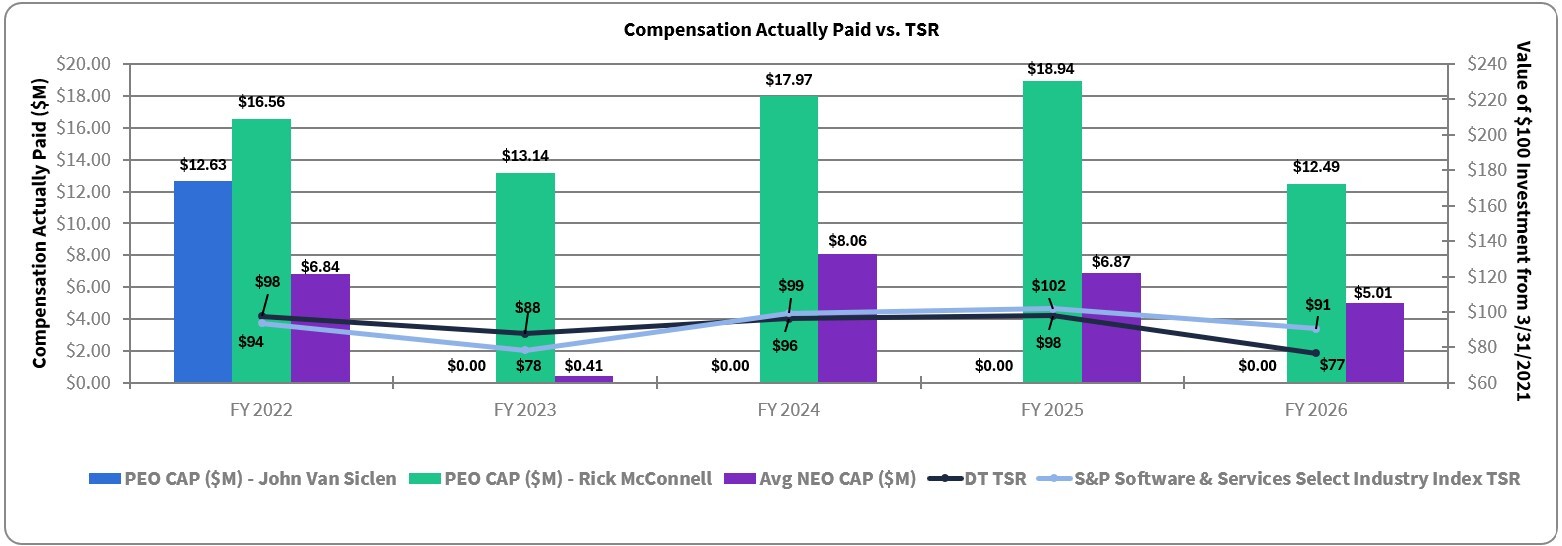
64
Compensation Actually Paid and Net Income
The following chart illustrates the relationship between our Compensation Actually Paid and Net Income (which is prepared and presented in accordance with GAAP). During fiscal 2025, Dynatrace completed an intra-entity asset transfer of the global economic rights of IP from a wholly owned U.S. subsidiary to a wholly-owned Swiss subsidiary, more closely aligning IP rights with business operations. The transfer generated an income tax benefit of $320.9 million.
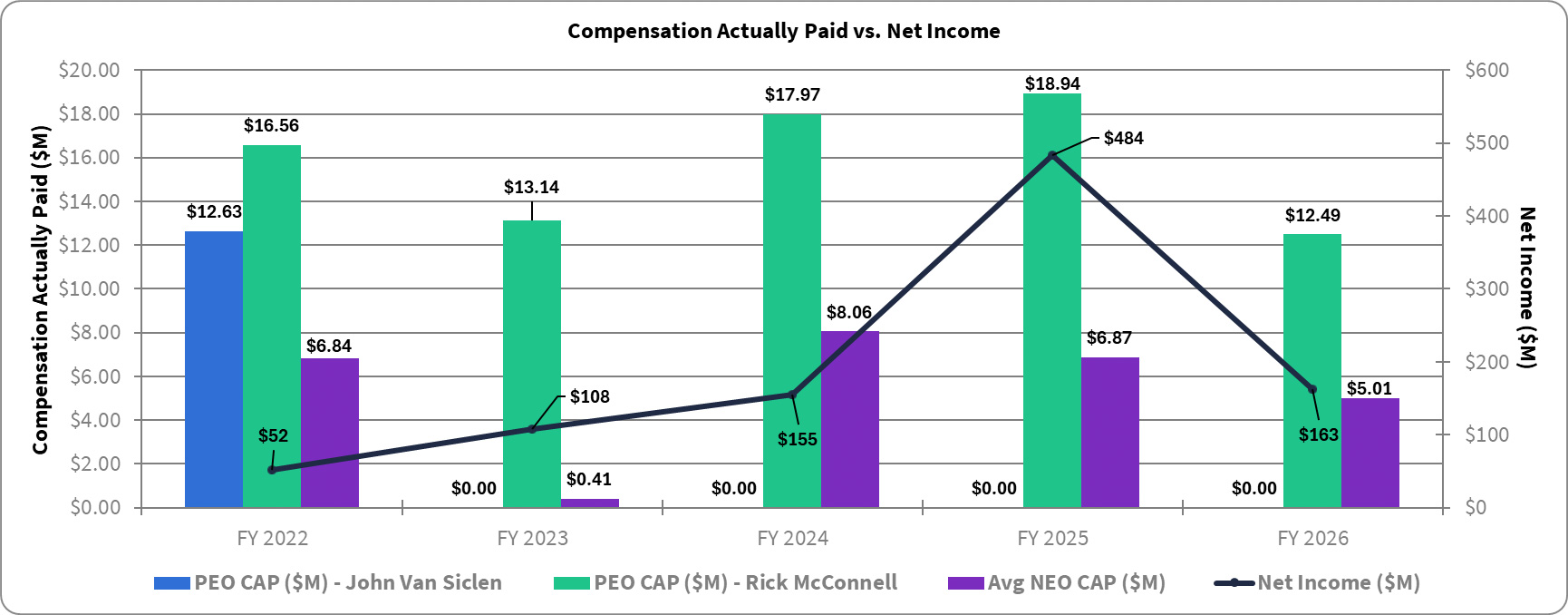
Compensation Actually Paid and Revenue
The following chart illustrates the relationship between our Compensation Actually Paid and Revenue.
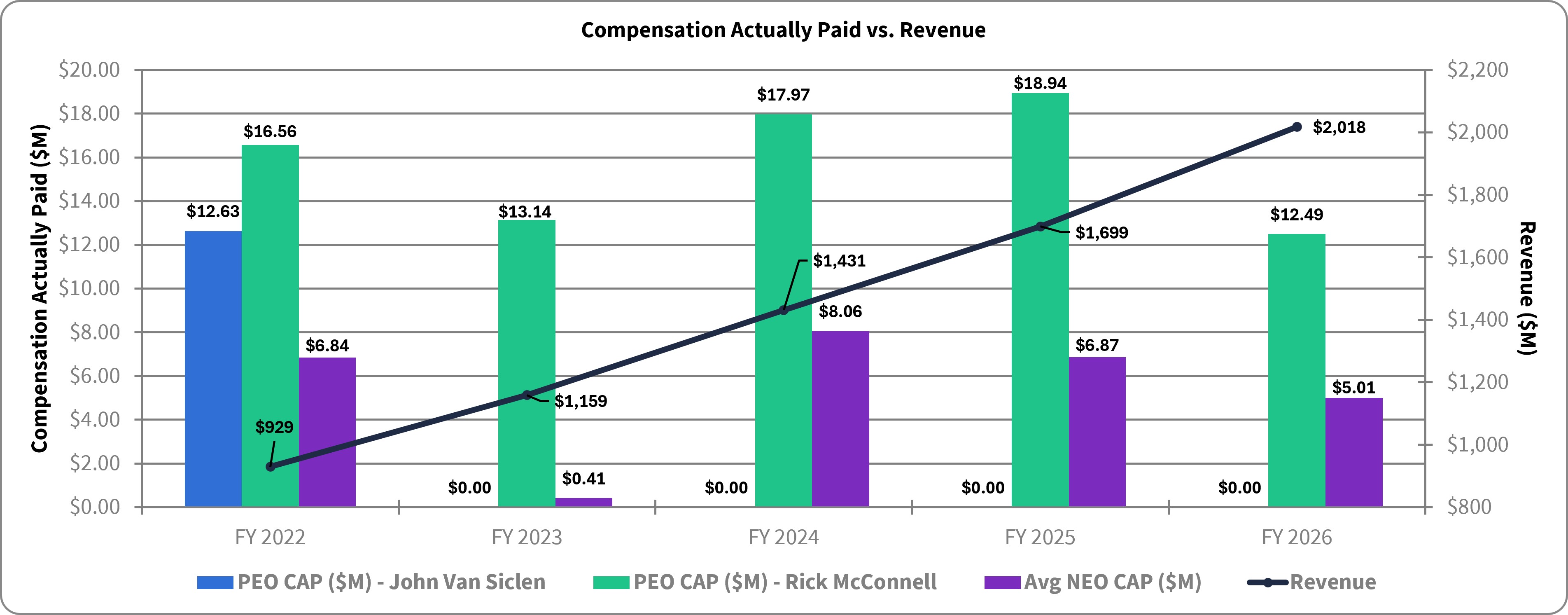
65
CEO Pay Ratio
Our compensation and benefits philosophy and the overall structure of our compensation and benefit programs are broadly similar across the organization to encourage and reward all employees who contribute to our success. Our ongoing commitment to pay equity is critical to our success in supporting a global workforce with opportunities for all employees to grow, develop, and contribute.
We are required by applicable SEC rules to disclose information about the CEO Pay Ratio, or the ratio of the annual total compensation of our Chief Executive Officer to the annual total compensation of our median employee.
Methodology
We identified our median employee, the employee with compensation at the median of annual total compensation of all of our employees excluding our CEO, based on the following:
•To identify our median employee, we considered the individuals employed by us on March 31, 2026, or our Determination Date, whether employed on a full-time, part-time, or temporary basis. We did not include any contractors or other non-employee workers in our employee population. On March 31, 2026, our global population of full-time, part-time, and temporary employees (including our CEO) consisted of 5,604 employees.
•To identify our median employee, we used a consistently applied compensation measure consisting of the annual base salary on March 31, 2026, the target incentive cash compensation for fiscal 2026 (including corporate bonus plan and commission plans under our sales and services incentive plans), and the grant date fair value for equity awards granted during fiscal 2026. We selected these compensation elements because they represent our principal broad-based compensation elements. We did not perform adjustments to the base salaries of part-time employees to calculate what they would have been paid on a full-time basis and did not make any cost-of-living adjustments. We converted all local currencies to U.S. dollars based on the applicable exchange rates in effect on March 31, 2026, similar to how we converted foreign currency amounts into U.S. dollars in the Summary Compensation Table.
Using this methodology, we determined that the median employee (excluding our CEO) was a full-time salaried employee working as a software engineer in the United States who was awarded equity during fiscal 2026.
CEO Pay Ratio
Once our median employee was identified, we calculated the median employee’s annual total compensation in accordance with the requirements of the Summary Compensation Table.
The annual total compensation of the median employee (excluding our CEO) was $152,204 for fiscal 2026. Our CEO’s annual total compensation as reported in the Summary Compensation Table was $21,234,453 for fiscal 2026. Based on this information, the CEO Pay Ratio was approximately 140:1 for fiscal 2026.
This information is being provided for compliance purposes and is a reasonable estimate calculated in a manner consistent with SEC rules, based on our internal records and the methodology described above. The SEC rules for identifying the median compensated employee allow companies to adopt a variety of methodologies, to apply certain exclusions and to make reasonable estimates and assumptions that reflect their employee populations and compensation practices. Accordingly, the pay ratio reported by other companies may not be comparable to the pay ratio reported above, as other companies have different employee populations and compensation practices, operate in different countries and may use different methodologies, exclusions, estimates and assumptions in calculating their own pay ratios. We are a global company with approximately 70% of our employees located outside the United States as of March 31, 2026. As a result, our employee population is different than other companies. Neither the Compensation Committee nor management of the company used the CEO Pay Ratio measure in making compensation decisions.
66
EQUITY COMPENSATION PLAN INFORMATION
The following table sets forth information regarding our equity compensation plans as of March 31, 2026.
| Plan Category | Number of Securities to be Issued Upon Exercise of Outstanding Options, Warrants and Rights (2) | Weighted-Average Exercise Price of Outstanding Options, Warrants and Rights ($) (3) | Number of Securities Remaining Available for Future Issuance Under Equity Compensation Plans (Excluding Securities Reflected in Column (a)) (4) | ||||||||
Equity compensation plans approved by stockholders(1) | 12,129,369 | 22.11 | 83,752,678 | ||||||||
| Equity compensation plans not approved by stockholders | - | - | - | ||||||||
| Total | 12,129,369 | 22.11 | 83,752,678 | ||||||||
(1)These plans consist of our 2019 Equity Incentive Plan, as amended, and the 2019 Employee Stock Purchase Plan (“ESPP”).
(2)This number includes 1,726,750 shares of our common stock subject to outstanding options and 10,402,619 shares of our common stock subject to outstanding RSU and PSU awards granted under our 2019 Equity Incentive Plan.
(3)The weighted-average exercise price is calculated based solely on the exercise prices of the outstanding options to purchase shares of our common stock. It does not reflect the shares of our common stock that will be issued upon the vesting of outstanding awards of RSUs and PSUs, which have no exercise price.
(4)This number includes 63,036,517 shares of our common stock available for issuance under our 2019 Equity Incentive Plan, and 20,716,161 shares reserved for issuance under our ESPP. The number of shares available for issuance under the 2019 Equity Incentive Plan automatically increases each April 1 by (i) 4% of the outstanding number of shares of our common stock on the immediately preceding March 31; or (ii) such lesser number of shares as determined by our Board or Compensation Committee. The number of shares available for issuance under the ESPP automatically increases each April 1 by (i) 1% of the outstanding number of shares of our common stock on the immediately preceding March 31; (ii) 3,500,000 shares of Common Stock; or (iii) such number of shares as determined by our Board or Compensation Committee. The 2019 Equity Incentive Plan expires in 2029 and the last day for the automatic increase provision under the ESPP is also in 2029.
67
CERTAIN RELATIONSHIPS AND RELATED PARTY TRANSACTIONS
In addition to the director and executive compensation arrangements, including employment, termination of employment and change in control arrangements, the following is a description of each transaction since April 1, 2025 and each currently proposed transaction in which:
•We have been or are to be a participant;
•The amount involved exceeded or is expected to exceed $120,000; and
•Any of our directors, executive officers or holders of more than 5% of our outstanding capital stock, or any immediate family member of, or person sharing the household with, any of these individuals or entities, had or will have a direct or indirect material interest.
Limitation of Liability and Indemnification of Directors and Officers
Our Charter contains provisions that limit the liability of our directors and officers for monetary damages to the fullest extent permitted by Delaware law. Consequently, our directors and officers are not personally liable to us or our stockholders for monetary damages for any breach of fiduciary duties as directors, except liability for the following:
•Any breach of their duty of loyalty to our company or our stockholders;
•Any act or omission not in good faith or that involves intentional misconduct or a knowing violation of law;
•Unlawful payments of dividends or unlawful stock repurchases or redemptions as provided in Section 174 of the DGCL; or
•Any transaction from which they derived an improper personal benefit.
Any amendment to, or repeal of, these provisions will not eliminate or reduce the effect of these provisions in respect of any act, omission or claim that occurred or arose prior to that amendment or repeal. If the DGCL is amended to provide for further limitations on the personal liability of directors or officers of corporations, then the personal liability of our directors or officers will be further limited to the greatest extent permitted by the DGCL.
In addition, our bylaws provide that we will indemnify, to the fullest extent permitted by law, any person who is or was a party or is threatened to be made a party to any action, suit or proceeding by reason of the fact that he or she is or was one of our directors or officers or is or was serving at our request as a director or officer of another corporation, partnership, joint venture, trust or other enterprise. Our bylaws provide that we may indemnify to the fullest extent permitted by law any person who is or was a party or is threatened to be made a party to any action, suit or proceeding by reason of the fact that he or she is or was one of our employees or agents or is or was serving at our request as an employee or agent of another corporation, partnership, joint venture, trust or other enterprise. Our bylaws also provide that we must advance expenses incurred by or on behalf of a director or executive officer in advance of the final disposition of any action or proceeding, subject to limited exceptions.
Further, we have entered into indemnification agreements with each of our directors and executive officers that may be broader than the specific indemnification provisions contained in the DGCL. These indemnification agreements require us, among other things, to indemnify our directors and executive officers against liabilities that may arise by reason of their status or service. These indemnification agreements also require us to advance all expenses incurred by the directors and executive officers in investigating or defending any such action, suit or proceeding. We believe that these agreements are necessary to attract and retain qualified individuals to serve as directors and executive officers.
The limitation of liability and indemnification provisions that are included in our Charter and bylaws and in indemnification agreements that we have entered into with our directors and executive officers may discourage stockholders from bringing a lawsuit against our directors and executive officers for breach of their fiduciary duties. They may also reduce the likelihood of derivative litigation against our directors and executive officers, even though an action, if successful, might benefit us and other stockholders. Further, a stockholder’s investment may be adversely affected to the extent that we pay the costs of settlement and damage awards against directors and executive officers as required by these indemnification provisions. At present, we are not aware of any pending litigation or proceeding involving any person who is or was one of our directors, officers, employees or other agents or is or was serving at our request as a director, officer, employee or agent of another corporation, partnership, joint venture, trust or other enterprise, for which indemnification is sought, and we are not aware of any threatened litigation that may result in claims for indemnification.
68
We have obtained insurance policies under which, subject to the limitations of the policies, coverage is provided to our directors and executive officers against loss arising from claims made by reason of breach of fiduciary duty or other wrongful acts as a director or executive officer, including claims relating to public securities matters, and to us with respect to payments that may be made by us to these directors and executive officers pursuant to our indemnification obligations or otherwise as a matter of law.
Certain of our non-employee directors may, through their relationships with their employers, be insured and/or indemnified against certain liabilities incurred in their capacity as members of our Board.
The underwriting agreement relating to our IPO and the underwriting agreement relating to that offering provide for indemnification by the underwriters of us and our officers and directors for certain liabilities arising under the Securities Act or otherwise.
Insofar as indemnification for liabilities arising under the Securities Act may be permitted to directors, executive officers or persons controlling our company pursuant to the foregoing provisions, we have been informed that, in the opinion of the SEC, such indemnification is against public policy as expressed in the Securities Act and is therefore unenforceable.
Related Person Transaction Policy
Our company has a written policy providing that our Audit Committee will review the material facts of all “related person transactions” prior to our company entering into the transaction if the amount involved exceeds $120,000 or the transaction is otherwise material to our company or the related person. A "related person transaction" is a transaction in which our company is a participant and a related person has a direct or indirect material interest. For purposes of this policy, a "related person" is a director of our company, an executive officer of our company, a director nominee, any securityholder known to our company to beneficially own more than 5% of any class of our voting securities, and any immediate family members of any such persons. In reviewing any related person transaction, our Audit Committee will take into account, among other factors it deems appropriate, (i) whether the transaction is on terms no less favorable to our company than terms generally available with an unaffiliated third party under the same or similar circumstances; (ii) whether the related person transaction is otherwise consistent with the interests of our company and our stockholders; and (iii) the extent of the related person’s interest in the transaction.
The policy identifies certain categories of transactions that are deemed to be pre-approved by the Audit Committee and includes procedures for the Audit Committee to approve and ratify related person transactions. The policy also provides that any conflicted director will provide all material information concerning the transaction to the Audit Committee and then will recuse themselves from any discussion or vote of the Audit Committee on the applicable transaction.
Related Person Transaction
The following related person transaction since the start of our fiscal 2026 (on April 1, 2025) involved an amount that exceeded $120,000 and a related person that had or will have a direct or indirect material interest. This transaction was reviewed by the Audit Committee. The employment arrangement discussed below was determined in accordance with Dynatrace compensation practices and policies for comparable employees in the organization.
Sok-Kheng Taing, a co-founder of our company and the spouse of Bernd Greifeneder, our Chief Technology Officer, is a Dynatrace employee. As of the date of this Proxy Statement, Sok-Kheng’s total compensation, based on her current base salary, short-term incentive bonus target, and the grant date fair value of a time-based RSU award granted to her in June 2026 (which vests over three years) was approximately $176,665, based on an exchange rate of 1 EUR:USD 1.1414 as of July 6, 2026.
Director and Named Executive Officer Compensation
Please see the "Corporate Governance - Director Compensation" and "Executive Compensation" sections of this Proxy Statement for information regarding the compensation of our directors and named executive officers.
+5% Stockholders
From time to time, in the ordinary course of business, affiliates of Vanguard Portfolio Management and Vanguard Capital Management (each as defined in the next section of this Proxy Statement and collectively referred to as "Vanguard") may, as a customer of our company, pay us for software or services. Fees for such software and services are the result of arm’s-length negotiations, are unrelated to the entity’s common stock ownership and comprise an insignificant amount of the total revenues of either Vanguard or our company. As a result, we do not believe Vanguard has any direct or indirect material interest in such transactions.
69
SECURITY OWNERSHIP OF CERTAIN BENEFICIAL OWNERS AND MANAGEMENT
The following table sets forth information, to the extent known by us or ascertainable from public filings, with respect to the beneficial ownership of our common stock as of July 6, 2026 by:
•each of our named executive officers;
•each of our directors;
•all of our executive officers and directors as a group; and
•each person, or group of affiliated persons, who is known by us to be the beneficial owner of more than 5% of our common stock.
The column entitled “Shares of Common Stock Beneficially Owned” is based on a total of 290,228,871 shares of our common stock outstanding as of July 6, 2026.
Beneficial ownership is determined in accordance with the rules and regulations of the SEC and includes voting or investment power with respect to our common stock. Options to purchase shares of our common stock that are exercisable, and shares of our common stock that may be acquired upon the vesting of RSUs or PSUs, in each case, within 60 days of July 6, 2026, are deemed to be beneficially owned by the persons holding these options, RSUs or PSUs, as applicable, for the purpose of calculating the percentage ownership of that person, but are not treated as outstanding for the purpose of calculating any other person’s ownership percentage. Except as otherwise noted, the persons and entities in this table have sole voting and investing power with respect to all of the shares of our common stock beneficially owned by them, subject to community property laws, where applicable. Except as otherwise indicated in the notes to the table below, the address of each named beneficial owner is c/o Dynatrace, Inc., 280 Congress Street, 11th Floor, Boston, Massachusetts 02210.
| Name of Beneficial Owner | Shares of Common Stock Beneficially Owned | |||||||
| Number | Percent | |||||||
| Named Executive Officers and Directors: | ||||||||
Rick McConnell(1) | 249,045 | * | ||||||
Jim Benson(2) | 176,244 | * | ||||||
Dan Zugelder(3) | 57,566 | * | ||||||
Bernd Greifeneder(4) | 1,300,054 | * | ||||||
Steve McMahon(5) | 22,013 | * | ||||||
Lisa Campbell(6) | 6,895 | * | ||||||
Michael Capone(7) | 50,582 | * | ||||||
Amol Kulkarni(8) | 14,318 | * | ||||||
Stephen Lifshatz(9) | 40,582 | * | ||||||
George Riedel(10) | 410 | * | ||||||
Steve Rowland(11) | 24,982 | * | ||||||
| Dan Streetman | — | * | ||||||
Jill Ward(12) | 44,722 | * | ||||||
Kirsten Wolberg(13) | 27,982 | * | ||||||
| All executive officers and directors as a group (14 persons) | 2,015,395 | * | ||||||
| 5% Stockholders: | ||||||||
BlackRock, Inc.(14) | 31,518,110 | 10.9% | ||||||
Vanguard Portfolio Management LLC(15) | 16,563,169 | 5.7% | ||||||
Vanguard Capital Management LLC(16) | 15,661,783 | 5.4% | ||||||
* Represents beneficial ownership of less than 1% of the outstanding shares of common stock.
(1)Consists of 248,545 shares of common stock, held directly by Rick McConnell. This amount also includes 500 shares of common stock held by the Anne Marie McConnell Trust, for which Rick McConnell's spouse, Anne Marie McConnell, is the sole trustee. Rick McConnell disclaims beneficial ownership of the shares held by the trust, except to the extent of any pecuniary interest therein.
(2)Consists of 176,244 shares of common stock held directly by Jim Benson.
70
(3)Consists of 57,566 shares of common stock held directly by Dan Zugelder.
(4)Consists of 948,678 shares of common stock and 349,400 shares issuable upon exercise of stock options that may be acquired within 60 days of July 6, 2026, held directly by Bernd Greifeneder. This amount also includes 1,976 shares of common stock held directly by Bernd Greifeneder's spouse.
(5)Consists of 22,013 shares of common stock held directly by Steve McMahon.
(6)Consists of 2,278 shares of common stock and 4,617 shares that may be acquired upon the vesting of RSUs within 60 days of July 6, 2026, held directly by Lisa Campbell.
(7)Consists of 46,471 shares of common stock and 4,111 shares that may be acquired upon the vesting of RSUs within 60 days of July 6, 2026, held directly by Michael Capone.
(8)Consists of 9,688 shares of common stock and 4,630 shares that may be acquired upon the vesting of RSUs within 60 days of July 6, 2026, held directly by Amol Kulkarni.
(9)Consists of 36,471 shares of common stock and 4,111 shares that may be acquired upon the vesting of RSUs within 60 days of July 6, 2026, held directly by Stephen Lifshatz.
(10)Consists of 410 shares of common stock held directly by George Riedel.
(11)Consists of 20,871 shares of common stock and 4,111 shares that may be acquired upon the vesting of RSUs within 60 days of July 6, 2026, held directly by Steve Rowland.
(12)Consists of 40,611 shares of common stock and 4,111 shares that may be acquired upon the vesting of RSUs within 60 days of July 6, 2026, held directly by Jill Ward.
(13)Consists of 23,871 shares of common stock and 4,111 shares that may be acquired upon the vesting of RSUs within 60 days of July 6, 2026, held directly by Kirsten Wolberg.
(14)This information is as of March 31, 2026 and is based solely on a Schedule 13G/A filed by BlackRock, Inc. ("BlackRock") with the SEC on April 24, 2026. BlackRock reported that it has sole voting power over 30,332,565 shares, sole dispositive power over 31,518,110 shares, and aggregate beneficial ownership of 31,518,110 shares. The mailing address of BlackRock is 50 Hudson Yards, New York, New York 10001.
(15)This information is as of March 31, 2026 and is based solely on a Schedule 13G filed by Vanguard Portfolio Management LLC ("Vanguard Portfolio Management") with the SEC on April 29, 2026. Vanguard Portfolio Management reported that it has sole voting power over 77,078 shares, sole dispositive power over 16,563,169 shares, and aggregate beneficial ownership of 16,563,169 shares. The mailing address of Vanguard Portfolio Management is 100 Vanguard Blvd., Malvern, Pennsylvania 19355.
(16)This information is as of March 31, 2026 and is based solely on a Schedule 13G filed by Vanguard Capital Management LLC ("Vanguard Capital Management") with the SEC on April 29, 2026. Vanguard Capital Management reported that it has sole voting power over 2,287,845 shares, sole dispositive power over 15,661,783 shares, and aggregate beneficial ownership of 15,661,783 shares. The mailing address of Vanguard Capital Management is 100 Vanguard Blvd., Malvern, Pennsylvania 19355.
71
ADDITIONAL INFORMATION
Householding
Some banks, brokers, and other nominee record holders may be participating in the practice of “householding” proxy statements and annual reports. This means that only one copy of our documents, including the annual report to stockholders and proxy statement, may have been sent to multiple stockholders sharing an address unless we have received contrary instructions from one or more of such stockholders. We will promptly deliver a separate copy of either document to you upon written or oral request to Dynatrace, Inc., 280 Congress Street, 11th Floor, Boston, Massachusetts 02210, Attention: Secretary, telephone: (781) 530-1000. If you want to receive separate copies of the proxy statement or annual report to stockholders in the future, or if you are receiving multiple copies and would like to receive only one copy per household, you should contact your bank, broker, or other nominee record holder, or you may contact us at the above address and phone number.
Stockholder Proposals
Requirements for stockholder proposals to be brought before the Annual Meeting
Our bylaws provide that for nominations of persons for election to our Board or other proposals to be considered at an annual meeting of stockholders, a stockholder must (i) have given timely written notice to Dynatrace, Inc., 280 Congress Street, 11th Floor, Boston, Massachusetts 02210, Attention: Secretary; (ii) have provided any updates or supplements to such notice at the times and in the forms required by our bylaws; and (iii) together with the beneficial owner(s), if any, on whose behalf the nomination or business proposal is made, have acted in accordance with the representations set forth in the solicitation statement required by our bylaws. For notice to be timely, a stockholder’s written notice shall be received by the Secretary at the principal executive offices of the company not later than the close of business on the 90th day, nor earlier than the close of business on the 120th day, prior to the first anniversary of the date of the preceding year’s annual meeting. We also encourage you, but such submission will not be considered notice, to also submit any such nominations or other proposals by e-mail to corporatesecretary@dynatrace.com.
Our bylaws also provide that in the event the date of the annual meeting is more than 30 days before or more than 60 days after such anniversary date, or if no such annual meeting were held in the preceding year, notice by the stockholder to be timely must be delivered by the Secretary of the company not later than the close of business on the later of the 90th day prior to such annual meeting or the 10th day following the day on which public announcement of the date of such meeting is first made. Any proposal must include all information required by our bylaws.
The advance notice requirements under our bylaws for the 2027 Annual Meeting of Stockholders are as follows: a stockholder’s notice shall be timely if delivered to our Secretary at the address set forth above not earlier than April 21, 2027 and not later than the close of business on May 21, 2027. However, if the date of our 2026 Annual Meeting of Stockholders occurs more than 30 days before or 60 days after August 26, 2027, the anniversary of the 2026 Annual Meeting, a stockholder notice will be timely if it is received at the address set forth above by the later of the close of business on (1) the 90th day prior to such annual meeting; or (2) the 10th day following the day on which public disclosure of the date of the meeting is made.
In addition, to comply with universal proxy rules, stockholders who intend to solicit proxies in support of director nominees other than the company’s nominees must also comply with the additional requirements of Rule 14a-19 under the Exchange Act.
Requirements for stockholder proposals to be considered for inclusion
In addition to the requirements stated above, any stockholder who wishes to submit a proposal intended to be included in the proxy statement for the 2027 Annual Meeting of Stockholders must comply with Rule 14a-8 under the Exchange Act. For such proposals to be included in our proxy materials relating to the 2027 Annual Meeting of Stockholders, all applicable requirements of Rule 14a-8 must be satisfied and we must receive such proposals no later than March 12, 2027. Rule 14a-8 proposals must be delivered by mail to Dynatrace, Inc., 280 Congress Street, 11th Floor, Boston, Massachusetts 02210, Attention: Secretary. We also encourage you to submit any such proposals, but such submission will not be considered notice, by e-mail to corporatesecretary@dynatrace.com.
The requirements for providing advance notice of business or nominations as summarized above are qualified in their entirety by our bylaws, Rule 14a-19 (as applicable) and, in the case of stockholder proposals submitted for inclusion in our proxy statement, Rule 14a-8, which we recommend that you read in order to comply with the applicable requirements. Failure to timely deliver the requisite notice or satisfy the requirements in our bylaws, Rule 14a-19 or Rule 14a-8, as applicable, may result in a proposal or nomination not being presented at our annual meeting of stockholders. You may contact our Secretary at our principal executive offices for a copy of our current bylaws, including the relevant provisions regarding the requirements for making stockholder proposals and nominating director candidates, or you may refer to the copy of our bylaws most recently filed with the SEC and available at www.sec.gov.
72
Stockholder Recommendations
Stockholders may submit recommendations for director candidates in writing to Dynatrace, Inc., 280 Congress Street, 11th Floor, Boston, Massachusetts 02210, Attention: Secretary, who will forward any such recommendations to the Nominating and Corporate Governance Committee. We also encourage you to submit any such recommendations by e-mail to corporatesecretary@dynatrace.com. Stockholder recommendations for director candidates must include (i) the name and address of record of the stockholder and how many shares of the company the stockholder owns beneficially or of record; and (ii) the name, age, business and residential address, educational background, current principal occupation or employment, and principal occupation or employment for the preceding five full fiscal years of the recommended director candidate. In selecting nominees for directors, the Nominating and Corporate Governance Committee will review candidates properly recommended by stockholders in the same manner and using the same general criteria as candidates recruited by the committee and/or recommended by our Board.
Other Matters
Our Board does not know of any other matters to be brought before the Annual Meeting. If any other matters not mentioned in this Proxy Statement are properly brought before the meeting, the individuals named in the enclosed proxy intend to use their discretionary voting authority under the proxy to vote the proxy in accordance with their best judgment on those matters.
73
APPENDIX A
RECONCILIATION OF NON-GAAP MEASURES
| (U.S. dollars in thousands) | Year Ended March 31, 2026 | ||||
| Non-GAAP operating income: | |||||
| Income from operations | $ | 245,387 | |||
| Share-based compensation | 299,626 | ||||
| Employer payroll taxes on employee stock transactions | 15,292 | ||||
| Amortization of intangibles | 3,544 | ||||
| Transaction, restructuring, and other | 28,080 | ||||
| Non-GAAP income from operations | $ | 591,929 | |||
| (U.S. dollars in thousands) | Year Ended March 31, 2026 | ||||
| Free Cash Flow: | |||||
| Net cash provided by operating activities | $ | 561,850 | |||
| Purchase of property and equipment | (32,173) | ||||
| Capitalized software additions | (194) | ||||
| Free Cash Flow | $ | 529,483 | |||
Non-GAAP financial measures do not have any standardized meaning and are therefore unlikely to be comparable to similarly titled measures presented by other companies. We consider these non-GAAP financial measures to be important because they provide useful indicators of its performance and liquidity measures. These measures are used to establish certain performance-based targets related to the compensation of our executives. Non-GAAP financial measures are presented for supplemental informational purposes only, should not be considered a substitute for financial information presented in accordance with GAAP, and may be different from non-GAAP financial measures presented by other companies.
74
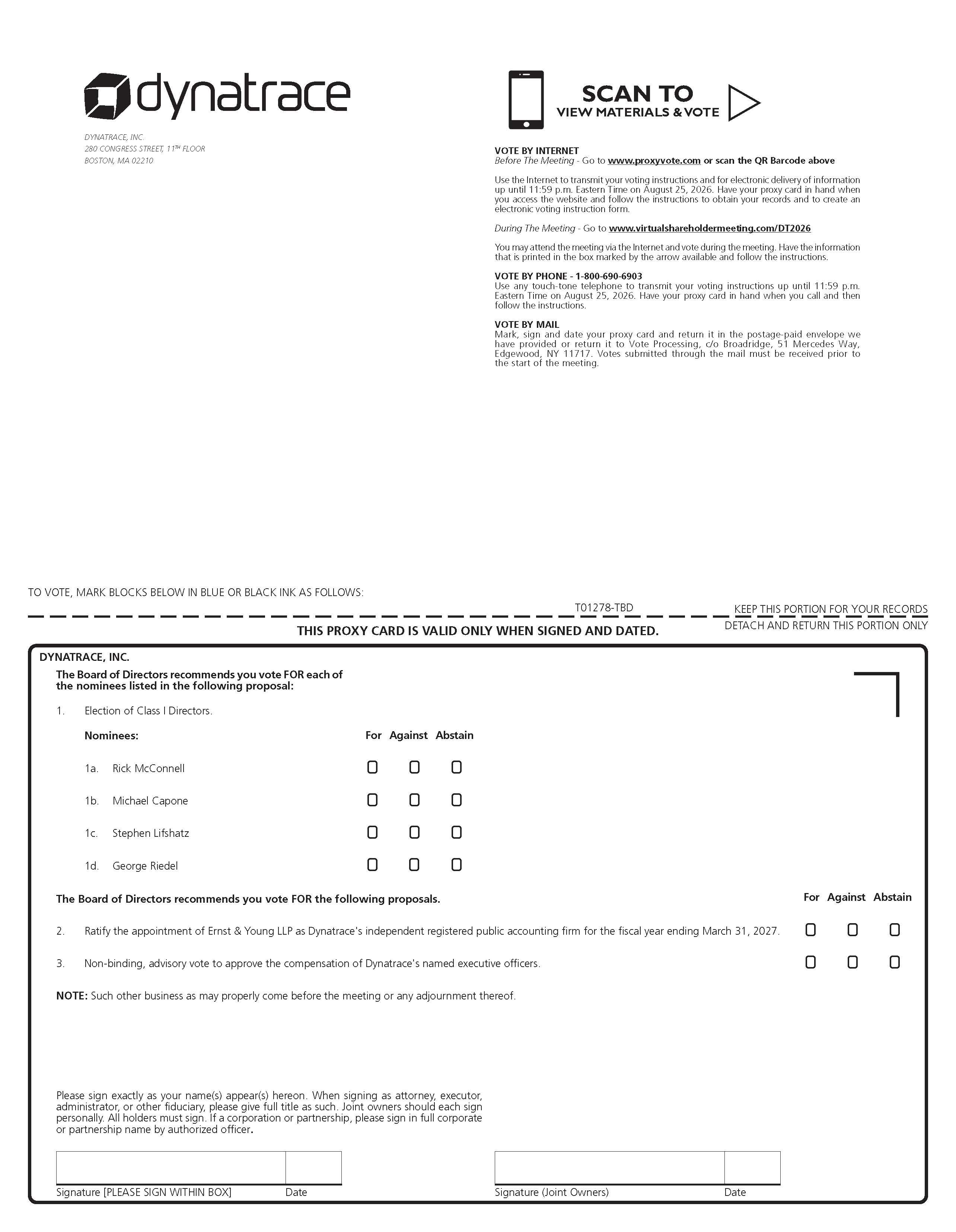
75
76